
European Union defense ministers: an aid fund for Ukraine, the provision of military equipment and ammunition, including F-16 aircraft, and the training of 30,000 soldiers until next October

- Europe and Arabs
- Thursday , 31 August 2023 14:3 PM GMT
Brussels: Europe and the Arabs
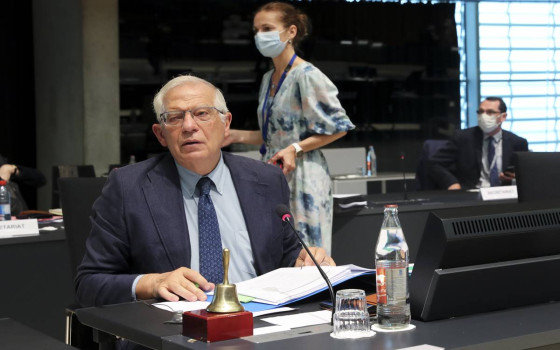
European Union Foreign and Security Policy Coordinator Josep Borrell said after a meeting yesterday evening of the defense ministers of the Union countries hosted by Spain, which holds the current rotating presidency of the Union, “Ukraine remained at the center of our discussions.” The Ukrainian Defense Minister, our friend Oleksiy Reznikov, addressed the Council via a video message and presented We have an update on the situation on the ground, and on the ongoing Ukrainian counterattack.
After speaking with the Minister of Defense of Ukraine, we discussed European short- and long-term commitments to Ukraine's security.
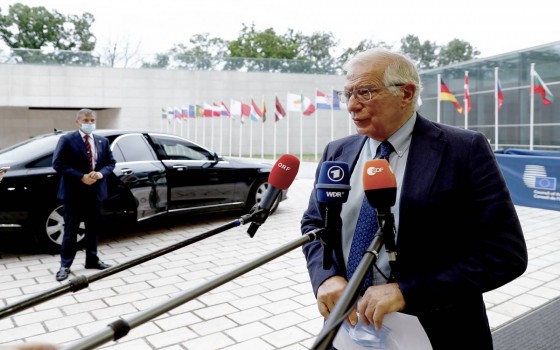
A European statement issued in Brussels quoted Borrell as saying, “First, let me underscore the fact that despite the global condemnation, Putin shows no sign of backing down from his aggression against the Ukrainian people. He is continuing the war and that is why Ukraine needs long-term military support.” Long-term, sustainable and predictable.
I would also like to stress that our continued support is important to the Ukrainian counter-offensive in response to the Russian invasion. And had it not been for Putin's war on Ukraine, there would be no need for this kind of support. There are causes and consequences. The reason is Russia's aggression against Ukraine, and the consequence is the need to support Ukraine in the short and long term.
We have discussed our support in three areas.
First, on military equipment. I have proposed creating an aid fund for Ukraine for the period 2024-2027 to ensure the sustainability of our military assistance.
This fund – which will be integrated into the European Peace Facility – must be an essential component of our long-term contribution to Ukraine's security, as European leaders agreed in June. I propose to create a fund of about 5 billion euros every year. This should be seen as a ceiling, not a spending target. If we could spend less, that would be a lot better, but that should be the ceiling of our efforts to program our efforts to support Ukraine in the medium term.
The ministers discussed this issue. It will also be discussed tomorrow with the foreign ministers, and I hope that an agreement can be reached as soon as possible. I hope before the end of this year.
The second instrument we focused on is the training mission, the European Union Military Assistance Mission (EUMAM), which is the training mission for the Ukrainian Armed Forces. This mission had a real impact, and was carried out with unprecedented speed.
This mission has already trained 25,000 Ukrainian soldiers, some of whom are here in Toledo, thanks to the Spanish Army. [The mission] will reach the target that was programmed for the end of the year, at the end of October, [when] we will reach the 30,000 soldiers that this mission has trained.
And, you know, I always say, "We need to do more, faster." "More, faster" has become a trending topic. Yes, more and faster. I still think we have to do more and faster, and I suggested to the ministers that the mission target be to train 40,000 Ukrainian soldiers [in the coming months].
It is also important to think about the evolving needs of the Ukrainian army and work not only on quantity but also on quality
The Ukrainians need more specialized training of smaller group size and leadership abilities.
We welcomed the decision of the Netherlands and Denmark to provide F-16s to Ukraine.
We will explore the possibility of how to integrate F-16 pilot training modules into our mission. And our mission should also be able to contribute to the training of these pilots on these aircraft.
The third area [we discussed] is ammunition.
You know that we were working within the framework of the Three-Track Ammunition Initiative. The first was the taking of stocks from European armies, and ended at the end of May. We have seized a large amount of ammunition worth about 1.1 billion euros, equivalent to about 224,000 rounds and about 2,300 missiles. This is the first track, which was actually closed because it had a limited time period
The second is the second path. The European Defense Agency (EDA) is negotiating over the summer with the European defense industry for the purchase of 155mm ammunition.
Three framework contracts have already been signed. Now member states have to pass specific orders within these framework agreements with industry. We've done our job. The agreement has already been signed with industry [and] now member states can use this possibility to pass joint requests to industry.
Then there is the third track, which is in the hands of the [European] Commission to build up industrial capacity to produce more military capabilities in Europe.




No Comments Found