
The most prominent criticisms of the State of the European Union speech: An agreement with Tunisia on immigration cost us a lot and stronger measures must be taken in the files of the Green Deal and economic governance and the social pillar.

- Europe and Arabs
- Thursday , 14 September 2023 15:54 PM GMT
Brussels: Europe and the Arabs
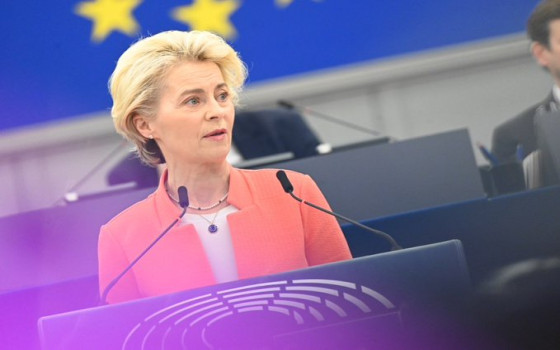
As soon as the speech on the state of the European Union, delivered by Commission President Ursula von der Leyen to members of the European Parliament, ended, reactions came from European parties in member states within the unified European bloc. In reactions to the speech, the extreme right-wing Vlaams Belang party in Belgium strongly criticized the so-called “ State of the European Union address by Commission President Ursula von der Leyen. "It's the annual show of good news for an EU that is increasingly trying to act like a superpower," said Gerolf Annemans, a member of the party's European Parliament. “For the vast majority of Europeans, what happens in this Parliament remains a distant proposition, but we should not underestimate the growing influence of the European Union on our lives.”
European Commission President Ursula von der Leyen today delivered her last State of the Union address before the 2024 elections. The address that the Commission President will deliver at the start of the new political year has been a (European) State of the Union address for some time. Now it has been called the "State of the Union" by analogy with the United States. “It's become an annual bragging show,” Annemans said. “A good news program with no room for criticism of the real situation in the EU. However, it is much less good than the Commission would like us to believe.
Von der Leyen has publicly called for replicating migration agreements with countries such as Tunisia. “The migration agreement with Tunisia cost us a lot of money and achieved nothing on the ground,” says Annemans. “Quite the contrary. Illegal immigration from Tunisia has increased. As with the previously concluded migration agreement with Turkey, we have now given a third country a way to blackmail us. It is time for us to finally take back control of Europe’s external borders and decide for ourselves who enters Europe.”
“We hope that the next state of the Union after the elections will look completely different.”
The Commission President also once again defended the enlargement of the European Union. This is something that was previously called for by European Council President Charles Michel. “We have to stop playing tricks on our partners,” answers Annemans. “The countries that von der Leyen wants to include are not at all ready for membership. It will also cost us a lot of money. It just shows an explicit imperial agenda. “By the way, we are showing that we are an unreliable partner by making such empty promises.”
Now, with the European elections approaching, Annemans expects the Commission to do everything in its power to advance the Green Deal. “One can expect the Commission to continue to push hard for the Green Deal,” says Annemans. “At least now that there is still a leftist majority. Make no mistake: the President of the Commission is a mouthpiece for all kinds of left-wing and far-left ideologies. Industry, our agriculture and citizens feel this. “We hope that the next State of the Union after the election will look very different without von der Leyen not having to return to the stage.”
Today, during the debate on the state of the European Union, the leader of the Group of Socialists and Democrats in the European Parliament, Iratex García, asked Commission President Ursula von der Leyen to show a stronger commitment to the implementation of the social pillar.
Garcia thanked the President of the Commission for the positive cooperation between the Body of Commissioners and the Social and Differential Support Group, based on the progressive initiatives included in the Commission’s work programme, such as the Green Deal and gender equality. However, the leader of the Socialists and Democrats said the group would remain vigilant on implementation and called for stronger action in some areas, including the Green Deal, the social pillar, as well as economic governance and the migration pact.
“Compared to the response to the financial crisis in 2008 - with the austerity policy imposed by the right - the response to the pandemic and the consequences of Russia's war against Ukraine, led by social democracy, was characterized by unity and solidarity,” said Iratex García.
The Socialists and Democrats called on the Commission President to explicitly support the pending files of the Green Deal, and during the discussion, Iratex García told Ursula von der Leyen: “It is necessary to break your silence on the ecological transition and the restoration of nature and the air.” Quality laws. We will do our best to ensure that these statements are implemented.”
“I would have liked to hear a stronger commitment to the social pillar,” Iratex García added. “Inflation, high interest rates and rising mortgage rates are making it difficult for people to make ends meet. Public housing is a right, not a commodity for speculation. The EU must also ensure equal wages.” Gender opportunities, a minimum vital income, and an anti-poverty strategy with binding targets.
Regarding women's rights, Garcia called on the Commission to take a step forward "because the time has come to include violence against women on the list of European Union crimes."
Finally, Iratex García called on EPP Group Chairman Manfred Weber to be consistent and "stop talking about a von der Leyen majority when the EPP reaches agreements with the far right in several member states and tries to build majorities with" them in this parliament. “.
In her speech to the European Parliament under the title “State of the Union,” European Commission President Ursula von der Leyen said, “In less than 300 days, Europeans will go to the ballot boxes in our unique and wonderful democracy. As with any election, It will be a time for people to reflect on the state of our union and the work done by those who represent them. But it will also be a time to decide what kind of future they want and what kind of Europe they want. Among them will be millions of first-time voters, the youngest of whom were born in 2008. As they stand in In that polling booth, they'll be thinking about what matters to them. They'll be thinking about the war on our borders. Or the devastating impact of climate change. About how artificial intelligence will impact their lives. Or their chances of getting a home or a job in the coming years.
Our union today reflects the vision of those who dreamed of a better future after World War II. A future in which nations, democracies and peoples work together to share peace and prosperity. They believed that Europe was the answer to the call of history. And when I talk to the new generation of young people, I see the same vision of a better future. The same burning desire to build something better. The same belief that in A world of uncertainty, Europe must once again answer the call of history. This is what we must do together. This begins with gaining the trust of Europeans to deal with their aspirations and fears.




No Comments Found