

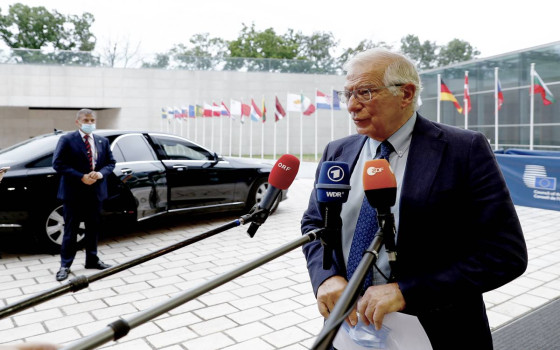
European financial support to Ukraine reached 25 billion euros, and military, civil and humanitarian support reached 85 billion.. Borrell must confront the misleading information accompanying Russian aggression.

- Europe and Arabs
- Monday , 2 October 2023 14:38 PM GMT
Brussels: Europe and the Arabs
European Union Foreign Policy Coordinator Josep Borrell stressed the need to combat misleading information accompanying Russian aggression on Ukrainian territory. He added, “This is a top priority for the European Union and Ukraine.” This came in a statement issued in Brussels that included the European official’s statements before journalists in Kiev. Borrell said that on Saturday, he was on the front line of Russia's military aggression against Ukraine. "I was in Odessa, where I had the opportunity to witness the way Russia attacks civilian infrastructure, churches and homes in a beautiful city like Odessa. And on Sunday, I had the honor of participating in the commemoration of the Day of Remembrance. Ukrainian Defenders, a day to honor the women and men who stand against Russian aggression, fight every day, risk their lives, fight for the future of their country, as well as for their own. Defending the international order. Yes, it was a very moving ceremony today, and I had the opportunity To exchange conversations with some of the soldiers who were injured in the fighting and who were present at the ceremony. And now, I was also visiting another front line, the front line of information warfare, because there is a war that is fought with weapons or a classic war, and there is another war, which is the information war. It has always existed, but now it is being used on a large scale. Russian aggression against Ukraine is accompanied by massive attacks, what we call hybrid attacks, which means propaganda, manipulation of information, disinformation campaigns, as well as cyber attacks on information networks. We have to confront this hybrid war, and In particular, we have to fight misinformation. This is a top priority for the European Union and Ukraine. I am happy to visit this center for the people who work here to fight this battle against propaganda, which we see developing on a massive scale. We see that in Africa, we see that in Latin America and Asia. Through this propaganda and disinformation war, Russia is trying to evade its responsibility for the war, by denying the occupation, annexations and atrocities, blaming others for the consequences of the food and energy crises, and trying to make the world believe that the same applies to Russia. The force that prevents the export of grain from Ukrainian ports is innocent of hunger, and “hunger does not arise from the naval blockade imposed by the Russian Navy.” [They say:] “No, no, [not] made by us, made by Ukraine and made by the West.” The European statement quoted Borrell as saying, “We have to fight twisted narratives, which, as I said, are not new. We have witnessed this kind of stories and narratives during the Cold War, and more recently since the annexation of Crimea. We have to fight this battle. We have to win this battle because It's not just about territory, it's about people's minds. That's why we have to build supporting organizations and entities like the one you just visited - the Ukrainian Center for Strategic Communications and Information Security. This center is at the forefront of the fight against Russian disinformation. But believe me, the disinformation ecosystem that the Kremlin has created is not just To undermine Ukraine. They are trying to undermine international support for Ukraine. They are trying to make people see this war as another war for the Europeans that they have nothing to do with. Another war that must stop. And yes, we want the war to stop. And the ones who want the war to stop as quickly as possible are the Ukrainians Who suffer the consequences. I have been witnessing this over the past days. But Russia does not have a positive narrative agenda on cooperation, it does not have a narrative agenda on peace, and that is why we must continue to expose and fight the twisted and misleading narratives. We are trying to do this in cooperation with this center, and with its support And helping Ukrainian society, which is strong and resilient as it proves every day, is how we can promote the truth of Putin's aggression and expose Russian lies to the whole world. And because we are here for that, we are here - as if we are also working in Brussels - with the efforts of the European Union. In this regard, the EU and Ukraine also support the same goal: Ukraine and the truth must prevail as well. Thank you. Borrell answered journalists' questions, including a question about a meeting between him and the new Minister of Defense of Ukraine. He said, "Well, it was a pleasure for me to meet personally with your new Minister of Defense." I had the opportunity to speak with him on the phone [before] – first to congratulate him on his nomination and wish him all the best in his challenging endeavours. Today, we had the opportunity to meet and exchange information, discuss the situation on the ground from a military perspective, and our support for the Ukrainian army from a military perspective. I cannot tell you everything we exchanged, you understand, but it was a meeting in order to define the priorities of the Minister of Defense, to tell him what we are doing. What more can we do, what more can we do? They are the most urgent necessities from the point of view of our munitions, training, provision of weapons and type of battle. And also to try to understand why, in some cases, the support we provide is not as important. Because it is. I want to emphasize the numbers and I explained to the minister: Our military support to Ukraine has reached 25 billion euros. In total, military, civil and humanitarian support reached €85 billion, which - together from European institutions and Member States - is the highest amount in the world and we are proud of it and know how important it is. . I assured the minister that yes, we will work for peace, but in the meantime we must continue to support him. We have reviewed all aspects of our cooperation, and we are committed to continuing to work together.
In response to a question about whether the European Union has any plan in the event of any delay in American aid to Ukraine, and the second question about European military support.
I understand the interest everyone has about the latest decision in the US Congress, Borrell said. Well, a few days ago, there was another vote, where the Democrats and part of the Republicans - part of them, not all of them, but part of them, voted in favor of allocating 300 million euros to the Ukrainian forces. Therefore, we believe that we are on the right track. In fact, we were surprised by the fact that a decision was made in a last-minute agreement, and we have to deeply and comprehensively regret it, and we believe that this is not the last word. After listening to President Biden, who called for reconsideration of the decision, I hope that this is not a final decision, and that Ukraine will continue to have the support of the United States. For our part, we did not wait for the [American] decision to increase our proposals to support Ukraine. Long before yesterday, the Commission announced a proposal to member states to create a Ukrainian fund worth 50 billion euros. In Toledo at the last informal meeting [of EU foreign ministers in August], I proposed and presented to my colleagues a proposal to create a special fund within the European Peace Facility dedicated to Ukraine of up to $20 billion for the next four years. "Well, the discussion continues. The whole thing has to be looked at, but it shows that our support for Ukraine is not only continuing, but increasing, or at least for the time being, the item on the table shows that we want to continue increasing it. We hope that the member states will decide on this matter in a positive way," he added. Joint and financial perspective before the end of the year. So, let's see what happens in the United States, but from our side we will continue our support and increase our support. And about ammunition. We have asked the member states to deploy the necessary capabilities to supply the Ukrainian army with the stocks it has. Now we are asking the European industry to increase its production capacity And we have developed a plan for member states to come together to present their request and demands to the industry in order to reduce production delays, shorten production time and increase production capacity. As for the numbers, I think we have reached at the moment approximately 300 thousand ammunition that has already been sent to Ukraine, and I am talking About 155 mm, plus about 2800 missiles. This is still not all we have to offer, but I think we are on a good track.
[We] are using three paths: asking European militaries to provide what they already have, asking industry to increase their capacity, and asking member states to work together for joint procurement in order to reduce delays and reduce prices.
Question: Did the Ukrainian Defense Minister tell you that Ukraine could make further gains before the end of the offensive? And if not, if there is a stalemate on the ground, how do you persuade European public opinion not only to continue to support Ukraine but, as you just said, to increase support for Ukraine?
Our support for Ukraine does not depend on how the war plays out in the coming days or weeks. Ukrainian soldiers fight with great courage in front of the impressive Russian defense fortifications. Satellite images show that in some cases the depth and width of these fortifications reach 25 kilometers. So the counterattack is difficult, you are fighting in a completely mined area, which makes it very difficult to use mechanized warfare in order to advance faster.
So, our support is not situational, nor dependent on one day's progress. It is organized and permanent support because we face an existential threat to Europe. The existential threat cannot be balanced by a “war offensive” one day or another. The Ukrainians are fighting with all their courage and abilities, and if we want them to be more successful, we have to provide them with better and faster weapons.
Question: You have said several times that the European Union has a plan by the end of this year to train up to 40,000 Ukrainian soldiers. Do you have a reason to continue this mission for next year to continue training Ukrainian soldiers? I would also like to ask whether a date has been agreed for the EU Council to be held in Kiev at Foreign Minister level, and do you think the EU Member States will agree to your €20 billion four-year plan? Because there are some indications that this may be delayed or postponed due to some positions of specific members.
I know how decisions are made in the European Union. It is not easy to decide these important issues overnight. Ministers are discussing and I am sure that by the end of the year when we agree the full multi-year financial perspective review package, a decision will be made on that, but I cannot tell you whether it will be next week or next month, but it will be done in due course.




No Comments Found