
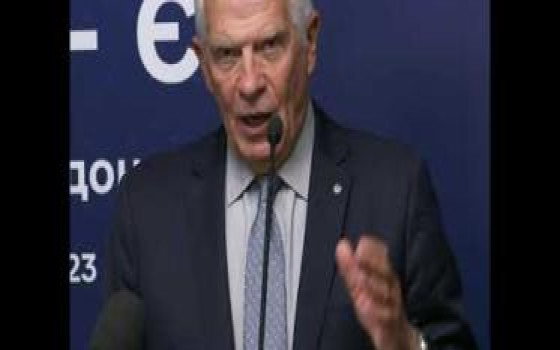
Borrell: The strongest security commitment we can offer to Ukraine is membership in the European Union. Russia uses hunger and energy as a weapon. These are the reasons for describing the ministerial meeting as “historic.”

- Europe and Arabs
- Tuesday , 3 October 2023 15:7 PM GMT
Brussels: Europe and the Arabs
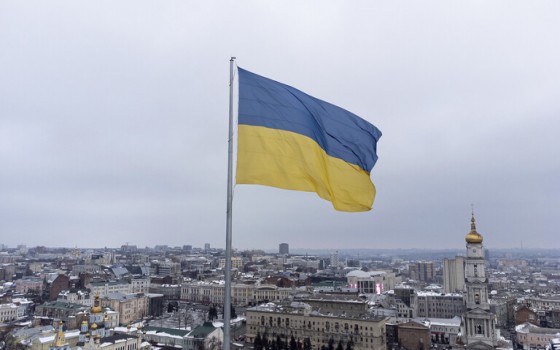
European Union Foreign and Security Policy Coordinator Josep Borrell said in his speech during the closing press conference of the Union foreign ministers' meeting in Ukraine yesterday, Monday, that this is the first time ever that the Council has met outside the European Union, and it is also the first time that we have met in a candidate country. For EU membership and also the first time that EU foreign ministers have met in a country at war. Of course, we would have much preferred to meet under different circumstances, but these circumstances are what they are, and we must support Ukraine in facing this challenge. With their visit to Kiev, the European Union Foreign Ministers sent a strong message of solidarity and support to Ukraine in the face of this unjust and illegal war.
A European statement in Brussels quoted MAGA in Borrell’s speech, including: “I personally - before our meeting - visited Odessa and Kiev, to meet with the Ukrainian people, to learn about their daily lives, to discuss their lives, and to see with my own eyes the brutal and inhuman nature of Putin’s aggression against this country.
Targeting churches, cultural heritage and ports that export food to hungry people around the world - this speaks volumes about the true face of Putin's so-called "special military operation" against the people of Ukraine, who are resisting staunchly. Incredible courage.
Russia uses hunger and energy as a weapon. Russia is doing so, expanding its crimes around the world, targeting the most vulnerable people in Africa and Asia, and depriving them of their food. This is the result of this marine blockage.
This is not our only requirement. This is also the perception of many, as we saw at the heart of the United Nations General Assembly two weeks ago.
Unfortunately, Russia seems intent on continuing its illegal actions, violating the rules-based international order, and putting global diplomacy to the test.
This means we have to work together more.
And we've started to do that - well, we haven't started because we've been doing that for months - but today's discussion has given us a better idea of the security dimension of this situation. This was a central discussion today with President Zelensky and Minister Kuleba.
We have spoken about the security commitments we want to make to Ukraine, demonstrating our determination to stand by Ukraine over the long term, to deter acts of aggression and to resist Russia's destabilization efforts.
You can imagine there are many different aspects with our continued involvement. Let me start with the military aspect.
I have proposed a new multi-year bilateral envelope under the European Peace Facility, worth up to €5 billion for next year, with more to come. I hope that we can reach an agreement before the end of the year when Member States must agree to review the Multiannual Financial Framework.
We continue to train Ukrainian soldiers. The goal today is to train 40,000 soldiers in the coming months, and this includes specialized training for fighter aircraft pilots.
We are also working to strengthen cooperation between European and Ukrainian defense industries. You had an important meeting here in Kiev a few days ago.
We will continue to work to increase resilience and cyber defense, defend against hybrid threats such as disinformation, and develop joint strategic communications.
It is extremely important to increase our support for mine clearance. This is a prerequisite for economic recovery and reconstruction in Ukraine.
We are also discussing further strengthening comprehensive law enforcement sector reform, accountability and resilience, mainly by strengthening the existing EU Advisory Mission (EUAM Ukraine) which I had the opportunity to visit in Odessa.
Certainly the strongest security commitment we can make to Ukraine is EU membership. This is Ukraine's strongest security commitment. Now that Ukraine has become a candidate state, it is on this path even further.
We talked about war, military efforts, resilience, and cyberattacks, but we also talked about peace. We must engage in the search for peace and in the reforms necessary for the accession process.
By the end of the year, the European Council will receive the [European] Commission's report on the enlargement package, which I and the Commissioner for Neighborhood and Enlargement, Oliver Wärhelyi, will present.
Another important issue is the ongoing work on accountability, including for the crime of aggression and inhumane acts such as the deportation of children. Russia must pay the price for its aggression and all its crimes.
We will now continue to work on these points, in close consultation with Ukraine. As I said before, alongside the accession process there is the peace formula. We have noted that the peace formula proposed by President Zelensky is the only peace initiative that has been discussed in the international community. Others were mentioned but have disappeared. The only remaining formula, and the only one that attracts the attention and action of the international community, is the peace formula proposed by President Zelensky. It's - we could say - the only game in town. It's the "formula". We will continue to work as the European Union to make it more universal and a basis for peace in the future.
Let me emphasize that this joint meeting of EU Foreign Ministers with Ukraine in Kyiv should be understood as a clear commitment of the European Union to Ukraine and its continued support in all dimensions. . Its military support, its support for peace – for a just peace, for accountability, for working towards the [EU] membership path.
It also sends a strong signal to Russia: We are not intimidated by your missiles or drones. Just after I left Odessa, a new rain of drones fell on the Odessa area – just a few minutes after I left the city.
We are not intimidated by your drones or missiles. It is our determination to support the struggle for the freedom and independence of Ukraine Constant and will continue. Yes, we will continue to stand for Ukraine.
Question and Answer
Question: Russia seems to be preparing for a long war. The West seems more and more divided. Symbolism is one thing, but can you specify what you are doing to ensure Ukraine's long-term support?
The European Union remains united in its support for Ukraine. We stay united. I do not see any Member State making a mistake in its commitment to supporting Ukraine with the tools we have available. And what do we do? I think I've already made it clear. You want me to repeat again what I told you? what shall we do? We will do more of the same. More - Putting financial demands on the table for member states who have to decide. And on the civilian side - economic support - which is no less important than military support because Ukraine's economy cannot collapse, otherwise there would be no possibility of supporting the war effort. You know there is an offer of 50 billion euros. Then on the military side, renewing the European Peace Facility, by creating a dedicated European fund to continue supporting Ukraine. As I said, there is a number for the next four years, and a commitment for next year of up to an additional 5 billion euros. This is what we have to do. I realize there's no big news, but to do the same bigger and faster, and to provide our support faster and in greater quantity is what Ukraine needs. This is what we continue to do.
Question [in Ukrainian]
ـ I don't know where this idea comes from. Who talked about partial membership, half membership, and 25% membership? Organic is organic, full stop.




No Comments Found