
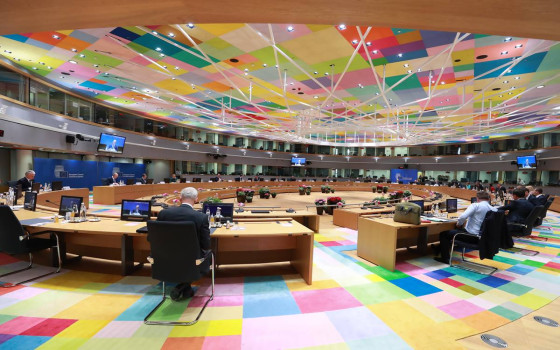
Brussels: More than 3.5 million legal immigrants arrived in the European Union last year, but 330,000 illegal immigrants were deported. The Granada summit was to prepare for the future and dealt with the Ukraine files, the economic consequences, and the expansion of the unified bloc.

- Europe and Arabs
- Saturday , 7 October 2023 12:52 PM GMT
Brussels: Europe and the Arabs
Ursula von der Leyen, President of the European Commission, said that the informal summit that took place on Friday in Granada, Spain, was about preparing for the future. A European statement in Brussels last night quoted von der Leyen’s speech at the summit’s closing press conference and said, “We met, as you know, 18 months ago.” At Versailles, immediately after the beginning of the Russian invasion of Ukraine. Today, we take stock of what we committed to then: a more secure and competitive Europe – with stronger defense capabilities, energy independence, and a strong economy. This was the foundation on which the Versailles Declaration was built 18 years ago. A month. We delivered.
We agreed in record time to purchase and provide massive financial and military support to Ukraine. Team Europe has already provided €82 billion in support to Ukraine. We have significantly reduced Russia's hold on our energy supplies. We have eliminated dependence on Russian fossil fuels. Just some numbers show it: We have completely eliminated Russian coal. We reduced the share of Russian oil in oil supplies from 27% to 6%. Pipeline gas imports from Russia amounted to 50% of our total energy imports in 2021. They are now less than 10%. This shows that it was a difficult journey. Brought to us by the energy crisis. But we've mastered it; We managed it. Today, energy prices have fallen to pre-war levels. Most importantly, we are leaping forward with a huge investment in renewable energy. So we can proudly say that last year, for the first time, we were able to produce more electricity from sun, wind, and renewable energy sources than from gas and coal.
We also took a good, hard look at our economic dependencies. You know the topics: important raw materials, or for example semiconductors. Here too, we delivered. We have taken measures to reduce these risks. Consider, for example, the chip law, which has already led to huge investments in semiconductor production in the European Union; Or consider the law of bio-raw materials; Or the Net Zero Industry Act, which is our proposal to ensure the future of clean technology in Europe. We have come a long way in just 18 months, but we must keep our eyes on the ball.
She addressed her words to the Spanish Prime Minister, who hosted the summit and whose country currently holds the rotating presidency of the Union, and said, “ Pedro, thank you very much for the very useful and excellent analysis that contributed to our discussion. This analysis points in the same general direction about what needs to be done: it starts from protecting and strengthening the system.” "Increasingly fragile rules-based international cooperation; strengthening research, investment and training in Europe in key sectors; and strengthening social cohesion in a context of profound and rapid change."
To these basic elements that I have just been describing, we need to add two more: the first is the critical issue of migration management. The second is the enlargement process to the European Union, which has more than 30 members. The process of joining the European Union is based on merit. This was also very clear today in our discussion: there are no shortcuts, no automatic accession to the EU. Based on merit. But it's not just candidate countries that work through this merit-based process. We must also do our part so that, if the candidate countries are ready to join, we are also prepared to welcome them into the European Union. By the beginning of November, we will have the Commission's annual report on accession and the status of the various candidate countries. This will then allow us to evaluate the matter and have an informed discussion during the European Council in December.
Regarding our tasks, we also discussed that we first need an agreement on electricity market reform. This is very important. We must bear in mind that this is about the leadership role that Europe plays in the fight against climate change. This is about the overall competitiveness of the EU compared to our main competitors. I am not talking about competition within the European Union, but rather about competitors from outside it. Second, we need agreement on reforming the economic governance framework. This is essential to allow public investment to play a strong and sustainable role in financing green and digital transitions.
My final point is about immigration. First of all, it is good news that two days ago we reached agreement in the Council – congratulations to the Spanish presidency – on the crisis management proposal. This is very important because it is an important piece of the puzzle for the Comprehensive Migration and Asylum Pact, so we hope now that we will soon be able to cross the finish line. But we mainly discussed the operational part of immigration management. And here, you know, there is the ten-point plan for the short-term reaction to the events in Lampedusa, but there is also a more structural approach in the medium and long term such as the memorandum of understanding with Tunisia.
Let me briefly mention five elements discussed. The first is actually a comprehensive understanding of our need to take a comprehensive approach towards partner countries that are either countries of origin or countries of transit. It is very important that we invest in those countries. Global Gateway can play a critical role in this investment. As you may recall, 150 billion euros have been allocated from the Global Gateway to African countries for infrastructure investment.
The second point is: There was also a comprehensive understanding about how important legal pathways and humanitarian pathways are. The better we do on legal and humanitarian corridors, the tougher we will be on irregular migration. Just to give you Two numbers. Last year we had 3.7 million regular migrants to the EU. It's important. We need them. We need more of them. But we also registered 330,000 illegal immigrants. This is the point at which we cannot accept smugglers and traffickers deciding who comes to the EU. We decide who comes to the EU, who gets asylum here, but also who has access to the labor market. So, these legal paths are obviously very important. The third point is: suppressing smugglers. This is organized crime. We must fight smuggling as we do against organized crime through Europol, Eurojust, Frontex and all the knowledge of our Member States.
The fourth point is: support countries that have to work hard to deal with migration. Here too, we have to work very closely with the International Organization for Migration and the United Nations High Commissioner for Refugees to help those countries return migrants to their countries of origin, and to also provide relief to the transit countries.
The fifth point is: return. We have seen in Lampedusa that the countries of origin are for example Ivory Coast, Senegal or Guinea. Vice President Schinas immediately went to those countries to agree on the rapid return of illegal immigrants. And as I said, in return, we want to create talent partnerships and legal paths. It is very important to bring back illegal immigrants to break the narrative of smugglers and send a strong message that legal paths are the ones that will get you to Europe, and choose them.
This whole approach is based on Team Europe. It is also very clear that none of us can do this alone. So it was a fruitful discussion among the Europe team.




No Comments Found