
For partnership with emerging economies and developing countries... a European-American commitment to accelerating progress towards the sustainable development goals... additional financing and multilateral development banks

- Europe and Arabs
- Sunday , 22 October 2023 13:3 PM GMT
Brussels: Europe and the Arabs
Both the United States and the European Union have pledged to accelerate progress toward the Sustainable Development Goals and mobilize additional development financing. To this end, we are committed to promoting reforms to create better, bigger and more effective multilateral development banks to address global challenges and countries' fundamental development needs. This includes implementing critical financial reforms and reviewing the climate financing structure to make it more effective and efficient. We are committed to raising the level of ambition to provide more space and concessional financing to strengthen the World Bank's capacity to support low- and middle-income countries facing global challenges, with a clear framework for allocating scarce, concessional resources, and providing robust support. Support the poorest countries. The United States and the European Union will intensify their efforts to make significant contributions to this end.
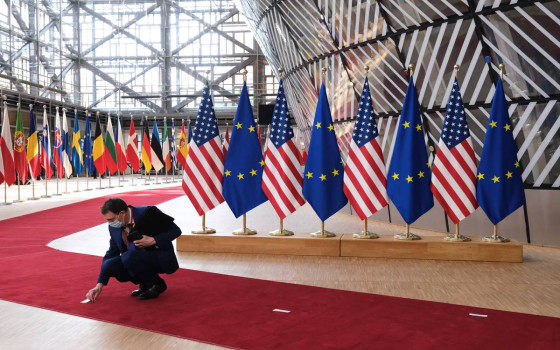
This was stated in the final statement of the joint summit between the European Union and the United States of America, which was hosted in Washington at the end of the week. The statement distributed in Brussels stated, “Given the enormous size of the needs, increasing the mobilization of private capital must play an important role in achieving our goals. We will continue to support the efforts aimed at To unleash private capital and we will work with G7 partners through relevant actions, to scale up the Partnership for Global Infrastructure and Investment, including the EU Global Gateway Strategy, and to mobilize $600 billion in high-quality infrastructure investments in low- and middle-income countries. Income. Middle-income countries by 2027. Building on discussions on US-EU cooperation on the Trans-Africa Corridor and the India-Middle East-Europe Corridor, we are working to identify additional regional economic corridors to cooperate on to unlock inclusive and sustainable economic growth.
. The United States and the European Union will also continue their efforts to promote digital inclusion and trustworthy ICT service supply chains around the world and continue to collaborate to develop a shared vision and industry roadmap on 6G wireless research and development. Systems.
. The US-EU Trade and Technology Council (TTC) is the primary forum for our cooperation on trade and technology matters. We commend the progress achieved and encourage further joint work in the lead-up to the next TTC Ministerial meeting later in 2023.
. The United States and the European Union are committed to strengthening the transatlantic market to support decent jobs and economic opportunity with a focus on mutually beneficial resilience and the sustainability of our supply chains. We will work to strengthen the implementation of the Transatlantic Initiative on Sustainable Trade, which focuses on facilitating mutually beneficial transatlantic trade of products and technologies that support the transition to a climate-neutral economy.
Building sustainable and resilient future economies
. The United States and the European Union are deepening our cooperation to address the urgent and interconnected crises of climate change, biodiversity loss, and pollution, and to urge all other major players to take ambitious action. We will work urgently to implement the Paris Agreement, halt and reverse global biodiversity loss and protect the oceans. We will intensify our outreach to third countries, particularly in light of the 28th UN Conference of the Parties on Climate Change (COP28), and make every effort to keep the 1.5°C limit on global temperature rise within reach. We are committed to working together and with others at COP28 to reach bold commitments to significantly increase global renewable energy capacity and energy efficiency while supporting the global transition away from fossil fuels, including the relentless end to new coal-fired power plants. We will continue to lead methane reduction efforts to support the achievement of the Global Methane Pledge and look forward to a strong announcement on the methane financing race at COP28.
Together, we will build climate-neutral, circular, resource-efficient and resilient economies, advance internationally recognized labor rights, and improve the resilience and sustainability of critical supply chains. We will continue our work to advance the energy transition to climate neutrality and enhance energy security through the Joint Task Force on Energy Security and the US-EU Energy Council.
. We are making bold public investments in our economies, and we will also continue to expand research collaborations, to ignite a clean industrial revolution, and with it good jobs, and to make our industries more sustainable and competitive. We will continue ongoing collaboration to this end, and work openly and transparently against zero-sum competition to maximize clean energy deployment, including through the Clean Energy Incentives Dialogue.
We have made progress towards a targeted agreement for critical minerals with the purpose of expanding access to sustainable, safe, diversified and high-quality biominerals and batteries supply chains and enabling those minerals extracted or processed in the EU to rely on the clean vehicle requirements of the Section 30D Clean Vehicle Tax Credit of the Inflation Reduction Act. We look forward to continuing to make progress and consulting with relevant stakeholders on these negotiations in the coming weeks.
Expand technological cooperation and exchanges
The United States and the European Union are intensifying our joint efforts to promote an open, free, global, interoperable, reliable, secure, innovative, and competitive digital ecosystem. We collaborate to manage risks and harness the benefits of artificial intelligence, working alongside our G7 partners , the Organization for Economic Cooperation and Development, and other multilateral forums. We underscore our ongoing work through the TTC's Joint Roadmap on Trustworthy AI and Risk Management to guide the development of tools, methodologies and methods for managing trustworthy AI and AI risks. We confirm our shared intention to agree a Code of Conduct for institutions developing advanced AI systems as part of the G7 Hiroshima Process in the near term. We affirm our commitment to using artificial intelligence for the public good, especially in the areas of agriculture, extreme weather forecasting, emergency management and response, improving the electrical grid, and health and medical research. As new and more advanced AI systems emerge, we plan to build on the work done to advance responsible AI and work with industry, civil society, academia and other stakeholders to enable the trustworthy development and uptake of those technologies, advancing our shared vision for AI. Responsible innovation in line with our shared democratic values. We recognize the importance of expanding EU-US research cooperation in critical and emerging technologies such as artificial intelligence, quantum intelligence, renewable energy and other key areas, including by enabling transatlantic research funding activities that allow both US and EU researchers. Leading with consideration of reciprocity in access to US and EU research programs and ensuring uniformity in intellectual property management. We are committed to working together to finalize an agreement on quantum-related provisions for upcoming TTC meetings.
We aim to build a safer cyberspace together. We seek cooperation to promote high cybersecurity standards to protect consumers and businesses and reduce exposure to cyber attacks. To this end, we commit to working together to achieve mutual recognition of our government-backed cybersecurity classification programs and regulations for IoT devices aimed at a common action plan for CyberSafe products. We will work to provide an easy and reliable way for consumers in Europe and the US to assess whether the devices they bring into their homes, offices and schools are safe.
Promoting rules-based trade and combating unfair competition
. The United States and the European Union have a common interest in reforming the WTO so that members can better achieve the core objectives of the WTO and address modern-day imperatives. We will work to achieve substantive reform of the WTO by the Thirteenth Ministerial Conference in 2024, including through discussions with a view to having a full and well-functioning dispute settlement system available to all WTO members by 2024.
On 31 October 2021, we announced that we would negotiate within two years an arrangement – known as the Global Arrangement on Sustainable Steel and Aluminum (Global Arrangement) – to address non-market excess capacity and emissions intensity in the steel and aluminum industries. Including promoting undistorted transatlantic trade. Over these two years, we have made significant progress in identifying sources of non-market surplus energy. We have also achieved a better understanding of the tools needed to address the emissions intensity of the steel and aluminum industries. We look forward to continuing to make progress on these important goals in the next two months.
Enhancing economic resilience and economic security
. The United States and the European Union continue to cooperate to strengthen the resilience of our economies and advance our economic security interests, supported by a rules-based order, while maintaining an open economy and a level playing field at the global level. We will de-risk and diversify the areas in which we assess risks through proportionate, precise and targeted measures to address economic security challenges. We will continue to work together to reduce over-reliance in critical supply chains, in close cooperation with partner countries. We share concerns about the challenges posed by, among other issues, economic coercion, the weaponization of economic dependencies, and non-market policies and practices. We will continue this work through, inter alia, the TTC, and with the G7 and other partners to diversify our supply chains and increase our collective preparedness, assessment, deterrence, and response to economic coercion.
32. We have a shared interest in protecting those advanced technologies that could be used to undermine global peace and security, and we are developing our economic security tools to ensure that our companies' capital, expertise and innovation are not used to do so. Recognizing the need for foreign investment measures to complement the existing economic security toolkit, the President of the United States issued an Executive Order to address risks from foreign investment and is consulting with stakeholders on U.S. rules. Likewise, the European Union and its Member States are exploring, based on a risk assessment, whether outward investment measures can complement its existing toolkit. Export control systems are essential to maintaining international security and stability, and require cooperation among actors – including multilateral forums – to ensure the continuous improvement of our ecosystem to protect dual-use technology from the potential for exploitation. We will collaborate and share lessons as we work to maximize the effectiveness of our economic security toolkit for our mutual benefit.





No Comments Found