
The European Commission: We are working with Cyprus to establish a sea corridor to ensure the permanent and orderly flow of aid to Gaza. We will continue to help evacuate wounded Palestinians... and the cycle of violence must be broken.

- Europe and Arabs
- Friday , 10 November 2023 16:37 PM GMT
Brussels: Europe and the Arabs
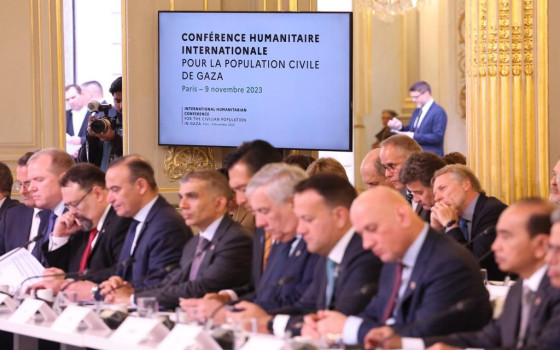
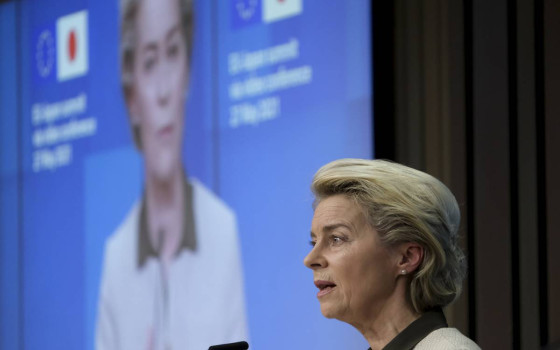
European Commission President Ursula von der Leyen said at the International Humanitarian Conference on the Civilian Population in Gaza, which was hosted by the French capital, Paris, on Thursday, that the very close relations we have established with the people of Gaza are bearing fruit today because this increases the possibility of coordination and response to needs. We, as the European Commission, have begun work immediately to provide this humanitarian assistance to the people of Gaza. In the run-up to this conference, we quadrupled humanitarian support to Gaza and the West Bank, but mostly for Gaza, to €100 million.
Most of our shipments arrived in Gaza by truck through the Rafah border crossing. But as almost everyone here has said, the quantities remain too small to match the vast humanitarian needs. So, while we fully support increasing the capacity of aid delivered through the Rafah crossing – this is our first priority – we also need to urgently consider additional routes. He called for more than one entrance. That is why we strongly welcome what Cyprus President Nikos Christodoulides has called for and are working closely with him to establish a sea corridor. I believe this will ensure a sustainable, orderly and robust flow of aid. The European Commission fully supports all logistics services and capabilities available to us. We will of course continue to assist in the evacuation of wounded Palestinians who received medical assistance in Egypt. This also includes providing medicines and medical equipment to Egypt.
This humanitarian effort goes hand in hand with work to avoid its spread into the area. Therefore, we are also working to provide strong support to the region. On Tuesday, she discussed with Jordanian King Abdullah during his visit to Brussels a new economic and financial package to strengthen Jordan. I also discussed with President Sisi how Europe can work to strengthen and intensify the partnership we have with Egypt. There is a complete comprehensive package here. This is in the immediate term, but also in the medium and long term, to stabilize the region and the most important actors in the region. Von der Leyen added in her speech, which was included in a European statement issued in Brussels, “Finally, we also believe that while we must deal with the urgency of today, we must make an effort to think about tomorrow. How to break the current cycle of violence. How to restore hope to Israelis and Palestinians. And from Yes, they need a political perspective. And that perspective is the two-state solution. We have to work intensively on this. Of course, in the end, Israelis and Palestinians have to agree on the way forward. But we have to, as part of an international effort, We also contribute, in close coordination with our friends and partners.
For his part, European Union President Charles Michel said in his speech to the audience, “The humanitarian crisis in Gaza is considered one of the worst crises in decades. In Paris today, and at the International Humanitarian Conference on the Civilian Population in Gaza, I reiterated the urgent need to deliver food, water and medical supplies to those in need.” We also need an agreement on fuel provision. We must spare no effort to save every life in Gaza. Every civilian's life matters. Always and everywhere.
At our recent European Council, all EU leaders agreed on the need to protect civilians in line with international humanitarian law.




No Comments Found