
After he informed the Palestinians of the plan: three nos and three yeses: ...the European Union Foreign Minister in Manama: We must move from war to peace through diplomacy.

- Europe and Arabs
- Saturday , 18 November 2023 14:33 PM GMT
After he informed the Palestinians of the plan: three nos and three yeses: ...the European Union Foreign Minister in Manama: We must move from war to peace through diplomacy.
Brussels: Europe and the Arabs
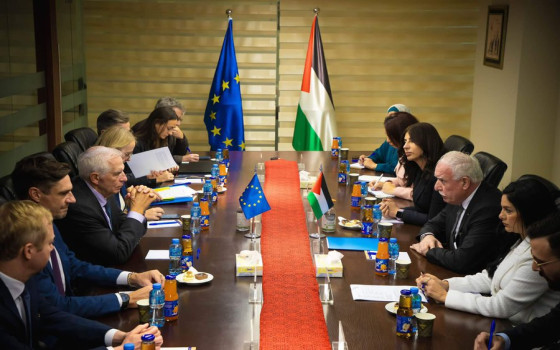
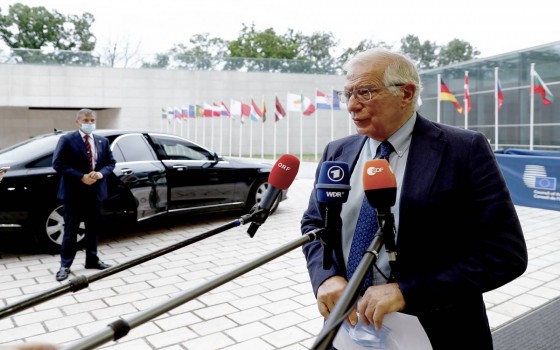
European Foreign Policy Coordinator Josep Borrell said: “Increasing polarization and emotional divisions are one of the biggest challenges we face.” We must move from war to peace and de-escalation, and the way to do that is through diplomacy. This came in a speech delivered by Borrell before the Manama Dialogue Forum in the Bahraini capital this morning, which he arrived from the Palestinian territories during his tour that has so far included Israel, Palestine, and the Bahri, after which he will head to Riyadh and Manama. Borrell wrote this morning on the X website, “formerly Twitter,” and said, “I conducted it yesterday.” We had an important exchange with representatives of Palestinian civil society. We discussed the tragedy unfolding in Gaza, the despair, and the sadness. But also the need to keep hope alive and work against all odds for peace and the right to a Palestinian state. Borrell spoke in another post after talks with Palestinian Foreign Minister Riyad al-Maliki and said, “I have come to express our solidarity regarding the tragic loss of civilian lives in Gaza and the deteriorating humanitarian situation, including in Gaza’s hospitals.” The European Union will continue to provide assistance. We discussed the importance of working to quickly release the hostages. Borrell’s office in Brussels also published the European official’s speech during a press conference with Palestinian Prime Minister Muhammad Shtayyeh, in which he stated that the European Union is a friend of the Palestinian people, and when I say tragedy, I am referring to what What is happening in Gaza, what happened in Israel, and what is happening in the situation in the West Bank.
In Gaza, there are already thousands of civilian casualties, almost half of whom are children. There is an acute shortage of food, water, electricity, fuel, everything. Yesterday, I listened to a briefing from the United Nations working [on the ground]. The situation is critical in terms of the functioning of hospitals, with the collapse of health systems and a serious shortage of medicines and medical supplies. We can say that October 7 - the terrorist attack that occurred on October 7 - changed the paradigm of an already fragile situation. On October 7, after the Hamas attack, I said that Hamas has harmed the Palestinian people and the Palestinian cause. Nothing can justify what Hamas did to the people it brutally attacked and took hostage, women, children and the elderly, and provoked such an intense Israeli response. Every civilian life is regrettable when lost. We condemned Hamas in the strongest terms for its terrorist attacks. We urged them to release the hostages and give them immediate access to the Red Cross or Red Crescent. I met a number of their relatives who described to me the difficult health conditions that many of them live in.
But the European Union also strongly emphasized that the way Israel exercises its right to defend itself is important. Israel must respect international humanitarian law and the principle of proportionality. Yesterday I conveyed this message, face to face, and in very clear terms, to the Israeli authorities I met. Horror does not justify another terror. Israel's best friends are the ones who ask them not to be swayed by anger. The European Union - and now also the United Nations through a recent resolution adopted by the UN Security Council - has called for an immediate humanitarian pause and increased humanitarian access, including water and fuel, [so that] This includes reaching civilians in Gaza. We, in the European Union, since the beginning of the Israeli military campaign against Hamas, have doubled our humanitarian aid to the people of Gaza to nearly €100 million and increased our funding for UNRWA by another €10 million, bringing funding [to] more than €90 million this year. . But we know that this is not enough. We know that the humanitarian needs are enormous and that providing everything that more than two million people need is a tremendous effort. The international community should be able to provide this assistance.
Mr. Prime Minister, the war against Hamas in Gaza is the result of a collective political and moral failure of the international community. A major political and moral failure for which the Israeli and Palestinian people will pay a heavy price. Only a political solution can end the untenable cycle of violence. Only a political solution can stop it. That is why I am taking this tour, starting with Israel, followed by Ramallah to visit you, the Palestinian Authority, in order to work with our partners on the way forward and to consider what needs to be done for this war to end. The end and how to create a better future based on peace. Allow me to put on the table some ideas about the work we have done because this dramatic event, at least, brought the Palestinian issue out of oblivion. No one was taking this problem seriously, and now there is no other solution than to take it seriously. And this frame of mind, which I think we have to work within, I can boil down to three “yes” and three “no.” The first “no” is: no to the forced displacement of Palestinians in and from Gaza. No forced displacement of the Palestinian people out of Gaza. No regional changes. No to reoccupying Israel or providing a safe haven for Hamas in Gaza. No to separating Gaza from the Palestinian cause as a whole. The solution in Gaza must be part of the solution to the entire Palestinian problem. Therefore, Gaza cannot be separated from the entire Palestinian issue.
And now with "Yes".
The first “blessing” is the return of the Palestinian Authority to Gaza. I say "pa" - you. You are already there. You never left Gaza. You have provided public services to the population with our support. You have the ability to keep doing the job. You may need support from the international community, but the Palestinian Authority must return to Gaza.
The second “yes” that we need is stronger participation of Arab countries. The third thing is increased participation of the European Union.Especially in the political process, in building the Palestinian state. We have a certain experience in state building in Europe, and we must engage in that in order to build the Palestinian state as part of the two-state solution. But we should not forget the situation in the West Bank. You know that better than me. I also discussed this with my Israeli counterpart [Eli Cohen] yesterday, and everyone must realize that there has been an escalation in settler terrorism since October 7. Since the beginning of the year, 421 Palestinians have been arrested and killed in the West Bank. Since the first days of October - since the dramatic October 7th, the number has reached 202. This means that since the start of this dramatic event, the same number of Palestinians have been killed in the West Bank as were killed from the beginning of the year until October. This has led to an increase in the numbers of communities forced to leave their homes. Today, there are more than 150 illegal settlement outposts, the main purpose of which is to serve as a launching base for settlers. We have urged the Israeli authorities to address this issue at the highest level to prevent the outbreak of violence in West Bank. Our support for the Palestinian Authority, as the sole representative of the Palestinian people, is political and financial. We are the largest international donor to the Palestinian people, and we will continue to make the largest financial contribution to the work of the Palestinian Authority. Because this war has shown us that we cannot leave the Palestinian issue unresolved. No matter how tragic things are now - and they are very tragic - we must seize this momentum to invest in peace and work towards a solution to the conflict. We must mobilize international support for the political process towards a two-state solution - a process that has been neglected for too long. A two-state solution is the only way applicable to peace. It is time to define the concrete steps that must be taken to implement it. Because we have been repeating for years - 30 years since the Oslo Accords - the “two-state solution,” without doing what is required to implement it on the ground. This is my message, Prime Minister, here in Ramallah. This is what I said yesterday in Israel. I say the same thing, in both places. This is the message I will carry to my next destinations, in Manama, Riyadh, Doha and Amman. Prime Minister, in September - remember - in New York we launched the “Peace Day Effort” to support the restart of the peace process. At that moment, there were a lot of doubts, and no one was taking care of this effort, except for you, me and some people who work with a vision about the necessity of dealing with this problem. Today, the current tragedy only forces us to redouble this effort - for the benefit of the Palestinian people so that they can finally To live in freedom, peace, prosperity and dignity side by side with the Israeli people, and to live in peace and security. This is what we want to do. Count on the European Union as a reliable and predictable partner that will and will remain with the Palestinian people in order to solve this problem – [as] difficult as it is, more difficult today than yesterday. At least, today it is on the front page of newspapers around the world. . This is the momentum that the conscience of the international community must muster in order to avoid an even greater catastrophe. Because if there is no peace here in the Middle East, we will not be safe at home either




No Comments Found