
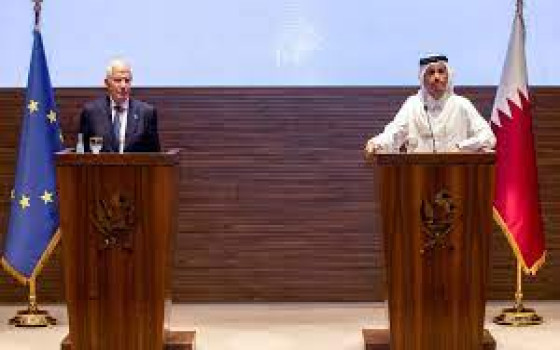
Before Borrell's statements about war crimes in Gaza, which ignited social media, he spoke in Qatar about liberating Israeli hostages and did not mention the Palestinians in occupation prisons.

- Europe and Arabs
- Monday , 20 November 2023 13:51 PM GMT
Brussels: Europe and the Arabs
Social media pioneers circulated a clip of the interview conducted by Josep Borrell, foreign policy coordinator with Al Jazeera. In his response to questions, Borrell refused to consider what is happening in Gaza as war crimes and said that he is not a lawyer, but when he answered a question about what happened by Hamas on October 7 against the Israelis, he said Borrell said that the position of the European Union considers what happened to be war crimes, which put Borrell in a dilemma, according to what was stated in people’s comments on this clip, and some of them commented in agreement with the broadcaster regarding the existence of double standards.
Hours before that, the speech delivered by European Foreign Policy Coordinator Josep Borrell during the joint press conference with the Prime Minister and Minister of Foreign Affairs of Qatar, Mohammed bin Abdulrahman bin Jassim Al Thani, emphasized some important points, but it was noted that the European official focused on the file of liberating Israeli hostages held by Hamas members. The European official also praised Qatar's role in mediating several files in Afghanistan, Iran and other issues, but the file of Palestinian prisoners in Israeli prisons was not addressed.
According to the speech published by Borrell’s office yesterday in Brussels, Borrell also focused on the tragic situation in Gaza, the international failure to deal with this issue, and the inability to persuade Israel to stop its aggression against civilians. Borrell said, “The United Nations considers what is happening in Gaza to be one of the largest humanitarian crises of our time.” In French they call it "massacre". There is no hierarchy among horrors. One horror does not justify another. The pain you inflict on other people's children will never justify, and will never compensate for, the pain your children suffer. On the contrary, it will create a spiral of violence. It will come back again unless we get peace, sustainable peace.
For this reason, the European Union called for an immediate humanitarian truce, and the United Nations Security Council, at the request of one of the European Union members - Malta, and with the support of France and Germany, two European Union members, adopted a very important resolution. An important decision demanding an immediate, urgent and sustainable humanitarian halt.
I want to mention that UN Security Council resolutions are not just words. They are mandatory, and must be implemented. But this decision has not been implemented, so far. On the contrary, the bombing continued. I must mention that this resolution of the United Nations Security Council must be implemented. Too many lives are lost every day.
In my discussions with our Israeli friends, I have insisted on respecting international humanitarian law and exercising utmost restraint against civilians in their reprisals. But the number of casualties, especially the number of children [victims], makes us believe that much remains to be done in order to preserve Civilian lives.
We are urgently seeking, with international partners, to find ways to move from war to peace. We established a humanitarian center in Egypt, launched humanitarian air bridges, and doubled our humanitarian aid.
Providing humanitarian aid is essential, but it deals with the symptoms. It makes no sense to serve food for dinner and then be killed the next day. We need to address the causes. We must make the humanitarian stage the first step to the political stage. Here, the two-state solution is the only viable path.
I must repeat again that we have been demanding a two-state solution for more than 30 years without doing what needs to be done to make this solution possible.
Now, in the midst of this horrific crisis, perhaps there is a wake-up call to the international community, and especially to us as Europeans and Arabs, that we have a special responsibility to engage in reaching a solution.
30 years ago, in Oslo, this was decided, and we must first define the steps and principles leading to this, to move from declarations to concrete actions and implementation. Because it is not limited to peace between the Arab countries and Israel, but it must be peace between the Palestinians and the Israelis, otherwise this crisis will continue to send shock waves around the world and [also] affect European societies and their fabric.
We are [already] witnessing the development of anti-Semitism, as well as anti-Muslims, and anti-anything, all of which must be stopped in order to maintain peace between us, within our societies, and between the countries of the Middle East.
And when I say that I call for a two-state solution, I fully realize that that will require a lot of effort, not only on the economic level, because Gaza has been rebuilt several times, not only through significant economic investment and support, but also from political investment, not just to build homes. But to build the state.
In this regard, the Palestinian Authority has an important role to play. Palestinians deserve dignity. Israel deserves security. They both deserve to live prosperously in peace and security in the same land.
We want to work together to achieve this,
Dear Prime Minister, I have visited Jerusalem, Tel Aviv and Ramallah. For about four hours, I met with two groups of families of people being held hostage: fathers, sons and brothers. I understand their sadness and suffering. They have asked me to convey to you what you must do - and I am sure you are doing - everything in your power to get these hostages released. For our part, as the European Union, we are doing exactly the same thing – putting pressure on both parties to make this deal possible.
I know that you have been working tirelessly since day one, even before the Israeli forces entered Gaza, to make this release possible, and it is part of the path that we must follow in order to achieve this. Bruel is currently on a visit to the region that has so far included Israel, Palestine, Bahrain and Qatar, and he heads today. Jordan




No Comments Found