


UN: Unexploded Ordnance Clearance in Gaza Long and Dangerous... US Optimism for Continued Ceasefire, Netanyahu Dismisses National Security Advisor

- Europe and Arabs
- Wednesday , 22 October 2025 7:44 AM GMT
Gaza - New York: Europe and the Arabs
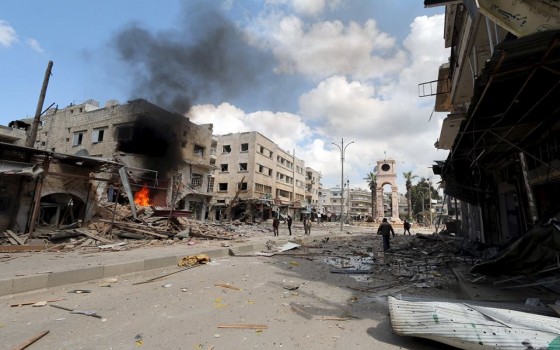
The United Nations Mine Action Service (UNMAS) confirmed that the risks posed by unexploded ordnance (UXO) to communities and humanitarian workers in Gaza are "extremely high," with increased movement of people across the Strip as a result of the ceasefire.
The UN Daily News reported that, speaking to reporters in New York from Jerusalem on Tuesday, Luke Irving, the head of the UN Mine Action Service's mission in the occupied Palestinian territory, expected contamination from these munitions to be widespread. However, he stressed that the full extent of the contamination could only be known "if and when a comprehensive survey is conducted."
Mr. Irving said that reports of five children being injured by these munitions last week "are one of hundreds of stories of people, often children, killed, suffering, and sustaining life-changing injuries from these hazardous materials."
He expressed the Department's grave concern about the increasing risks in the coming days, weeks, months, and years, "as people try to salvage what's left of their homes and belongings, as children play in conflict-affected areas, and as humanitarian workers travel to areas previously inaccessible due to fighting."
Getting the Message Through
Mr. Irving emphasized that humanitarian mine action is "indispensable" to paving the way for aid delivery and for the recovery and reconstruction of the Strip, and will require rapid expansion. He added that UNMAS and its partners have been "preparing for this moment."
He explained that the service has reached an estimated 460,000 people with personalized risk education messages and has produced more than 400,000 risk education materials, more than 300,000 of which are pre-positioned with humanitarian partners for distribution to the communities they reach.
He said, "We need to get these messages out to all Gazans to mitigate the threat of these explosive ordnance."
Expanding Work
Mr. Irving added that the Department is supporting humanitarian partners to expand service delivery to the affected population, prioritizing roads and access to vital services and infrastructure, including water and sanitation facilities, health centers, shelters, agricultural areas, and bakeries.
He said that partners have sent nearly 100 requests for mine action support to the Department since the ceasefire took effect, with an average of about 10 new requests per day.
He said that the Service is well positioned to respond to this demand, including by working with partners to bring additional technical personnel to Gaza to support the expanded work. “However, these measures will not eliminate the threat of explosive ordnance in Gaza.”
He emphasized that the humanitarian mine action sector requires approval to bring in essential technical equipment for ordnance disposal, which will assist Gaza’s long-term recovery, and expressed hope that this will happen soon. A Long and Dangerous Process
In response to reporters' questions, Mr. Irving said that clearing unexploded ordnance in Gaza "will not happen overnight," stressing that it is "a long, arduous, and dangerous process."
He emphasized that, for now, the focus should be on warning people of the dangers and on methods for removing and disposing of them to avoid harming the population.
In the same context, US Vice President J.D. Vance expressed optimism that the ceasefire between Israel and Hamas would continue as part of President Donald Trump's peace plan for the region, but stressed that he could not confirm the agreement's success "100%."
This came during a press conference Vance held in Israel on Tuesday, hours after his arrival in the country, where he said: "I think everyone should be proud of where we are today. It will require continued effort, and it will require continued monitoring and oversight."
He added: "I feel deeply optimistic. Can I be 100% certain that the agreement will succeed? No. But you don't accomplish difficult tasks by limiting yourself to what is absolutely guaranteed. You try, you deliver, and that is exactly what the President of the United States has tasked us with." According to what was reported by the European news network in Brussels, Euronews.
In response to a question from The Times of Israel about Turkey's role in the post-war Gaza Strip, the vice president said that Ankara could play a "constructive role" there, but stressed that "any military or security presence on Israeli territory will not be imposed on Israel under any circumstances."
Separately, Israeli Prime Minister Benjamin Netanyahu dismissed his national security adviser, Tzachi Hanegbi, on Tuesday, in a decision effective immediately. The announcement came after Netanyahu informed Hanegbi of his intention to appoint a new national security adviser, according to a statement received by Agence France-Presse. In his statement, Hanegbi said, "The terrible failure of October 7, in which I was a part, must be thoroughly investigated to ensure that the necessary lessons are learned to help restore shattered trust."
He added, "I thanked the prime minister for the privilege of partnering with me in formulating Israel's foreign and security policy during these difficult years, for giving me the opportunity to express an independent position in sensitive discussions, and for the professional level that characterized our dialogue even during times of disagreement."
According to the Prime Minister's Office, Netanyahu intends to appoint Gil Reich, deputy head of the National Security Council, as acting head of the council. Meanwhile, an informed Israeli source told CNN that Hanegbi's dismissal stemmed from his objections to Netanyahu's plans to take control of Gaza City, his position on prisoner negotiations, and his disagreements with Ron Dermer, a close confidant of the prime minister.







No Comments Found