
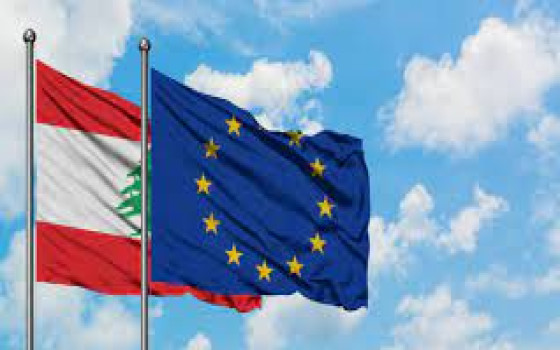
EU-Lebanon Association Council: Discusses the political, social, and economic situation in the country, the return of Syrian refugees, the disarmament of non-state armed groups, and strengthening the partnership

- Europe and Arabs
- Tuesday , 16 December 2025 9:59 AM GMT
Brussels: Europe and the Arabs
The ninth meeting of the EU-Lebanon Association Council was held in Brussels. Both sides reviewed the state of relations between the EU and Lebanon and reaffirmed their shared commitment to strengthening the bilateral partnership within the framework of the Association Agreement and its priorities. A concluding statement was issued at the end of the meeting on Monday evening, which read: “The European Union reaffirmed its support for the reforms initiated by President Joseph Aoun, Prime Minister Nawaf Salam, and the new Lebanese government, and reiterated its continued commitment to supporting democratic institutions in Lebanon. It expressed its strong support for the implementation of measures to strengthen state sovereignty, including ensuring that the legitimate state institutions have a monopoly on the use of force. In this context, the EU and Lebanon stressed the paramount importance of continuing efforts to disarm all non-state armed groups throughout Lebanese territory, particularly Hezbollah and Palestinian armed groups inside and outside the camps, and the full implementation of all Security Council resolutions. The EU reaffirmed its full support for Lebanon’s sovereignty, state authority, territorial integrity, political independence, and stability, in accordance with UN Security Council Resolution 1701. Both sides expressed their deep concern regarding the continued violations by the Israeli Defense Forces of the ceasefire agreement signed in November 2014, particularly the targeting of UNIFIL personnel, civilians, and civilian infrastructure. They called on Israel to withdraw from Lebanese territory and to abide by international humanitarian law.
Both sides welcomed the EU’s commitment…” The EU and Lebanon reaffirmed their unwavering support for key security institutions in Lebanon, particularly the Lebanese Armed Forces and the Internal Security Forces, which remain essential pillars of national and regional sovereignty and stability. They expressed their readiness to provide further support to the Lebanese security sector through the full use of EU instruments, including the European Peace Facility, the International Security Cooperation Initiative programs, and by exploring the possibility of future engagement within the framework of the Common Security and Defence Policy.
The EU and Lebanon discussed the political, social, and economic situation in the country. The EU commended the progress made by the Lebanese authorities in achieving economic stability and improving access to justice and public services, noting the importance of the strong bilateral cooperation that has supported these efforts. Both sides stressed the need for further comprehensive reforms in governance, the rule of law, public financial management, and the functioning of state institutions, recognizing their pivotal role in supporting stability, economic recovery, and facilitating access to international assistance, including progress towards the IMF program.
The EU reiterated its readiness to support Lebanon in its efforts to achieve economic stability, strengthen institutions, advance reforms, and support the government's recovery and reconstruction plans following the end of the current crisis. The conflict.
Lebanon reiterated the importance of holding general elections according to the announced timetable and in line with constitutional and international standards, as a fundamental element of democratic accountability and institutional legitimacy. Lebanon invited the European Union to send an election observation mission.
The European Union and Lebanon also discussed the situation of refugees and internally displaced persons. The EU acknowledged the significant challenges Lebanon continues to face in hosting large numbers of refugees and reaffirmed its continued support for vulnerable Lebanese, internally displaced persons, and refugees. The EU will continue to work with Lebanon and cooperate with UN agencies to facilitate the voluntary, safe, dignified, and sustainable return of refugees to Syria, in accordance with international law and international humanitarian law. Within a reasonable timeframe, the EU and Lebanon are committed to continuing to work with all relevant parties to find durable solutions that enable Syrians to rebuild their country and earn a decent living in Syria.
The meeting also provided an opportunity to exchange views on regional and international developments. The EU and Lebanon reaffirmed their commitment to the two-state solution to the Israeli-Palestinian conflict as the only viable basis for achieving lasting peace. They stressed the importance of protecting civilians in Gaza and ensuring The meeting addressed the unimpeded delivery of humanitarian aid. Discussions also covered Lebanon’s relations with Syria, cooperation on border management, the issue of enforced disappearances by the Assad regime, and security and humanitarian matters. The EU welcomed the enhanced coordination and cooperation between Lebanon and Syria on issues of common priority and encouraged continued bilateral cooperation.
The EU and Lebanon expressed their readiness to continue considering the modernization of the Association Agreement and to explore options for strengthening bilateral relations, including the possibility of developing it into a comprehensive strategic partnership, in parallel with the ongoing progress of the reform process. The meeting was co-chaired by High Representative Kaja Kallas and Foreign Minister Youssef Raji, with the participation of Commissioner Dubravka Šueča and EU foreign ministers. Both sides reaffirmed their commitment to deepening the EU-Lebanon partnership and working together for a stable, secure, and prosperous Lebanon.




No Comments Found