
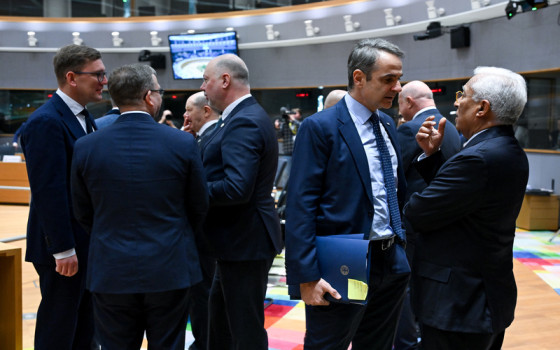
The Brussels summit focuses on two issues: Ukraine and security in Europe, and the Multiannual Financial Framework, in addition to migration and the situation in the Middle East.

- Europe and Arabs
- Thursday , 18 December 2025 8:54 AM GMT
Brussels: Europe and the Arabs
The winter summit bringing together the leaders of the European Union member states begins today, Thursday, in Brussels. Crucial discussions will take place, focusing primarily on two issues: Ukraine and security on our continent; and the EU's Multiannual Financial Framework for the period 2028-2034. In his letter to the leaders of the member states inviting them to the summit, European Council President António Costa stated, “We will begin the European Council meeting with a discussion on Ukraine. Recent developments underscore the need for urgent action from the European Union. At the European Council meeting in October, we committed to meeting Ukraine’s urgent financial needs for 2026-2027, including support for its military and defense efforts. At our upcoming meeting, we will decide, based on the ongoing preparatory work, how to implement this commitment. As I write this letter, diplomatic efforts are continuing to achieve a just and lasting peace in Ukraine. In this context, we will discuss how best to continue defending Europe’s interests and how to strengthen Ukraine’s negotiating position. Increasing pressure on Russia is a key part of this equation.
Secondly, I would like us to focus on the next Multiannual Financial Framework. The Danish Presidency has made significant progress in the preparatory work. Our discussions will be an opportunity to assess the progress made so far and to provide the necessary guidance for the next stage of negotiations. Reaching an agreement on the financial framework by the end of 2026 will require intensive effort.” The next multi-year plan and its financing are crucial. Adherence to this timetable is essential, as it will enable the EU to implement new financing programs from the beginning of 2028. It will also demonstrate the EU's ability, in a volatile world, to make timely and wise decisions in defining the financial foundations of its work.
The current geopolitical context underscores the importance of enlargement as the EU's most important geopolitical investment in peace, security, stability, and prosperity. Through a merit-based approach, the reforms are having a profoundly transformative impact on candidate countries. Given the progress made by some candidate countries in their accession pathways, some may meet the criteria for EU membership in the near future. Today's European Council meeting will be a good opportunity for us to discuss the way forward.
I would also like us to exchange views on the geoeconomic situation and its implications for the EU's competitiveness. European competitiveness is not built in isolation. It is important to discuss the pressures, as well as the opportunities, that are emerging in a world of increasing geoeconomic competition, where rules-based economic relations and traditional partnerships can no longer be taken for granted. How can the EU How can the European Union best defend itself against external economic and political pressures? How can we accelerate our trade diversification agenda? How can the EU gain the necessary strategic autonomy to ensure our economies remain competitive? These are some of the questions I would like to address at our meeting in December, in the context of our ongoing discussions on the EU Competitiveness Agenda.
The situation in the Middle East requires our continued attention. The adoption of UN Security Council Resolution 2803 offers an opportunity to move forward towards peace. The EU has an important role to play in contributing to the full implementation of the ceasefire in Gaza and ensuring that this process remains on track towards a comprehensive, just, and lasting peace based on a two-state solution.
We will also assess the implementation of our previous decisions on European Defence and Security, which aim to decisively raise Europe’s defence readiness by 2030. Recent events indicate that Russia and Belarus have intensified their hybrid campaign in Europe. This reminds us of the need to accelerate efforts at all levels to strengthen our defence readiness.
In accordance with our usual practice, we will also assess progress in implementing The previous conclusions on migration. We expect the Commission President's message to enrich our discussions, as the EU continues to contribute in this area.
As always, I will strive to keep our meeting to one day. However, my main priority is to make the important decisions that need to be made, particularly regarding funding for Ukraine.
We will begin on Thursday, December 18, at 10:00 a.m. with the traditional exchange of views with the President of the European Parliament. Following that, we will hear from President Zelensky. We will then continue our work at the level of Heads of State and Government of the EU.




No Comments Found