
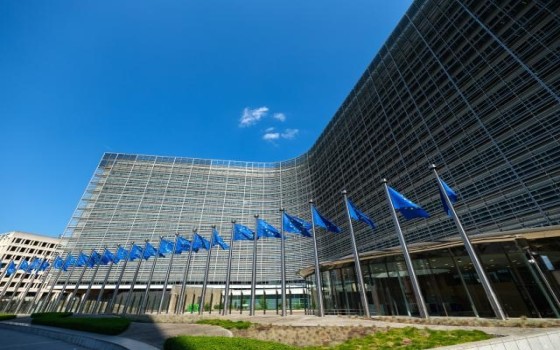
The European Security Council convened following an emergency ministerial meeting on a potential strike against Iran. Brussels: Any escalation that could threaten the Middle East and Europe, and have serious consequences, particularly economic ones, must be avoided.

- Europe and Arabs
- Monday , 2 March 2026 7:15 AM GMT
Brussels: Europe and the Arabs
European Commission President Ursula von der Leyen is convening a meeting of the Security Council today, Monday – a new format comprising senior officials focused on security, defense, and foreign policy. This follows an emergency ministerial meeting on Sunday in which the European Union discussed political and consular issues related to the war in Iran. The repatriation of European nationals stranded in Iran and the Middle East emerged as one of the most pressing issues, according to two sources with direct knowledge of the talks, as reported by Euronews.
According to media reports in Brussels, "Europe has improved at keeping pace with the accelerating pace of world affairs, holding rapid and frequent meetings to forge a common position (even on weekends). But when it comes to speaking with one voice on the Middle East – or having any real influence – it remains divided and far removed from the United States," as reported by Playbook Europe, the European edition of Politico.
On Sunday, EU foreign ministers held an informal videoconference to discuss the situation in Iran and the Middle East, following the outbreak of hostilities between the United States and Israel on one side and Iran on the other.
The ministers expressed their deep concern about the situation and called for maximum restraint, the protection of civilians, and full respect for international law, including the principles of the UN Charter and international humanitarian law.
The ministerial meeting also addressed communication with partners in the region, the potential economic repercussions of the crisis, and its consular dimensions. At the conclusion of the meeting, the Council issued a joint statement from the 27 EU member states on developments in the Middle East. The statement read: "The EU is following developments in Iran and the Middle East with grave concern. The EU has imposed extensive sanctions in response to the Iranian authorities' actions, including brutal repression and human rights violations against the Iranian people, as well as threats to regional, European, and international security through its ballistic missile and nuclear programs and its support for armed groups in the Middle East. We will continue to protect the EU's security and interests, including through further sanctions. The EU has repeatedly urged Iran to end its nuclear program, curb its ballistic missile program, refrain from destabilizing activities in the region and Europe, and cease the appalling violence and repression against its own people. We call for maximum restraint, the protection of civilians, and full respect for international law, including the principles of the UN Charter and international humanitarian law. The Middle East would suffer greatly from any prolonged war. Iran's attacks and violations of the sovereignty of several countries in the region are unforgivable. Iran must refrain from..." Indiscriminate military strikes. We express our solidarity with our partners in the region who have been attacked or affected. We reaffirm our commitment to regional stability and the protection of civilian lives.
We remain in close contact with our partners in the region to contribute to de-escalation, and we reiterate the unwavering commitment of the European Union and its Member States to safeguarding regional security and stability. The EU will continue to support all diplomatic efforts aimed at reducing tensions and achieving a lasting solution that prevents Iran from acquiring a nuclear weapon. Iran’s full cooperation with the International Atomic Energy Agency, as well as its adherence to its legal obligations under the Treaty on the Non-Proliferation of Nuclear Weapons and the Comprehensive Safeguards Agreement, is crucial, and nuclear safety is a top priority. Maintaining maritime security and respecting freedom of navigation is also of paramount importance.
The EU and its Member States are taking all necessary steps to ensure the safety of EU citizens in the region, including activating the EU Civil Protection Mechanism where necessary.
The events unfolding in Iran must not lead to an escalation that could threaten the Middle East, Europe, and beyond, with potentially serious consequences, particularly in the economic sphere. Disruption of waterways must be avoided. Vital, like the Strait of Hormuz.
The European Union reaffirms its solidarity with the Iranian people and strongly supports their fundamental aspirations for a future in which universal human rights and fundamental freedoms are fully respected.




No Comments Found