

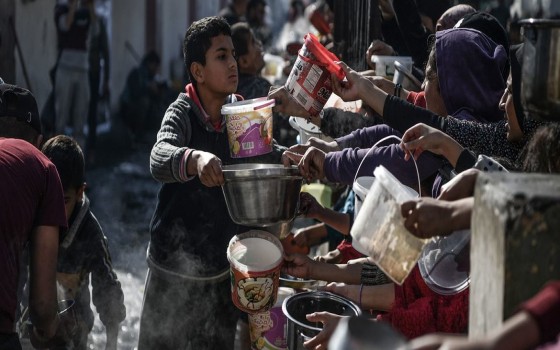
The crisis in the Middle East casts a shadow over food security in fragile countries. Yet, a UN agency implements more than 1,000 projects and provides 26 million workdays amidst crises and conflicts.

- Europe and Arabs
- Friday , 5 June 2026 8:34 AM GMT
New York : Europe and the Arabs
The World Food Programme (WFP) has warned that the ongoing crisis in the Middle East is impacting people's ability to afford food, particularly in fragile countries, where the crisis is driving up fuel and food prices, disrupting supply chains, and reducing incomes.
This came in a report issued by the WFP, the findings of which were commented on by the program's Acting Executive Director, Carl Skau, in remarks to journalists at the United Nations headquarters in New York. According to the UN Daily News, a copy of which we received Friday morning,
Skau said that the WFP had issued an "urgent warning that if the crisis continues and oil prices remain above $100 a barrel until June, some 45 million people will be pushed into hunger." He added that the new report begins to monitor how the effects of this crisis are unfolding.
To assess the extent of the crisis's impact, the WFP conducted case studies in Afghanistan, Somalia, and Sri Lanka; countries chosen because of their varying levels of economic development and their dependence on trade, energy, and remittance flows linked to the Middle East region. The report revealed the following:
In Somalia, up to 2.5 million more people could be unable to afford a basic food basket this year, while nearly 60% of households may struggle to meet their basic needs.
In Afghanistan, up to 2.3 million more people could fall into food insecurity if the Middle East crisis intensifies and border crossings with Pakistan remain disrupted.
In Sri Lanka, an additional 1.3 million people are projected to face difficulties in meeting their basic food needs, joining the 4.7 million already at risk.
A Crisis Beyond Food Security
The UN official explained that in all three countries, a complex mix of factors is driving the situation. “Rising prices are one factor, but another is the lack of funding for humanitarian and development responses.”
The program warned that the crisis is not only exacerbating the living conditions of those already suffering from hunger, but is also creating new pockets of vulnerability. Poor families in urban areas and marginalized rural communities are facing increasing hardship as their purchasing power erodes due to rising prices and declining income levels.
He also noted that the risks extend beyond food security. Concerns about political stability are legitimate, as the convergence of a new major economic shock, a historic decline in foreign aid, and insufficient global economic growth to reduce extreme poverty is a deeply worrying development for many countries.
The Impact of the Funding Decline
The acting executive director of the program addressed the funding shortfall, stating, "We are facing a perfect storm. There are record levels of hunger, and these levels are likely to rise further. At the same time, we have seen a historic decline in funding, which fell by 40 percent last year."
He explained that "some contexts are more affected than others," citing Somalia and Afghanistan as examples.
Regarding Somalia, he said that famine conditions are looming, emphasizing that "colleagues on the ground are working around the clock to prevent this." He gave the example of the impact of funding cuts on a clinic he visited in Jalalabad, Afghanistan, where mothers returned empty-handed after a three- to four-hour walk, carrying their malnourished children, because the clinic had run out of supplies.
Meanwhile, from Gaza, Yemen, and Sudan to Ukraine, Haiti, and other regions, the United Nations Office for Project Services (UNOPS) implemented more than 1,100 projects in 2025 across 130 countries and territories, amidst escalating international challenges, armed conflicts, and the worsening climate crisis.
UNOPS’ annual report stated that it provided technical, operational, and logistical support through these projects, contributing approximately $2.7 billion to humanitarian response, sustainable development, and peace and security initiatives.
Most of these projects were implemented in response to conflicts and crises, including in high-risk areas. “Against the backdrop of international challenges, UNOPS has done what it does best: assist communities in need around the world with flexible and practical solutions,” said UNOPS Executive Director Jorge Moreira da Ceva. Two-thirds of the office's work is carried out in complex circumstances. Through its projects, the agency has provided some 26 million paid workdays to local communities—including the poorest—including 10 million paid workdays for women.
The United Nations Office for Project Services (UNOPS) provides practical solutions in the areas of peace and security, humanitarian operations, and development. UNOPS assists the United Nations, governments, and other partners in managing projects and delivering sustainable infrastructure.





No Comments Found