

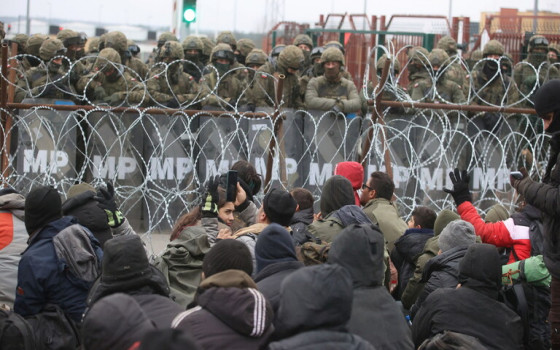
The Netherlands is looking to replicate the British plan to deport refugees to Rwanda, despite its failure.

- Europe and Arabs
- Saturday , 21 November 2026 9:49 AM GMT
The Hague: Nour El-Dine Amrani
The Netherlands is looking to replicate the British plan to deport refugees to Rwanda, despite its failure. What has driven five European nations—the Netherlands, Germany, Denmark, Greece, and Austria—to revive a scheme that failed for the British? The answer is self-evident: officials in these countries feel the growing influence of the far-right breathing down their necks. These far-right groups, in turn, allow mainstream parties to present themselves as "moderate" by comparison. Thus begins a race toward a humanitarian "race to the bottom," all in an effort to appear "tough." A recent example is the call this week by populist MP Geert Wilders (of the Party for Freedom) to establish a Dutch investigative agency modeled after the U.S. Immigration and Customs Enforcement (ICE). Setting aside the political maneuvering, one can understand the desire to achieve results regarding the notoriously difficult issue of repatriation—a challenge that has persisted for decades, especially when countries of origin refuse to cooperate. Yet, the legal hurdles are numerous, and the likelihood of any tangible success is slim. Consequently, there remains a significant risk that this initiative will prove to be nothing more than a costly "trial balloon," with potentially dire consequences for the individuals involved. To use a term common in The Hague, this plan crosses the "humanitarian pain threshold." Promises to uphold human rights—offered by a nation that barely respects the rights of its own citizens—are hardly reassuring; Rwanda ranks 161st out of 174 countries on the human rights index. Ultimately, the question remains: should any state make itself beholden to the Kagame regime? This week, the Christian Democratic Appeal (CDA)—a partner in the governing coalition—spoke in the House of Representatives of a "historic" deal. In reality, however, what looms on the horizon is a historic mistake. A line must be drawn somewhere to halt this race toward a humanitarian "race to the bottom." Instead of pursuing this ominous plan, the government should focus on establishing better agreements with countries of origin. This is all the more urgent, lest a court eventually be forced to intervene and block the implementation of a proposal that has already generated significant controversy in the Dutch press—which has been quick to report the angry reactions of human rights organizations and advocacy groups in the Netherlands and across Europe. Numerous civil society and independent organizations, including Amnesty International and various migrant-advocacy groups, have condemned the plan—which would see individuals deported from Europe to Africa—as both "diabolical" and unethical. Conversely, extremist political factions have welcomed this punitive measure, viewing it as a means to seal Europe’s borders against migrants—particularly those arriving from Africa—while simultaneously sending a clear, exclusionary signal to Arab and Muslim migrants arriving from the Middle East.






No Comments Found