

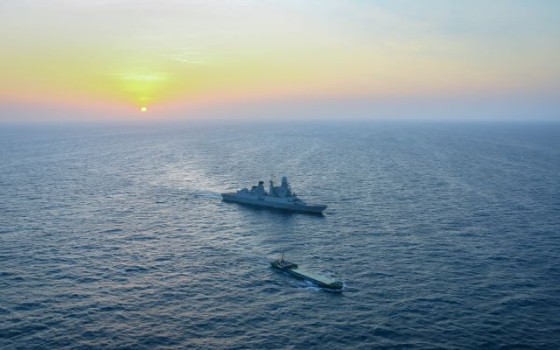
New escalation in the Strait of Hormuz: Iranian commercial vessel targeted after US forces rerouted 100 ships following a blockade; Houthis confirm attack on Saudi Arabia, citing the targeting of a military base.

- Europe and Arabs
- Sunday , 13 September 2026 6:58 AM GMT
Tehran – Sanaa: Europe and the Arabs
One person was killed in an attack on an Iranian commercial vessel in the Strait of Hormuz, according to European media reports from Brussels this morning. The reports added that an Iranian commercial vessel was targeted in an attack in the Strait of Hormuz on Sunday, resulting in one fatality, as stated by authorities.
Amir Teimouri, the governor of Qeshm, said in a statement carried by state media (state television and the Tasnim News Agency): "A commercial vessel was attacked off the coasts of Hengam and Qeshm islands this morning at approximately 5:00 a.m. (01:30 GMT)." The attack resulted in one death and injuries to three others.
Reports emerged of several explosions overnight near Qeshm Island—the largest island in the Strait of Hormuz, a vital corridor for oil, gas, and fertilizer exports from Arab Gulf states.
US forces have diverted 100 ships during the blockade of Iranian ports.
US forces have diverted 100 ships since the military resumed the blockade of Iranian ports in mid-July, according to US Central Command (CENTCOM) on X.
The statement read: "CENTCOM forces have diverted 100 commercial vessels over the past 60 days." According to the command, no ship has breached the blockade without authorization from US forces.
The United States is blockading Iranian ports to cut off Tehran's revenue streams. This move is Washington's response to Iran's closure of the Strait of Hormuz, a major shipping lane.
At least 1,400 people have fled Yemen for Djibouti.
On Saturday evening, Minister of Economy Ilyas Moussa Dawaleh announced via X that 1,400 refugees from Yemen had arrived in Djibouti over the past 24 hours. Djibouti is a small nation in the Horn of Africa, overlooking the Bab al-Mandab Strait, which connects it to the Red Sea.
Houthi rebels have advanced along the Yemeni coast in recent days, seizing the coastal city of Mokha on Thursday. They subsequently took control of the coastline and Red Sea islands, consolidating their hold on the strategic Bab al-Mandab Strait, a key passage for shipping bound for the Suez Canal.
Since July, according to the International Organization for Migration, at least... ...fewer than 76,000 people due to the violence in Yemen.
Houthis Confirm Attack on Saudi Arabia: "Targeting a Military Base"
The Iran-backed Houthis claimed to have attacked a military base in southern Saudi Arabia using drones and missiles between Saturday night and Sunday morning.
Saudi civil defense authorities had previously reported that two people were injured by a projectile fired by the Yemeni Houthis.
According to the Houthis, the attack targeted the military base in Sharurah, near the border with Yemen. A Houthi military spokesman stated in a post on X that the attack targeted, among other things, "weapons depots and command centers from which attacks on our nation and people are directed."
Trump Believes Iran Is Behind Attack on Saudi Pipeline
US President Donald Trump believes Iran is behind the drone attack that forced the shutdown of a vital oil pipeline in Saudi Arabia. Injuries also occurred during the attacks on Thursday, which were carried out by multiple drones originating from Iraq. When a journalist asked Trump during his visit to Dublin whether Iran was responsible for the attack, he replied: "I think so, probably." "They have been responsible for that for some time."
According to CNN, it remains unclear who is behind the attack. The "Islamic Resistance in Iraq"—a major faction comprising Iranian-backed militias—denied responsibility for the attack, the US news outlet reported.
Trump stated that he had spoken with Saudi Crown Prince Mohammed bin Salman and the Houthis. A source told CNN that the Saudi Crown Prince had urged Trump on Thursday to attack the Houthis, but Trump refused. Trump mentioned that the Houthis had contacted the Americans, conveying that they neither wanted to fight the United States nor wanted the US to attack them.
Yesterday, the situation in Yemen saw a military escalation; Riyadh-backed government forces announced they had carried out over 20 airstrikes targeting Houthi positions, gatherings, and vehicles in Al-Bayda Governorate, according to the Brussels-based European news network Euronews.
In contrast, the military spokesman for the Ansar Allah group, Brigadier General Yahya Saree, announced that Saudi aircraft had conducted 129 airstrikes over a 48-hour period, hitting the governorates of Taiz, Marib, Al-Hudaydah, Al-Jawf, Saada, Amran, and Hajjah, according to the group.
In a statement released by Yemeni military media, Saree said that the group's forces had launched an attack using ballistic missiles and drones against a military base in the Sharurah area of southern Saudi Arabia, targeting weapons depots and command-and-control centers. The Ansar Allah spokesman warned Saudi Arabia—which he described as the "enemy"—that continued "aggression against our people will be met with even more severe and massive operations deep within its territory, with dire consequences," according to a post on the X platform.
This escalation on the ground coincides with statements made by the President... ...in which American Donald Trump said that the Houthis had asked Washington not to intervene in Yemen.




No Comments Found