
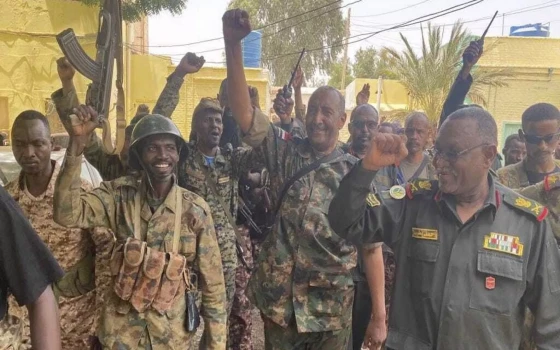
Sudanese Government: No lasting peace in the country without halting foreign interference and the flow of arms; we welcome sincere efforts to end the war imposed on the Sudanese people, who reject any foreign agendas.

- Europe and Arabs
- Tuesday , 29 September 2026 4:55 AM GMT
Khartoum – New York: Europe and the Arabs
Sudanese Foreign Minister Mohieddin Salem stated that his country is open to "any constructive and sincere effort leading to an end to the war imposed on its people"—an effort that achieves peace, preserves the state's unity, territorial integrity, and political independence, and "guarantees that no new armed rebellion erupts."
At the same time, however, he emphasized Sudan's categorical rejection of "any attempts to impose solutions, dictates, or foreign agendas on our people." He affirmed that the Sudanese people "are the ones who determine their own future, free from influence or pressure."
These remarks were made during Minister Mohieddin Salem’s address to the General Debate of the UN General Assembly at its eighty-first session, according to the daily UN news bulletin received on Tuesday morning.
**The Issue of General Al-Burhan’s Visa**
At the beginning of his speech, the Sudanese minister noted that General Abdel Fattah al-Burhan, Chairman of the Transitional Sovereignty Council, had been scheduled to address the General Assembly; however, the host country (of the UN headquarters) failed to issue the entry visa required for him to participate in the High-Level Week proceedings.
He stated that this situation persisted despite efforts made by the UN Secretariat and the Secretary-General’s call for the host country to issue the visa in accordance with its obligations under the 1947 Headquarters Agreement.
Mohieddin Salem called upon the Secretary-General, the UN General Assembly, and the Committee on Relations with the Host Country (the United States) to take the necessary measures to uphold the integrity of the Headquarters Agreement, formally document the incident, and address it through the relevant UN mechanisms. Disarmament and Support for Civilian Protection
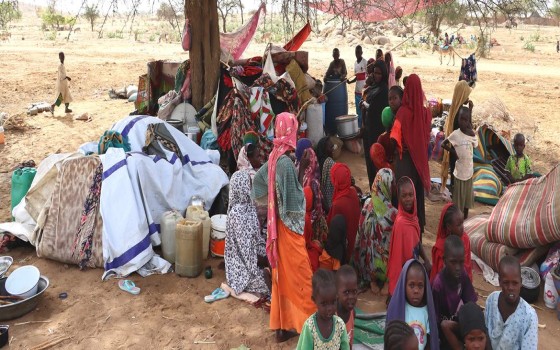
Minister Salem emphasized that a comprehensive, lasting, and just peace in Sudan cannot be achieved without halting foreign interference and the influx of weapons, ammunition, and mercenaries into the country, as well as "dismantling the terrorist militia" and stopping its attacks. He stressed the necessity of disarming the militia and ensuring that arms remain "exclusively in the hands of the State and its legitimate national institutions," while supporting the steady progress the Sudanese government is making in protecting civilians and advancing the peace-building process.
The Sudanese minister stated that "there can be no talk of peace and stability in Sudan" while the war—which he described as "imposed upon the people of Sudan"—continues. He pointed to "foreign interventions targeting Sudan’s strategic location, geopolitical standing, natural resources, and precious minerals."
He criticized what he termed the "silence of the international community" and its failure to take steps to deter the violations and atrocities allegedly committed by the Rapid Support "militia," despite the existence of "documented and credible evidence." He also called for measures to curb the cross-border flow of weapons, military equipment, and mercenaries.
He stated that addressing Sudan's demands in this regard "represents the fastest path to ending the war and protecting civilians in Sudan."
Minister Salem also addressed the situation of civilians, noting that silence regarding the "atrocities" committed by the Rapid Support Forces "amounts to letting down civilian victims—including women and girls who are demonstrating unprecedented resilience in enduring suffering that defies description—as well as the entire nation." **Support for the Personal Envoy’s Efforts**
Minister Salem stated that Sudan has supported the efforts of the Secretary-General’s Personal Envoy, Pekka Haavisto, and has responded to proposals and initiatives aimed at ending the war.
He added that the government also put forward a "wholly Sudanese effort to emerge from the crisis and restore stability and reconstruction," embodied in a roadmap submitted to the Security Council and the Secretary-General in December 2025.
He further noted that Sudan had developed and begun implementing a comprehensive plan to protect civilians, supported by monitoring and implementation mechanisms, with periodic reports submitted to the Security Council and relevant organizations.
**Sudanese-Sudanese Dialogue**
Regarding a political solution, Salem stated that calling for an inclusive Sudanese-Sudanese dialogue—grounded in "national ownership"—to achieve peace represents a key pillar and the optimal path to addressing the current crisis; however, he emphasized the necessity of creating the right conditions for its success.
The Minister outlined several measures he deemed essential, including taking simultaneous, measurable steps to protect civilians, reduce polarization, halt escalation, and bridge the political divide among civilian, political, and military forces, as well as implementing confidence-building measures to lend credibility and legitimacy to the dialogue. He also emphasized the need for the dialogue to be conducted with "purely Sudanese will," free from external interference, bargaining, and intimidation. Furthermore, he called for the implementation of the provisions of the Jeddah Declaration between the Armed Forces and the Rapid Support Forces—including fundamental obligations under international humanitarian law, the facilitation of humanitarian operations, the meeting of the needs of civilians and those affected, and the assurance of safe and voluntary passage for civilians leaving areas of hostilities.




No Comments Found