

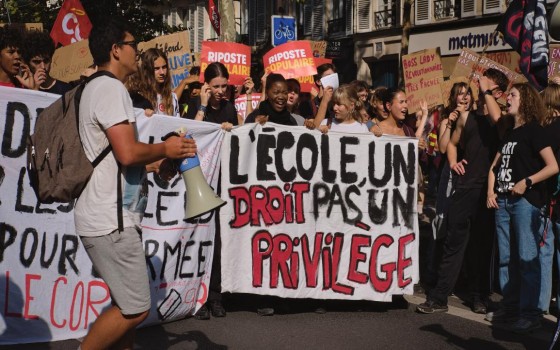
France: Vandalism and violence mark student protests over overcrowded classrooms, teacher shortages, and poor facilities. Spain: Labor unions move toward a general strike in response to the housing crisis and low wages.

- Europe and Arabs
- Tuesday , 6 October 2026 4:42 AM GMT
Paris–Madrid: Europe and the Arabs
Student protests erupted in Paris in mid-September before spreading across the country, with some demonstrations escalating into violent clashes with the police.
When students from a school in the Créteil suburb, southeast of Paris, joined their teachers in a protest demanding more resources and staff, they did not anticipate that their initiative would evolve into a nationwide movement. According to the Brussels-based European news network "Euronews":
The campaign launched on September 17 and quickly gained momentum as videos of the protests circulated on social media. This prompted students across France to join the movement, demanding government action on issues such as classroom overcrowding, teacher shortages, and poor facilities, among other grievances.
More than two weeks after the initial protest, student unions called for rallies on Tuesday as part of a broad day of action. Meanwhile, hundreds of schools closed their doors—either fully or partially—on Monday after authorities determined that necessary safety conditions could not be met.
Clashes, Vandals, and Police
While many demonstrations remained peaceful, others saw acts of violence and rioting on their fringes, involving confrontations with law enforcement. According to the French Interior Minister, more than 5,060 arrests have been made—with minors accounting for 87% of them—while over 170 students, 78 school staff members, and more than 600 police officers have been injured since the unrest began.
Schools across various regions of France have suffered damage, arson, and looting, while some protests saw rioters infiltrating the ranks of the demonstrators.
In the northern city of Lens, a 15-year-old boy was injured on Monday by a police-fired grenade, resulting in the amputation of his hand, according to reports. Prosecutor Étienne Thieffry told the press that it was not yet possible to determine with certainty "whether the teenager picked up the grenade" or if it had been thrown at him.
In the central city of Tours, the family of a 16-year-old student filed a complaint against the police on Sunday alleging violence, after the boy lost sight in his right eye in the preceding days. According to the public prosecutor's office, his injuries suggest he may have been struck by a police-fired rubber bullet; investigations have been opened into both incidents.
Amid these developments, the French Human Rights League (LDH) condemned what it described as a "wholesale departure from the rule of law and a disregard for legal frameworks" during police interventions involving students.
Nathalie Tehio, the organization's president, stated at a press conference on Monday that international law is not merely being "ignored" but "completely trampled upon." Meanwhile, Stanislas Gaudon, spokesperson for the Alliance Police Nationale—one of France’s major police unions—told Euronews that security forces remain focused on ensuring safety in the vicinity of schools.
He added, "When acts of violence and the use of force occur, the question becomes one of determining proportionality and the legitimacy of the action."
He continued, "If force is used against individuals who have fired upon police officers or thrown acid at them, then resorting to force to disperse them becomes necessary. I dislike using terms like 'suppressing' or 'silencing' student protests; that is not the issue. If there is no public disorder, then there is no justification for law enforcement to use force."
Political Debate Heats Up
As the unrest continues, politicians have stepped into the crisis, intensifying pressure on the government to find a solution and address the students' demands.
Against this backdrop, Education Minister Édouard Geffray held a meeting on Friday with education unions and school staff, attended by representatives of parents' associations. That same day, French Justice Minister Gérald Darmanin stated that violent incidents had affected 735 of France's 3,700 schools "in one way or another." Two days later, French Minister of the Armed Forces Sébastien Lecornu announced a five-point government action plan. He reaffirmed the executive branch's commitment to preventing the cancellation of classes, improving infrastructure and facilities in cooperation with local authorities, better organizing the school day, and increasing the transparency of the "Parcoursup" university admissions platform, alongside a general pledge to support students.
Meanwhile, the radical left expressed strong support for the protests; Jean-Luc Mélenchon, leader of the "France Unbowed" (*La France Insoumise*) party, stated on Thursday: "What we want is for the country's youth to emerge from this period with their heads held high."
However, this stance drew criticism from his opponents, who accused him and his party of inciting young people and exploiting them for political gain. Mélenchon maintains that his party supports the movement without organizing it and is keen to ensure it remains peaceful.
"Schools in Crisis"
Amid the controversy surrounding the protests, Jean-Rémi Girard—a teacher and head of the National Union of Teachers in Schools and Universities (SNALC)—warned against the dangers of politicizing the demonstrations.
Speaking to Euronews, he said: "We must be extremely careful not to turn what is happening—regardless of the political faction involved—into a political tool, because that is extremely dangerous." He emphasized the need to look after and protect those working in the sector, adding: "We are out there in the field, and we need to be cared for and protected. The profession already suffers from low interest and difficulty in attracting qualified talent; if we lack protection on top of that, finding teachers in the coming years will become even harder."
His remarks came as a teacher was also doused with gasoline on Friday during a protest near a school in southern France, while a 16-year-old student was placed in custody pending investigation. According to Gérard, the students' demands are not new; he explained: "We are increasingly struggling to cover for teacher absences, and French classrooms are among the most overcrowded in Europe; furthermore, they are ill-equipped for heatwaves. These are issues we have known about for a long time." He emphasized that "the starting point is that the school system is in crisis—and has been for a long time"—though he also stressed that only a small minority of individuals are behind many of the most severe acts of violence.
"They come here to cause trouble; I’ve seen it with my own eyes," he said.
Faced with the risk of escalation, he explained that a group of his colleagues were standing outside the school to speak with students and try to prevent the situation from deteriorating, adding: "Anything can happen; the atmosphere can shift completely in just five minutes. We are familiar faces to the students, and we have an established relationship with them that we want to maintain through ongoing dialogue."
Spanish trade unions move toward a general strike in response to the housing crisis and low wages.
The call for a strike follows a weekend marked by protests in more than 50 Spanish cities. In Madrid, thousands demonstrated on Saturday under the slogan "Towards a General Strike," while further actions continued on Sunday in various other cities. Spain’s two major trade unions, the General Union of Workers (UGT) and the Workers' Commissions (CCOO), have announced an agreement to call a 24-hour general strike this autumn. The strike aims to demand decent wages that allow workers to afford housing costs; the specific date has yet to be finalized and will be determined in coordination with social organizations and the "Tenants' Union."
In a joint statement, the unions explained that the strike date would be discussed with social organizations and the Tenants' Union. The goal is to mobilize workers to participate in this 24-hour work stoppage to defend the right to housing and demand wages sufficient to cover housing expenses.
This move by the UGT and CCOO follows their announcement on Friday, made after the Spanish Parliament (Congress) rejected housing decrees that had been issued with the force of law.
The unions aim to bring the workforce into the heart of the movement demanding the right to housing, coordinating with social movements, neighborhood committees, and tenants' associations.
The call for a strike follows a weekend of protests across more than 50 Spanish cities. In Madrid, thousands demonstrated on Saturday under the slogan "Towards a General Strike," while protests continued in various cities on Sunday.
The UGT and CCOO link the housing crisis to wage trends and are demanding measures that include establishing a public sector for permanent social housing, capping rental prices, and effectively implementing the Right to Housing Law across all regions. The two organizations also include the issue of housing within the framework of collective bargaining; their proposal for the so-called "Sixth Agreement on Employment and Collective Bargaining" includes wage increases ranging from 4 to 7 percent, alongside clauses for wage reviews and measures to facilitate access to housing.
Through this strike, the two unions aim to mobilize workers and call upon public administrations and employers' organizations to adopt measures ensuring that wages enable access to housing.





No Comments Found