

Climate Conference: Extreme Weather, Climate Finance, Clean Energy, and Protecting Communities — Key Challenges for Representatives from 200 Nations in Antalya, Turkey

- Europe and Arabs
- Tuesday , 10 November 2026 8:4 AM GMT
Antalya, Turkey – Europe and the Arabs
Representatives from nearly 200 countries have arrived on the Turkish Mediterranean coast to participate in a climate conference, which, this time, focuses on reaching practical decisions. With the El Niño phenomenon expected to intensify and extreme weather events set to worsen, negotiators face challenges regarding climate finance, clean energy, and the protection of communities already suffering from the impacts of climate change—as noted in the United Nations’ daily news bulletin on the COP31 conference.
The conference began yesterday, Monday, under Turkey’s presidency. The city of Antalya is hosting over 90,000 participants for a series of events scheduled to conclude on Friday, November 20.
Australia—which is presiding over the negotiations—is pushing for an early agreement, urging nations to begin drafting a political accord at the very start of the conference rather than waiting until its final days.
Finance remains a point of contention; developing nations are demanding faster access to climate funding. Meanwhile, clean energy, climate change adaptation, and a "just transition" for energy systems and economies top the agenda.
The conference places a strong emphasis on the human impact of climate change. A dedicated day for food, agriculture, and health will highlight growing risks and practical solutions.
The Mediterranean city of Antalya boasts a long history, with the Greeks, Romans, Byzantines, and Ottomans all having left their mark on this stretch of Turkey’s southern coast. Today, as nearly 200 nations gather for the UN Climate Change Conference (COP31), the question arises: can these countries translate decades of climate pledges into concrete action?
Inside the sprawling conference venue, the Turkish tulip—featured in the COP31 logo—is visible everywhere, while participants navigate long corridors leading to national pavilions and negotiation halls.
Beyond the conference halls, the challenges are mounting as the impacts of extreme weather events intensify globally. Meanwhile, governments face mounting pressure to demonstrate that their climate commitments can yield tangible results.
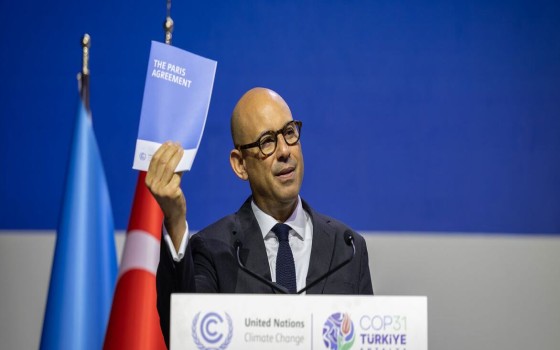
During Monday’s opening session, Simon Stiell, Executive Secretary of the UN Framework Convention on Climate Change (UNFCCC), stated that the progress made thus far falls far short of what is required—both in scale and in terms of equity. He urged nations to move beyond merely setting targets and to accelerate the implementation of solutions that can make a real-world difference.
"No COP is a silver bullet," he added. "A single conference cannot bridge the gap between science and reality."
A Test for Negotiators
Unlike previous climate conferences that focused on reaching a single, landmark agreement, the primary focus of COP31 is to transform existing commitments into actual, on-the-ground action. Turkish Minister of Environment Murat Kurum has officially assumed the presidency of the conference, while Australian Minister for Climate Change and Energy Chris Bowen is overseeing the negotiations—an unconventional co-presidency arrangement agreed upon during the previous climate summit, COP30.
"Our decisions must be reflected in urban infrastructure, on farmers' land, and along factory production lines," Kurum told the delegates. "Families should feel the impact through lower energy bills."
Bowen announced plans to develop a presidency-led resolution throughout the course of the conference, rather than waiting until its final days. This move aims to secure agreement on practical measures to accelerate climate action, even as disagreements persist regarding the level of ambition that should be embedded in the final resolution.
Finance is expected to be one of the most challenging issues on the table, with developing nations demanding faster access to the financial resources required for climate adaptation and the support of clean development. Negotiators must also make progress on agreements concerning emissions reductions and a "just transition."
"We know there are differing views on the value of the resolution, its components, and how far we can go," Bowen explained. "But our task is to work toward narrowing these gaps and reaching the most ambitious, results-oriented resolution that consensus allows."
When climate change becomes a health emergency
Monday was also designated as Food, Agriculture, and Health Day, highlighting the growing impacts of climate change on human health. According to the World Health Organization, between 3.3 and 3.6 billion people live in areas highly vulnerable to climate change. Rising temperatures, floods, and shifting weather patterns pose risks to human life and place increasing strain on health systems worldwide.
Speaking at a press conference organized by the World Meteorological Organization (WMO), Alan Dangour of the Wellcome Trust stated: "The main character in this story is not the atmosphere, the land, the oceans, or the ice. It is us—you and me, our families, and our communities." He urged negotiators to place people at the heart of their decision-making.
"We cannot adapt to a future in which no action is taken to curb climate change," Dangour warned.
Rising temperatures are a particularly concerning example; scientists are increasingly worried about their link to premature births and stillbirths, while outdoor workers, children, and the elderly face specific risks.
Joy Shumake-Guillemot, from the World Meteorological Organization, explained to UN News how meteorologists and health specialists are collaborating to mitigate some of these risks.
Through a joint initiative with the World Health Organization, climate data is being integrated into public health planning. For instance, forecasts of dangerously high temperatures can help hospitals prepare for an influx of patients, while projections regarding rainfall and seasonal shifts enable health authorities to anticipate outbreaks of diseases such as malaria. "Meteorological information is highly practical and directly relevant to decision-making in the health sector; yet, those working in this field often lack access to it," she stated.
Shumake-Guillemot added, "From a public health perspective, virtually all heat-related deaths are, in fact, preventable."
Health is one of ten priority areas on the climate conference agenda. Nations are being urged to implement the Belém Action Plan on Health—agreed upon during COP30—and a new "Antalya Initiative" is being launched to strengthen resilience within the health sector.
Agriculture: From Emissions to Solutions
The food and agriculture sector accounts for approximately one-third of global greenhouse gas emissions. At the same time, the sector is profoundly affected by climate change, with rising temperatures, droughts, and floods threatening crops and the livelihoods of millions of farmers.
Agriculture can also be part of the solution. Christian Paraswita, from the World Rural Forum, told UN News that farmers have already begun adopting various adaptive practices. In Fiji, for instance, families are experimenting with different crop varieties and exploring ways to protect seedlings from increasingly intense cyclones.
The role of farmers is also under discussion at the current climate conference in Antalya, where countries are reviewing the Sharm el-Sheikh Joint Work on Agriculture and Food Security and deliberating on the next steps.
For Paraswita, the priority is to ensure that family farmers are involved in shaping climate policies and that they gain access to the funding necessary to adapt to climate change. He explained that complex procedures and a multitude of intermediary entities make accessing international climate finance difficult, especially for small-scale agricultural organizations.
With the El Niño phenomenon expected to intensify in the coming months, Paraswita emphasized that farmers need support now—not after years of planning and paperwork.
His remarks align with several key issues that emerged during the conference’s opening day, as UN agencies also issued stark warnings regarding the potential impacts of El Niño.





No Comments Found