

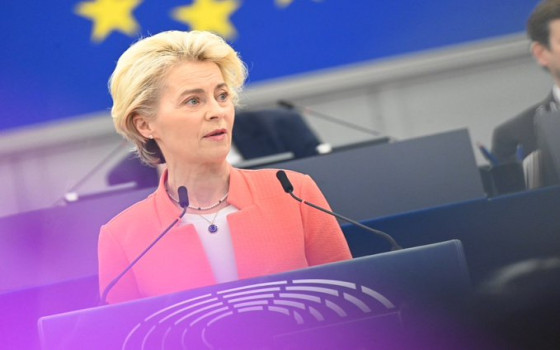
Von der Leyen in a speech entitled “Strengthening European defense in a volatile geopolitical landscape: The illusion that peace is permanent has been shattered...and Europe must wake up as soon as possible.”

- Europe and Arabs
- Wednesday , 28 February 2024 16:13 PM GMT
Brussels: Europe and the Arabs
European Commission President Arussula von der Leyen said in her speech this morning at the plenary session of the European Parliament on strengthening European defense in a volatile geopolitical landscape that it is time for Europe to step up. To defend our interests and values ourselves. To reduce our dependence on energy, key technologies and defence. We need to start working on the future of our security architecture, including all these dimensions. She added that in recent years many European illusions have been shattered. The illusion that peace is permanent. The illusion that economic prosperity may be more important to Putin than the destruction of a free and democratic Ukraine. The illusion that Europe was doing enough on its own regarding security – whether economic or military, traditional or cyber. When we look around us, it is clear that there is no room for more illusions. Putin used the peace gains to prepare for his war. As a result, the world has become as dangerous as it has been for generations. Russia's brutal war of aggression against Ukraine is now in its third year, and more entrenched and intense than ever. We are witnessing the power and dangers of a growing and alarming nexus of autocrats. North Korea makes order after order of ammunition shells to Russia. Iran provides attack drones, and the technology behind them, to inflict untold damage on Ukrainian cities and citizens. The ongoing war in Gaza and widespread destabilization in the Middle East point to an era of insecurity and conflict in the region and beyond. Of course, we are witnessing a continuing rise in fierce economic competition and distortion, which brings with it some real European security risks. So, frankly, as outgoing Finnish President Niinisto said last month: “Europe has to wake up.” I would add: urgently. Because there is a lot at stake here – our freedom and our prosperity. We have to start acting like it. We have to start working on the future of the European security architecture. In all its dimensions and with all the speed and political will required. Because the truth is that we have not only been living in conflict since 2022, but for much longer. Threats to our security, prosperity and way of life come in many forms. Some are clear, some are more blurry on the surface. From addressing political interference, to reducing our dangerous dependencies – a policy I have called “de-risking.” Or whether that be eliminating hostile actors from our critical infrastructure. We Europeans must be prepared. And it's not just about defeating bullies on the battlefield, but throughout our society. It will be a joint effort. But I am confident that we will meet this challenge.
The good news is that we've already started a lot of this work. The truth is that recent years have not only served to shatter some European illusions. But it also shattered many illusions about Europe. Our unity will not withstand a war on our continent. Or that our rules and divisions would hinder us from providing massive financial, military, and political support. Over the past two years, Europe has shown that it will support Ukraine no matter what it takes. We have also shown that a more sovereign Europe is not just wishful thinking.
At this point, let me be clear: European sovereignty will make our partnerships stronger. This will never compromise the importance and need of our NATO alliance. Indeed, a more sovereign Europe, especially in the field of defence, is crucial to strengthening NATO. That is why I am happy about the news that Sweden will soon become a NATO ally. I would like to congratulate Sweden, under the leadership of Prime Minister Kristersson, on this historic step for this country and for our common security. At its core, European sovereignty is about taking responsibility for what is vital, even existential, to us. It is about our ability and willingness to defend our interests and values ourselves. This is what the leaders agreed upon with the Versailles Agenda immediately after the start of the war to reduce our strategic dependence in vital areas such as energy, key technologies, economic capabilities, and of course defense.
Member States have stepped up. Just last week, the ASPEDS naval mission was launched to protect against the direct threat to freedom of navigation. Freedom of navigation that forms the cornerstone of global trade in one of the world's most important waterways. Member states have increased their defense spending as well. National defense budgets have already increased by 20% compared to last year. NATO has just announced that it expects 18 of its member states to be able to exceed their defense spending target of 2% this year. This is up from just 3 members a decade ago. Together we are now spending more money jointly on joint European capabilities and projects. The European Peace Facility has mobilized €6.1 billion to support the Ukrainian Armed Forces with lethal and non-lethal military equipment and supplies. The European Defense Fund invests in cutting-edge defense capabilities in vital areas such as sea, land and air combat, space-based early warning and cyber. We have taken major steps forward decisively in developing our defense industrial and manufacturing capabilities. In the coming weeks we will announce award decisions under the ASAP programme. This funding will enable us to almost double European ammunition production to more than two million shells per year by the end of 2025.
All this progress shows that Europe is beginning to realize the urgency and scale of the challenge Which awaits us. But there is a lot to do. We need to act quickly. The threat of war may not be imminent, but it is not impossible. The risks of war should not be exaggerated, but we should be prepared for them. This begins with the urgent need to rebuild, renew and modernize the armed forces of member states. In doing so, Europe must strive to develop and manufacture the next generation of operational capabilities capable of winning the battle, and ensure that it has the sufficient material and technological superiority that we may need in the future. This means strengthening our defense industrial capabilities in the next five years.
At the heart of this must be a simple principle: Europe must spend more, spend better, and spend Europeans. We will put forward some proposals in the coming weeks regarding the first ever European Industrial Defense Strategy. One of the main objectives of this strategy, and the European Defense Investment Program that will come with it, will be to prioritize joint defense procurement. Just as we did with vaccines or natural gas. This will help us reduce fragmentation and increase interoperability. But to do this, we must collectively send a strong signal to the industry. This is why we will look at how we can facilitate purchase agreements or advance purchase agreements where we provide guarantees. This would give our defense industry companies stable demands and long-term predictability.
We will increase support for industrial intensification, as we are doing now with ammunition through the ASAP programme. We will identify European defense projects of common interest, to focus efforts and resources where they will have the greatest impact and added value. We will focus on innovation to ensure that Europe gets that advantage in new technologies, which we see spreading around the world in different conflicts. This must be a real European effort. That is why I am proud to announce that we will establish a Defense Innovation Office in Kyiv. This would bring Ukraine closer to Europe than ever before and would enable all Member States to benefit from Ukraine's battlefield experience and expertise in defense industrial innovation.
Taking this defensive move won't be easy. It will require bold decisions and political courage. It will above all require a new European defense mindset, from institutions to industry to investors alike. That is why I am very encouraged by President Calviño's words that the EIB is ready to do more to contribute to joint projects that strengthen the European defense industry. I call on Member States to support this proposal. Europe's defense industry needs access to capital. I would encourage public and private lenders to support our defense industry especially SMEs. Also in defence, SMEs are the backbone of our industry. They are the engine of innovation and a decisive factor in the single market. The topic requires full attention. That is why I personally support the appointment of a Defense Commissioner for the next committee.
And then I would like to think bigger. It is time to start a conversation about using windfall profits from frozen Russian assets to purchase joint military equipment for Ukraine. There can be no greater symbol and no greater benefit than this money to make Ukraine and all of Europe a safer place to live. Ultimately, it is about Europe taking responsibility for its security. The simple truth is that we don't have the luxury of rest. We have no control over elections or decisions in other parts of the world. We simply do not have time to get around this issue. With or without the support of our partners, we cannot allow Russia to win. The cost of insecurity – the cost of Russian victory – is far greater than any savings we can make now. That is why it is time for Europe to step up. She concluded by saying, "Long live Europe."




No Comments Found