
President of the European Commission: The upcoming Brussels summit will focus on the situation in the Middle East, defense and expansion

- Europe and Arabs
- Tuesday , 12 March 2024 15:44 PM GMT
Brussels: Europe and the Arabs
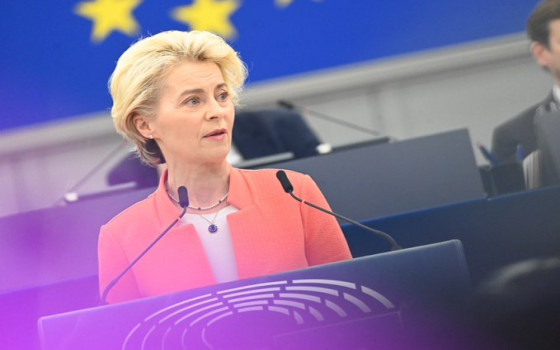
European Commission President Ursula von der Leyen delivered a speech this morning before the European Parliament about preparations for the next European summit scheduled in Brussels on March 21 and 22. She said in the speech, “We are heading toward a crowded European Council, with topics ranging from Ukraine to the Middle East, and from defense to enlargement.” I want to focus today on two topics: one is the Middle East and the other is enlargement. As we speak now, a ship is sailing from Cyprus to northern Gaza. It is carrying the basic kind of humanitarian aid, which is also what is most needed today: food, plain and simple food for a population that They are facing a humanitarian catastrophe. This sea corridor is the result of unprecedented international cooperation led by President Nikos Christodoulides. We have worked hand in hand not only with Cyprus, but also with the United Arab Emirates, the United States and the United Kingdom. I was in the port of Larnaca a few days ago to witness the final preparations before Departure of the ship. It is as impressive as it needs to be. When this sea corridor is fully operational, it can ensure a sustained, orderly and robust flow of aid to Gaza. This is the first time a ship has been allowed to deliver aid to Gaza since 2005. Finally, it is Serving as an additional lifeline for the people of Gaza.
The situation on the ground has become more dramatic than ever and has reached the point of no return. We have all seen reports of children starving to death. This cannot be. We must do everything we can to stop it. Everyone knows how difficult it is to move aid into and within Gaza. All methods must be used to reach people in need. Here comes the role of the sea corridor. It can crucially help increase the amount of aid that effectively reaches people in northern Gaza. The United States will now work to establish a floating port to unload the cargo of large ships. Until this is ready, we are working with smaller vessels. The United Arab Emirates and other partners will participate in financing the shipment. Cyprus will operate departures at Larnaca port. We, in the European Union, will intensify our logistical support on the ground. There is a European Union coordination team in Cyprus. We will finance and coordinate the flow of European goods through this corridor.
In parallel, several countries, including some Member States, began airdropping humanitarian aid from Jordan to Gaza. Today, I can announce that we have activated the EU Civil Protection Mechanism to strengthen our support. I encourage all Member States to contribute their assets, from parachutes to containers, to allow a stable and meaningful supply of aid to Gaza.
This year alone, the European Commission has allocated €250 million in aid to the Palestinians. But aid must reach civilians in need. Delivery on the ground is a major challenge. At the end of last February, the World Food Program was forced to end its operations in the northern Gaza Strip, due to the security conditions. Aid is now often distributed independently by residents. We've all seen the dramatic images. We must ensure the safe distribution of aid inside Gaza. This makes it even more important to work with those agencies that still have a presence on the ground. This is the case with UNRWA. We all know about the serious allegations made against UNRWA staff in January. That is why we decided to evaluate our funding decisions in light of the actions taken by the United Nations and UNRWA in response to these allegations. The United Nations has since conducted an internal investigation and established an independent review group led by Catherine Colonna. UNRWA also agreed to an audit by external experts appointed by the European Union. As a result, we will initiate a payment of €50 million to support UNRWA. The following slides will be released once the agency takes the other steps we have agreed together. All this with one simple goal: that every euro we invest is spent according to our rules and reaches Palestinians in need.
But in the current circumstances, aid alone will not solve the crisis. Of course, Israel has the right to defend itself and fight Hamas. But the protection of civilians must be guaranteed at all times, in line with international law. Currently, there is only one way to restore adequate flow of humanitarian aid. The people of Gaza need an immediate humanitarian truce that would lead to a sustainable ceasefire. And they need it now.
Let's keep in mind that the risk of further escalation is real. The situation on the Israeli border with Lebanon remains volatile. Iran - Hamas' sponsor - has continued to stoke regional tensions, for example, through its support for Houthi terrorists in Yemen. As we know they continue to fuel Russia's war against Ukraine. Let me add that we are prepared to respond with additional sanctions, should Iran supply ballistic missiles to Russia, as was recently reported. Without a permanent ceasefire, the contagion of the Gaza war could spread throughout the region. This is the time to redouble our efforts, together with Member States. So that the hostages can return to their homes. The people of Gaza can receive not only humanitarian relief, but also a glimmer of hope for a two-state solution.
The second topic I would like to address is the expansion of membership, with a focus on the Western Balkans. In these years, we have changed our approach to the region. We realized that it is not enough to wait for the Western Balkans to come closer to us. It is not enough to say that the door is open. We must also take responsibility and support their path toward our union in any way we can.
That is why we have developed the Western Balkans Growth Plan. That is why we opened accession negotiations with Albania and North Macedonia, and that is why we committed to doing the same with Bosnia and Herzegovina. Today, we, the Commission, present a report on the progress achieved by Bosnia and Herzegovina. It is a realistic analysis of the latest developments. It paints a very clear picture
Since we were granted candidate status, Bosnia and Herzegovina has made impressive steps forward. More progress has been made in just over a year than in over a decade. First, Bosnia and Herzegovina is now fully aligned with our foreign and security policy, which is crucial in these times of geopolitical turmoil. Second, the country is adopting important laws, such as the Conflict of Interest Prevention Law, which has been stalled for seven years and has now been adopted; The Anti-Money Laundering and Combating the Financing of Terrorism Law. Third, the management of migration flows continues to improve, as negotiations on the Frontex Agreement are now ready to begin following the Presidency's approval of the negotiating framework. Fourth, the Ministry of Justice agreed to include the judgments of the International Criminal Tribunal for the Former Yugoslavia in domestic criminal records. Fifthly, with regard to dialogue and reconciliation, a new peacebuilding steering committee has just begun its work.
Of course, it is necessary to make further progress to join our union. But the country is showing that it can meet its membership standards, and the aspirations of its citizens to become part of our family. For this reason, today we will decide to recommend to the Council the opening of accession negotiations with Bosnia and Herzegovina.
The message coming from Bosnia and Herzegovina is clear. So our message must also be clear. The future of Bosnia and Herzegovina lies in our union




No Comments Found