
Concurrently with the launch of the Peace Council, the humanitarian crisis in Gaza worsens amid Israeli violations.

- Europe and Arabs
- Friday , 23 January 2026 7:10 AM GMT
Gaza – New York: Europe and the Arabs
The ceasefire agreement in the Gaza Strip entered its 106th day, coinciding with US President Donald Trump's announcement from Davos of the launch of the new "Peace Council." Initially focused on Gaza, the council's mandate was not limited to this issue, a move that appeared to have a broader international dimension.
During the Davos Forum, the United States unveiled plans to rebuild what it called "New Gaza," as part of efforts to bolster the ceasefire, which has been strained by repeated Israeli violations, according to Palestinian sources.
Meanwhile, Hamas condemned Israeli Prime Minister Benjamin Netanyahu's inclusion in the council, while European Council President Antonio Costa stated that European leaders have "serious doubts" about the scope of the "Peace Council's" work, while expressing their willingness to cooperate with the United States and the new council regarding Gaza.
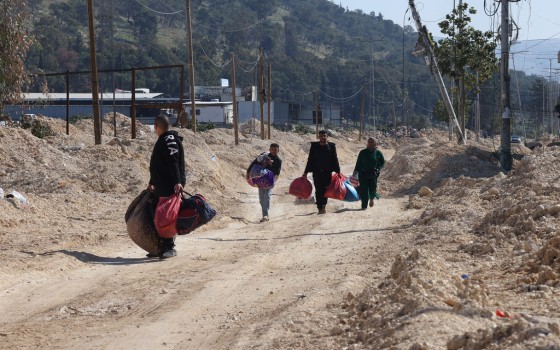
On the ground, the Israeli army continues to target several areas in the Strip, amid a worsening humanitarian crisis due to a severe cold wave and ongoing restrictions on aid deliveries. According to the European news network Euronews in Brussels,
On the humanitarian front, Ali Shaath, head of the technocrat committee in Gaza, announced that the Rafah crossing between Gaza and Egypt would reopen next week. While Tel Aviv had linked the reopening of the crossing to the return of the body of Israeli soldier Ran Gavili, held in the Gaza Strip, the Israeli newspaper Yedioth Ahronoth quoted an Israeli official confirming that the crossing would not reopen before the body was recovered. Later, an Israeli political source stated that the issue of reopening the Rafah crossing would be discussed at a cabinet meeting early next week, in parallel with discussions on the Gavili case.
Meanwhile, the United Nations Office for the Coordination of Humanitarian Affairs (OCHA) stated that residents throughout Gaza are struggling to meet their basic needs due to ongoing restrictions on expanding humanitarian aid.
The United Nations Population Fund (UNFPA) also reported an increase in the risks of gender-based violence, child marriage, and the exploitation of women and girls. The fund noted that damage to health facilities, safe spaces, and clinics, coupled with displacement, movement restrictions, and flooding, has severely limited access to psychosocial support and medical care, according to the UN Daily News.
OCHA reported that UN partners providing emergency shelter assistance reached more than 13,000 families between last Sunday and Wednesday, distributing hundreds of tents and plastic sheeting.
It confirmed that partners are also continuing to distribute mattresses, sleeping bags, blankets, warm clothing, cooking utensils, and solar lamps.
OCHA quoted partners managing the sites as saying that, due to capacity and funding constraints, they are currently only able to provide support to approximately 40% of the 970 displacement sites across Gaza. The Situation in the West Bank
Regarding the situation in the West Bank, the Office for the Coordination of Humanitarian Affairs (OCHA) reported that more than 100 Palestinian Bedouin and herding families from five communities in the central West Bank were displaced in just two weeks, between January 6 and 19.
OCHA added that this displacement was due to ongoing settler attacks, threats, and intimidation, explaining that these attacks prevented residents from accessing their homes, grazing lands, and water sources.
The United Nations Population Fund (UNFPA) reported on Wednesday that ongoing Israeli military operations, along with settler violence and movement restrictions, continue to impede access to schools, workplaces, markets, and healthcare.
The agency estimates that more than 230,000 women and girls, including nearly 15,000 pregnant women, face difficulties accessing reproductive health services due to the escalating violence. This came after the head of the Independent International Commission of Inquiry on the Occupied Palestinian Territory, including East Jerusalem, and Israel, affirmed the commission's independence, emphasizing that it aims to investigate all violations, whether in Palestine or Israel, adding, "We undertake this task with a deep sense of responsibility and optimism."
This came during the commission's first press conference in its new composition, held in Geneva on Thursday, where its new chair, Srinivasan Muralidar, said: "This commission seeks to be a human-centered commission. We want to hear the voices of people in both Israel and Palestine, and we are engaging with them to hear their stories and grievances, and we will do our utmost to investigate each and every one of them."
He affirmed that the commission's work will continue with dedication and steadfastness, guided by its unique and strong mandate, "the important work done by our predecessors," and the shared belief that human rights and accountability are the foundation of peace and justice. He stated that in the coming months, the Commission would engage with the State of Israel and the State of Palestine, as well as Israeli and Palestinian civil society organizations, "to listen to and learn from those who live the reality on the ground," emphasizing that their voices would guide and enrich the future direction of their work.
He spoke of hope amidst resilience and the tireless pursuit of international justice, adding, "Our responsibility is to translate this hope into action by seeking the truth, promoting accountability, and contributing to ending the cycles of violence and suffering for both Palestinians and Israelis."
Florence Mumba, the Commission's newest member (from Zambia), said that after reviewing previous Commission reports, "I realized that this is a tremendous responsibility because we need to examine the situation of the conflict, look at the people, listen to them, analyze the evidence, and ensure that the evidence on which our reports are based is credible."
She expressed her hope that they would be able to continue the work begun by their predecessors, "so that this Commission remains credible and trustworthy."
For his part, Committee member Chris Sidoti, who has served on the Committee since its previous term, emphasized that he has no illusions about the difficult task ahead.
He said, "It is tragic that events on the ground in Israel and Palestine make the continued existence of this Committee essential, and its work vital, even if it is extremely difficult."
Killing of journalists and raid on UNRWA compound
In response to journalists' questions about the Gaza peace plan (welcomed by Security Council Resolution 2803) and the peace council announced by US President Donald Trump, the Committee Chair said, "We expect the peace plan to take into account the interests of all residents in the conflict zone, and we do not see anything in it that would impede the work of this Committee. We expect full cooperation from all authorities in both territories, Israel and Palestine."
Also in response to journalists' questions, Committee member Chris Sidoti commented on the Israeli authorities' demolition of the UNRWA compound in East Jerusalem, saying, "Israel should think very carefully before rejecting the work done by UNRWA—important work that relieved Israel of its obligations." He stressed that there would be human rights consequences. He noted the fundamental rights provided by UNRWA, including the highest attainable standard of mental health, livelihoods, and the right of children to education.
Committee member Florence Mumba commented on the killing of journalists in conflict zones, saying, "When you kill a journalist, it means you have something to hide." She expressed concern about the obstruction of journalists' work.
The United Nations Independent International Commission of Inquiry on the Occupied Palestinian Territory, including East Jerusalem, and on Israel was established by the UN Human Rights Council on 27 May 2021 "to investigate, within the Occupied Palestinian Territory, including East Jerusalem, and within Israel, all alleged violations of international humanitarian law and all alleged violations and abuses of international human rights law that occurred before and since 13 April 2021." Resolution A/HRC/RES/S-30/1 also requested the Commission of Inquiry to "investigate all the root causes underlying the recurring tensions, instability and protracted conflict, including systematic discrimination and oppression based on national, ethnic, racial or religious identity."




No Comments Found