
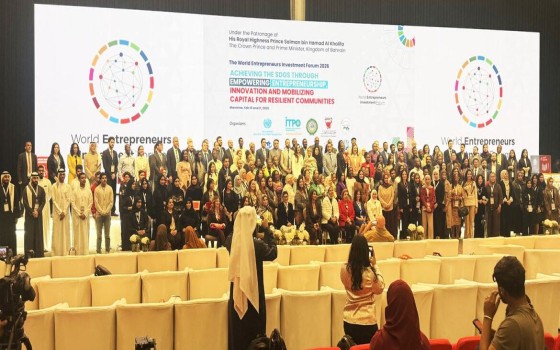
At the conclusion of the Bahrain Entrepreneurs Forum, the "Manama Declaration" was issued, emphasizing youth as partners in global economic transformation and calling for an end to conflicts and the achievement of sustainable peace.

- Europe and Arabs
- Thursday , 12 February 2026 7:34 AM GMT
Manama – Europe and the Arabs
The Global Entrepreneurship and Investment Forum concluded its work in Bahrain with the issuance of the "Manama Declaration," which placed youth at the heart of economic transformation as active partners, not just beneficiaries. The declaration emphasized the need to empower women and promote integration between the green, blue, and orange economies. The closing ceremony included the awarding of the UNIDO Prize winners for 2025, according to the UN News Daily.
The closing day's events featured dialogue sessions and panel discussions on a variety of topics, including a panel entitled "Voices of the Future: Youth Speak Out," with the participation of young men and women from Egypt, Palestine, Syria, Jordan, Bahrain, Sudan, Kenya, and Mali.
Palestinian youth Ahmed Diriya participated, representing his country's youth. In an interview with UN News, Diriya stated that he is implementing a project on the ground that contributes to strengthening Palestinian industry. He noted that the proceeds from the manufactured products go to support a fund for needy students in Palestine, helping them pay their tuition fees. He said that participating in the Global Entrepreneurship and Investment Forum was "extremely important and effective, and has greatly contributed to developing my skills, knowledge, and ideas. I try as much as possible to transfer the knowledge I learned here to Palestinian youth."
In response to a question about the future of entrepreneurship in Palestine under the current circumstances, Mr. Ahmed said: "We cannot deny that the political and security situation on the ground is difficult. But despite all the circumstances, I believe we have an opportunity, and we, as young people, are trying, as much as possible, to play our roles in improving people's conditions and increasing opportunities for young men and women. At the same time, we are strengthening their role by enhancing their skills and knowledge in the field of entrepreneurship."
Innovative Solutions for Global Challenges
The UNIDO Global Award, also known as the "Global Call," was launched in 2020 and is celebrating its sixth edition this year. It is UNIDO's flagship annual event, recognizing companies that offer innovative solutions to global challenges.
Through this event, UNIDO identifies technologies that can be leveraged to achieve sustainable industrial development in developing countries, while companies showcase their technical expertise and innovations on the international stage, thus contributing to the achievement of the Sustainable Development Goals.
This year's UNIDO competition was themed "The Creative Orange Economy: Innovating the Future." It included four categories:
Trade and Heritage in the Orange Economy
Environmentally Friendly Production
Digital Innovation
A special student track, introduced for the first time at the Global Call for Innovation, hosted university and high school students to present their ideas for potential awards. The event organizers stated that this year's Global Call for Innovation received over 800 applications from around the world.
Winners from Bahrain, Sudan, and Tunisia
In the Cultural Heritage category, the Bahraini non-profit organization "Art Station" won first place. Sudanese fashion designer Hiyam Hamida won second place. Third place went to Sarah Jumaa from Tunisia for her project specializing in reviving Tunisian craft motifs using silver and natural materials.
In the Cultural Heritage category, the organization "Art Station" won first place. In an interview with UN News, Hiyam Hamida expressed her delight at the honor, noting that it was a tribute to Sudanese women. She added, "We are celebrating culture and heritage at a time when Sudan is going through extremely difficult circumstances. Women are at the heart of my brand. I encourage Sudanese women to use their skills as a means of generating income for their families while remaining connected to their heritage, which is incredibly rich."
How can academia empower Bahraini female students to enter the world of entrepreneurship?
The role of the academic curriculum in entrepreneurship was a prominent theme in many of the topics discussed at the Global Entrepreneurship and Investment Forum. In an interview with UN News on the sidelines of the forum, Dr. Nihal Al-Najjar, a professor at the Royal University for Women in Bahrain, stated that young entrepreneurs need training and guidance to navigate this field. She continued, "Our academic role is to integrate entrepreneurship, not just as a subject to be taught, but as an educational methodology based on entrepreneurial approaches—that is, experiential and practical learning. We strive to encourage students to think, innovate, and develop their ideas, as well as to identify gaps in society and try to find solutions for them." She added that this is an essential part of curriculum design, and continued, "Our role is to develop curricula, guide students, and provide them with opportunities to discover their abilities and develop their skills, in addition to connecting them with the entrepreneurial ecosystem so they know where to turn when they want to start a project, seek mentorship, or obtain advice or financial support." UNIDO Illuminates the Path for Youth to Become Future Leaders
Dr. Hashim Hussein, Head of the Investment and Technology Promotion Office at UNIDO, confirmed that the sixth edition of The Global Entrepreneurship and Investment Forum was an important milestone, as it coincided with the 30th anniversary of the establishment of the UNIDO office in Bahrain and the 25th anniversary of the success of the Bahraini model in entrepreneurship in more than 56 countries.
In an interview with UN News, he said, "The forum is one of the most important UN forums in the field of entrepreneurship and innovation," noting the participation of approximately 700 business leaders, experts, and representatives from universities, financial institutions, and civil society.
He added that this year's Manama Declaration focused on the "Triple Economy: Blue, Orange, and Green," to promote creativity and link it to marketing.
Dr. Hashim Hussein emphasized the importance of youth engagement, saying, "We must listen to them... and they must take the lead in development," stressing that young people are "the leaders of the future and of change."
Manama Declaration
It is worth noting that the Manama Declaration, adopted at the conclusion of the forum, affirmed that young people are not only beneficiaries but also partners in building economic transformation.
The declaration called on governments, financial institutions, development agencies, universities, schools, and the private sector to integrate a youth perspective into investment, policy design, and national development strategies; to fund youth-led technologies and projects; and to encourage youth leadership in emerging sectors, including green technology, digital innovation, and social entrepreneurship. A Call to End Conflicts and Achieve Sustainable Peace
The Manama Declaration also emphasized, among other things:
The need to empower women as an inclusive growth driver, recognizing the outstanding leadership role and resilience of women entrepreneurs.
A call for stakeholders to strengthen support for productive families and creative industries, and to support the orange economy as a driver of sustainable livelihoods.
Strengthening integration among the three economies: green, blue, and orange.
Bridging the digital divide that affects women, youth, people with disabilities, and entrepreneurs in rural areas.
Promoting peace, stability, and post-crisis economic recovery.
Urging the international community to work towards ending conflicts and achieving sustainable peace.







No Comments Found