

Addressing the situations in Palestine, Sudan, and Ukraine... United Nations At the Human Rights Council: The use of force to resolve conflicts between and within states has become commonplace, and the global balance of power is shifting.

- Europe and Arabs
- Tuesday , 24 February 2026 6:31 AM GMT
Geneva: Europe and the Arabs
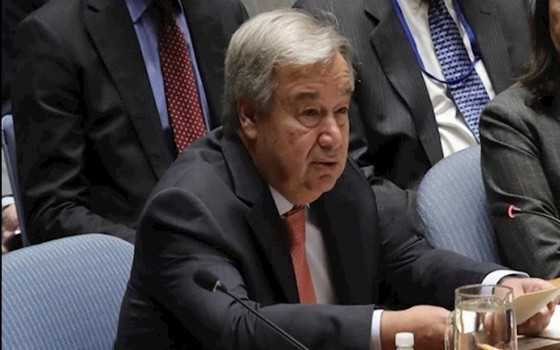
UN Secretary-General António Guterres warned that human rights are under a comprehensive attack worldwide, noting that "the rule of force is trumping the rule of law." He explained that this assault is not happening in secret, nor is it a sudden occurrence; "rather, it is happening in full view of everyone, and is often led by the great powers."
The Secretary-General spoke at the opening of the 61st session of the Human Rights Council in Geneva on Monday, noting that this would be his last address to the Council as Secretary-General of the United Nations, as his term ends at the end of this year.
Guterres pointed out that human rights are facing a systematic setback worldwide, "sometimes deliberately, sometimes according to a deliberate strategy, and sometimes even with a boastful display of this regression."
He warned of dire consequences for this regression, noting that when human rights collapse, everything else collapses—from peace to development to social cohesion to trust and solidarity. For this very reason, António Guterres stressed the importance of the Human Rights Council’s tools, including the Special Rapporteurs, investigative mechanisms, and the Universal Periodic Review. Marking the Council’s 20th anniversary, Guterres emphasized the urgent need to translate geopolitical engagement into concrete action to promote and protect human rights globally.
The human rights crisis is not an isolated case.
The Secretary-General stated, “We live in a world where collective suffering is justified, where human beings are used as bargaining chips, and where international law is treated as a mere obstacle. Conflicts are on the rise, and impunity has become an epidemic. This is not due to a lack of knowledge, tools, or institutions. It is the result of political choices.”
He explained that this crisis of respect for human rights is not an isolated case, but rather a mirror reflecting and amplifying every other global divide. He added: “Humanitarian needs are growing exponentially while funding is collapsing. Inequalities are widening at an alarming rate. Countries are sinking deeper into debt and despair. Climate deterioration is accelerating. And technology—particularly artificial intelligence—is increasingly being used in ways that suppress rights, deepen inequalities, and expose marginalized people to new forms of discrimination, both online and offline.”
On all fronts, according to the Secretary-General, the already vulnerable are being pushed further into marginalization, noting that human rights defenders are the first to be silenced when they try to warn us.
He explained that human rights are the first casualty of “this coordinated assault.” He added: “We see it in the tightening grip on civic space. The imprisonment of journalists and activists. The closure of NGOs. The rollback of women’s rights. The disregard for children’s rights. The exclusion of people with disabilities. The erosion of democracies. The crushing of the right to peaceful assembly.”
In this regard, Guterres reiterated his condemnation of the violent crackdown on recent protests in Iran. Human rights are indivisible.
The UN Secretary-General stressed that human rights “are not a slogan to be chanted in times of prosperity, but a constant obligation. Therefore, we must defend them, even if it is difficult, inconvenient, or costly.” He explained that this requires urgent action on three fronts:
First, the need to protect our shared foundations without compromise.
In this context, he emphasized that “the UN Charter, the Universal Declaration of Human Rights, and international human rights law instruments are not selective options. Leaders cannot pick and choose what suits them and ignore the rest. Human rights themselves are indivisible.”
Second, the need to strengthen our institutions.
In this regard, the Secretary-General stated that we cannot pretend that the dysfunction of the current global governance system is separate from the global decline in human rights. He stressed the need to reform the Security Council so that it “reflects the reality of our world today, not the world of 1945.” Third, unleashing the power of human rights.
In this regard, António Guterres said that human rights are not just something we defend, but something that makes the world a better place. He noted that "when rights are protected, people live more freely. Economies grow more equitably. Societies have greater trust. Peace and stability prevail because dignity takes root."
He emphasized that "human rights are not an obstacle to progress; they are its foundation."
Ukraine, Palestine, Sudan
The Secretary-General addressed the situation in Ukraine, noting that he would be addressing the Security Council on Tuesday, the fourth anniversary of Russia's full-scale invasion of Ukraine, in which more than 15,000 civilians were killed. Guterres stressed that the time has come to stop the bloodshed.
Ukraine, Palestine, Sudan António Guterres also referred to his address earlier this month to the Committee on the Exercise of the Inalienable Rights of the Palestinian People on the flagrant violations of human rights, dignity, and international law in the occupied Palestinian territory, warning that "the current trajectory is clear, deliberate, and intentional: the two-state solution is being undermined day and night." He stressed that the international community cannot allow this to happen.
He also spoke about his participation in the African Union Summit, where the crises in Sudan, the Democratic Republic of Congo, the Sahel region, and other areas were at the heart of the discussions.
A shield for all who need it.
In his closing remarks at the opening of the Human Rights Council, Secretary-General António Guterres, as Secretary-General of the United Nations, made an appeal, saying: “Do not allow the erosion of human rights to become an acceptable price for political interests or geopolitical competition. Do not let power write new rules in which the weak have no rights and the powerful have no limits. Let this Human Rights Council be a voice and a shield for all who need it. Let it be a place that helps put an end to the brutal and widespread assault on human rights. Because a world that protects human rights protects itself.”
A Call to Learn from History
The President of the UN General Assembly, Annalena Baerbock, said that her address—like that of the Secretary-General—was a call to action for all of us, because, as she said, “History teaches us that great systems rarely collapse in an instant. Rather, they erode slowly, rule by rule, commitment by commitment, with the silence of those who were supposed to defend them, until what once seemed permanent disappears.”
She continued: “We are not bystanders with the luxury of standing on the sidelines while injustice unfolds. Silence is a choice. Inaction is a choice, and it has consequences. But the good news is that action is also a choice, and it is in our hands.” The President of the General Assembly addressed the closing of the Olympic Games in Italy and the start of the Paralympic Games, stating: “Athletes from around the world, in all their diversity, have once again shown us what we can achieve when we unite, despite our differences, or rather, because of our diversity, to compete with strength and fairness, on an equal footing, according to the same rules, and always with mutual respect, believing that life is life, and that a human being is a human being.”
The Human Rights Council is of paramount importance.
The President of the Human Rights Council, Siddharth Riza Suryodipuro, called for a minute of silence in remembrance of the victims of human rights violations worldwide.
He said that the strong presence of more than 120 high-level figures at the opening of the 61st session of the Human Rights Council sends a powerful message that this Council is of paramount importance, that human rights are of utmost importance, and that multilateral cooperation remains essential to address shared challenges.
Suryodipuro called for this session to serve as a renewed call to listen, cooperate, and act, and to demonstrate the Council’s responsiveness to the demands of the present moment. Unprecedented Fierce Competition
Human Rights Commissioner Volker Türk said the world is witnessing "fierce competition for power, influence, and resources at a pace and intensity not seen in 80 years." He said people feel lost, anxious, and insecure.
The High Commissioner added that the global balance of power is shifting, and the consequences are unclear: "Some are pointing to the end of the world order as we know it. But today I want to talk about another world order. A fundamental order for how people interact with each other, based on our intrinsic worth, our shared hopes, and our common values. I am referring to people's pursuit of dignity, equality, and justice."
Volker Türk warned that the use of force to resolve conflicts between and within states has become commonplace. He added: "Provocative threats are being made against sovereign states, with no regard for the potentially disastrous consequences. The laws of war are being brutally violated. Mass civilian suffering is unfolding before our eyes—from Sudan to Gaza to Ukraine to Myanmar."


No Comments Found