

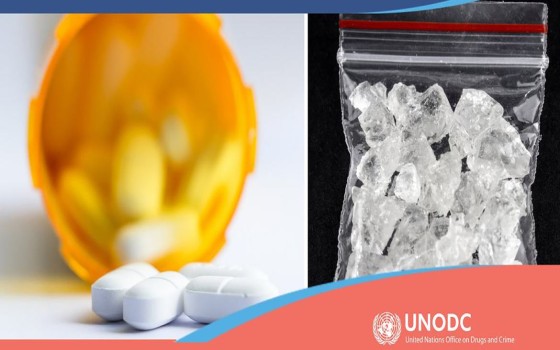
331 Million People Use Drugs... UN Report: Traffickers Exploit Technology and Global Instability to Introduce New Types

- Europe and Arabs
- Saturday , 27 June 2026 9:0 AM GMT
New York: Europe and the Arabs
Drug traffickers are exploiting modern technology and global instability to introduce new types of drugs, experiment with new trafficking routes and methods, and aggressively expand into new markets, the United Nations Office on Drugs and Crime (UNODC) warned in its 2026 World Drug Report, released Friday.
“We have seen an unprecedented rise in the emergence of new drugs on the market, and what is most worrying is that some of these substances are more potent or more dangerous than their predecessors,” said UNODC Executive Director Monica Juma, according to the UN Daily News, a copy of which was received Saturday morning.
She added, “We are already seeing the effects: millions of premature deaths, years of healthy life needlessly lost, drug trafficking networks that distort economies, destroy lives, communities, and livelihoods, and exacerbate insecurity and violence.” She stressed that the need to focus on dismantling organized criminal groups is more urgent than ever, emphasizing the necessity of strengthening deterrence efforts, sharing intelligence, coordinating joint operations, and investing more in prevention and treatment.
The report estimated that the number of people using drugs in 2024 would reach approximately 331 million – equivalent to 6.2 percent of the world’s population aged 15 to 64 – compared to 5.2 percent in 2014. Cannabis remains by far the most widely used drug, with 256 million users in 2024, followed by opioids (63 million), amphetamines (32 million), cocaine (25 million), and ecstasy (21 million).
Drug traffickers continue to innovate.
Illicit drug manufacturers continue to develop new synthetic drugs in an attempt to circumvent regulations and avoid detection. The number of drugs seized in 2024 was five times higher than before 2000.
The number of new psychoactive substances reported in drug markets reached 755 in 2024, including 118 substances reported for the first time.
A turning point in the global opioid market.
According to the report, the 2022 drug ban in Afghanistan continues to significantly reduce the illicit production of opium and heroin. Despite a rise in production in Myanmar from 420 tons in 2021 to over 1,000 tons in 2025, this increase—along with production in other countries monitored by the Office, such as Laos and Mexico—does not offset the sharp decline in Afghanistan, which produced over 6,000 tons of opium in 2022. The growing availability of new synthetic opioids, such as fentanyl, nitazines, and orphines, indicates that traffickers are seeking alternatives to heroin. The shift from plant-based opioids to synthetic alternatives could lead to a permanent transformation of the global opioid market, with implications for drug use patterns and associated harm.
The methamphetamine market has become global. New smuggling routes and the gradual spread of methamphetamine production have led to the emergence of new markets for this drug, particularly in the Near East, the Middle East, Africa, and parts of Europe. Seizures saw an average annual increase of 13 percent, driven primarily by seizures in East and Southeast Asia. While Myanmar remains the main source of methamphetamine, high demand has also attracted suppliers from North America, West and Southern Africa, and Southwest Asia.
Methamphetamine shipments from North America have also begun crossing the Pacific Ocean to countries on the western Pacific coast, leading to increased trafficking and use in Pacific islands.
In the Middle East, the disruption to the Captagon market following the fall of the former Assad regime in Syria in December 2014, and the subsequent doubling of Captagon prices in some areas, may lead some users to switch to methamphetamine, whose use has increased in the region. Changing Perceptions of Cannabis Fuel Increased Use and Trafficking Patterns
Cannabis production, trafficking, and use are undergoing rapid changes, likely partly due to evolving perceptions of the drug in many countries, particularly in North America, where some jurisdictions have adopted policies to legalize or decriminalize its use.
The number of cannabis users increased by 40 percent over the past decade, while its prevalence among 15- to 64-year-olds rose from 3.8 percent in 2014 to 4.8 percent in 2024. Cannabis seizures also reached record highs in 2024. Historically, most cannabis trafficking has been regional due to its availability in most areas, but cross-border trade, with increasing reliance on supplies from North America, is growing. Between 2015 and 2024, 57 countries or territories outside North America identified this region as a source of seized cannabis, compared to only 11 countries or territories in the previous decade.
Deaths from opioid use disorder increased by 71% over the past ten years, and methamphetamine seizures reached record highs. To help countries protect health and take necessary action, the United Nations Office on Drugs and Crime provides practical resources on legislation, forensics, and health policy.
Cocaine Supply Growth May Outpace Demand
Cocaine production continued its upward trend in 2024, more than quadrupling in the previous decade to over 4,000 tons of pure cocaine, driven by increased productivity and expanded cultivation areas.
Organized crime groups continue to channel increasing quantities of cocaine to traditional and emerging markets, seeking to maximize profits and expand their consumer base beyond their largest markets in Western and Central Europe, North America, and Oceania.
Evidence of this expansion is evident in Africa and Asia, where some countries recorded the highest growth rates in cocaine seizures globally during the period 2020-2024, although the quantities seized remain relatively low.
The Impact of Drug Use on Safety and Security
Drug use is linked to property crimes, domestic and social group violence, and increases the vulnerability of drug users and others to violence.
However, these outcomes are also influenced by broader factors, including the circumstances of substance use, personal backgrounds such as poverty, homelessness, and poor mental health, as well as societal factors such as limited access to addiction treatment and social services. The report emphasizes that these factors also represent important entry points for strengthening prevention and early intervention efforts.








No Comments Found