

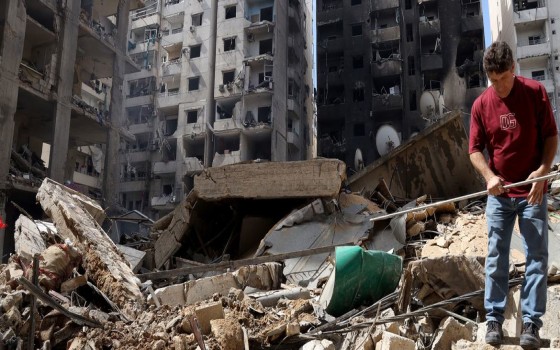
UN Official in Lebanon: I Was Shocked by the Destruction, Suffering, and Widespread Violations I Saw, Which May Amount to War Crimes... Syria: Between 130,000 and 300,000 Missing .. and New Details Regarding Search Efforts to Find Them

- Europe and Arabs
- Tuesday , 28 July 2026 6:12 AM GMT
Beirut-Damascus: Europe and the Arabs
The UN High Commissioner for Human Rights, Volker Türk, said he was shocked by the scale of the devastation and compounded suffering he witnessed in Lebanon. He added that feelings of shock, frustration, and despair were palpable, and that he also sensed a strong demand for justice from those he met. According to the UN daily news bulletin, a copy of which we received Tuesday morning, Türk was speaking to reporters at the conclusion of his two-day visit to Lebanon. He noted that the situation involving the United States, Israel, and Iran cast a shadow over the country earlier this year, leading to a renewed escalation in the conflict between Hezbollah and Israel, and inflicting devastating consequences on the Lebanese population.
[This information was included in the UN daily news bulletin, which was received Tuesday morning.] Turk reported that he met with the President, the Prime Minister, the Speaker of Parliament, the Minister of Social Affairs, and the Minister of Justice, as well as internally displaced persons forced to flee due to the hostilities, and a wide range of representatives from national human rights mechanisms, civil society, and the diplomatic corps.
The High Commissioner for Human Rights stated that ongoing Israeli airstrikes, shelling, and the use of explosive weapons in densely populated areas have resulted in a massive number of civilian casualties, widespread destruction, and mass displacement. He added that rockets fired by Hezbollah into populated areas in Israel have caused civilian casualties and damage to civilian infrastructure.
He said, "My office has documented widespread violations of international humanitarian law, some of which may amount to war crimes. Under certain circumstances, these violations may also constitute crimes under international law."
Villages razed to the ground
Turk also spoke about his visit to a school that had been converted into a shelter housing approximately 1,000 victims of the conflict. He said in this regard: “Some told me they tried to return to their homes last week, only to discover that their villages had been completely destroyed.”
Turk heard testimonies about entire villages south of the Litani River being razed to the ground or rendered uninhabitable.
He added: “With the mandate of the United Nations Interim Force in Lebanon (UNIFIL) set to expire this year, I am concerned about the potential repercussions for the protection of civilians in the south, and I hope this issue will be taken into account in any future arrangements.”
He stated that Israeli forces continue to occupy large swathes of Lebanese territory in the south, expressing concern that the overall conduct that led to widespread displacement and prevented the return of displaced persons may amount to international crimes.
Rebuilding the Social Contract
The UN official said he heard harrowing accounts of the experiences of displaced victims of the conflict, particularly people with disabilities who face difficulties in moving to safe areas and accessing shelters. He said that Lebanon had made significant progress – including ratifying the Convention on the Rights of Persons with Disabilities – but noted that implementing its provisions still faced challenges.
He also welcomed the draft law to abolish the death penalty, building on the country’s long-standing moratorium on executions, and urged Parliament to pass it quickly. According to Mr. Volker Türk, this would make Lebanon the first country in the region to take this step.
Mr. Türk further emphasized that the social contract must be rebuilt so that the dignity and human rights of all segments of Lebanese society are respected, and the state is able to protect their rights and provide the services, security, and safety they need.
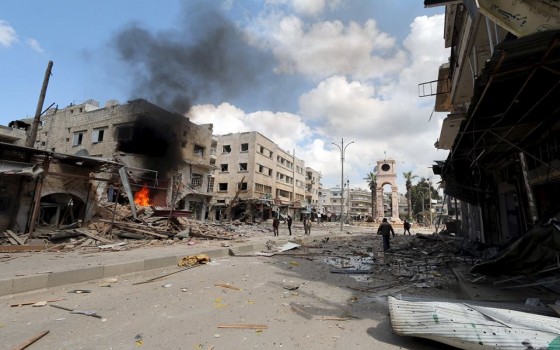
He continued, “This also means the full empowerment of the Lebanese state, with complete respect for its sovereignty and territorial integrity, and without any external interference.” In neighboring Syria, Carla Quintana, head of the Independent Foundation for Missing Persons in Syria, said the foundation had made significant progress in its efforts to uncover the fate of missing persons, having processed more than 75,000 documents in the past year. Quintana explained in an interview with UN News that this information enabled the organization to connect the dots, identify patterns of disappearances, and begin providing families with gradual answers about the fate of their loved ones. She noted that the organization is working with the Syrian National Commission for Missing Persons on several projects, including mapping hundreds of mass graves and developing mechanisms for analyzing and sharing information, which will aid in future forensic investigations and victim identification.
She also mentioned estimates that the number of missing persons in Syria could range between 130,000 and 300,000, emphasizing that almost every Syrian family knows someone who is missing or has lost a member.
She stressed that the success of this mission depends on four key elements: political will, information, trust, and methodologies. She affirmed that the organization is working to establish a permanent office in Syria to enhance coordination with the authorities and work closely with families.






No Comments Found