
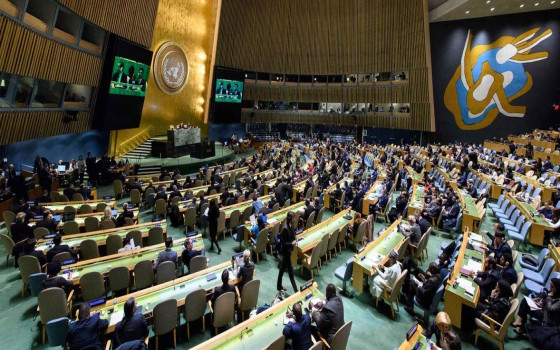
The General Assembly discusses the issue of using the veto in the Security Council

- Europe and Arabs
- Thursday , 20 July 2023 18:17 PM GMT
New York - Brussels: Europe and the Arabs
The United Nations news bulletin, of which we received a copy this morning, Thursday, stated that the United Nations General Assembly held a session yesterday, Wednesday, to discuss the issue of the use of the veto by one of the five permanent members of the Security Council.
Last April, the UN General Assembly adopted a new procedure that authorizes it to meet, automatically, within ten days, after any of the five permanent members of the Security Council used their veto power - so that all UN member states could scrutinize. And comment on the veto.
Yesterday's session came in the wake of Russia's use of its veto right in the Security Council session that was held on July 11, in which the Council failed to extend the mechanism for delivering humanitarian aid across the border to Syria, after Russia objected to the draft resolution submitted by Brazil and Switzerland. They are the two countries concerned with drafting resolutions on the Syrian humanitarian file in the Security Council.
At that meeting, the Council voted on two competing draft resolutions. The first draft resolution was submitted by Brazil and Switzerland, while the second draft resolution was submitted by Russia.
The Brazilian-Swiss draft resolution received the support of 13 countries, the abstention of one country (China), and the objection of one country, Russia. Consequently, the resolution was not adopted due to Russia's veto power.
The Brazilian-Swiss draft resolution would have allowed UN agencies and humanitarian partners to continue using the Bab al-Hawa crossing on the Syrian-Turkish border for nine months - that is, until April 10, 2024.
As for the Russian draft resolution, it received the support of two countries and three countries (the United States, Britain and France) voted against it, with 10 countries abstaining from voting. Therefore, it was not adopted either.
China, France, Russia, the United Kingdom and the United States have veto power over Security Council resolutions enshrined in the UN Charter - a right granted to these countries because of their key roles in the creation of the United Nations.
General Assembly President urges non-politicization of humanitarian relief
Speaking at the opening of the session, UN General Assembly President Chaba Kuroshi said that life-saving relief programs should not be held hostage to political interests.
He stressed the importance that “humanitarian action should always be guided by the principles of impartiality, neutrality and independence. As such, effective humanitarian assistance can never be hostage to any political interest.”
The President of the Assembly urged the members of the Security Council to give priority to the needs of affected people. added:
“I call on you to be aware of the facts and direct your efforts towards real solutions; to urgently prioritize long-term cooperation over division; and the humanitarian imperative over brinkmanship. Together, we have the power to effect serious change. The people of Syria count on us to help them.”
Brazil: The interest of the Syrian people "above everything"
Permanent Representative of Brazil to the United Nations, Sergio Franca Danis, said that his country and Switzerland worked hard with all members of the Security Council, in good faith, and in consultation with Syria and other interested parties in order to draft the draft resolution that the Security Council failed to pass due to the Russian veto.
He said that his country and Switzerland had tried to agree on everything in accordance with the requests and concerns expressed by the parties and to reach a compromise.
He stressed that the interest of the Syrian people comes "at the forefront of everything."
The Brazilian ambassador reported that there have been developments since the council session, in which he failed to pass the draft resolution on the aid mechanism, referring to "the Syrian government's decision to open the Bab al-Hawa crossing - voluntarily in front of aid convoys."
He expressed his country and Switzerland's commitment to continue working with members of the Security Council, the Office for the Coordination of Humanitarian Affairs, Syria and other humanitarian actors to help the Syrians.
Russia explains why it used its veto
Russia's deputy permanent representative to the United Nations, Dmitry Polyansky, explained the reason for his country's use of the veto, noting that the Russian delegation "was forced to use it," and that those who drafted the resolution did not respond to Russia's proposals that it presented on behalf of Syria. "The United States and its allies...were primarily concerned about the timing of the cross-border extension of the mechanism, and were not prepared to make any improvement in the mechanism," he added.
Syria: accuses the West of using the aid mechanism as a "pressure tool"
Permanent Representative of the Syrian Arab Republic, Ambassador Bassam Sabbagh, said, "Western countries' continued politicization of humanitarian work in Syria, trading in the suffering of the Syrians, obstructing any sincere effort to alleviate that suffering, persisting in imposing inhuman and inhumane sanctions against them, and using a cross-border mechanism as a tool of pressure and political blackmail." Against my country, and the threat to cut off funding, is what brought the Security Council to the state of division that we witnessed in it.”
He added, "The United States' record of unjustly using the veto over the past decades against the peoples of our region, especially regarding resolutions pertaining to the Palestinian cause, and its obstruction of a peaceful solution to many international crises, does not qualify it to lecture here about the reasons and motives for using the veto in the Security Council." .

No Comments Found