

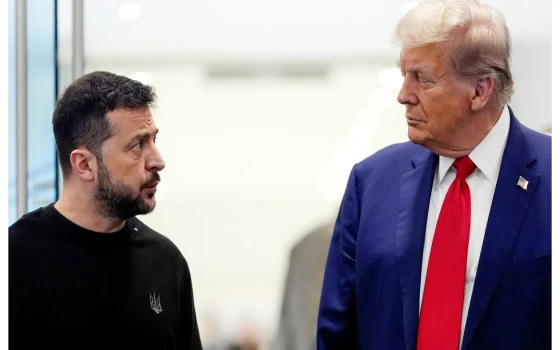
Trump's Peace Plan for Russia-Ukraine Revealed: European Concerns and the Ball in Zelensky's Court

- Europe and Arabs
- Thursday , 20 November 2025 11:11 AM GMT
Washington – Brussels: Europe and the Arabs
NBC News reported that President Donald Trump has approved the peace plan for Ukraine, which was the subject of media reports yesterday. German Foreign Minister Johannes Wadephul told reporters, "We have not been briefed on this plan. There are ongoing efforts by all international partners to bring President Putin to the negotiating table."
Wadephul added, commenting on the reports, "We naturally support anything that moves things in this direction. We are focused on supporting Ukraine, and in doing so, we are making it clear to Putin that there is no alternative to the path of negotiations." According to a report by the Brussels-based European news network Euronews, which added under the headline "Zelensky is not in a good position," Ukrainian President Volodymyr Zelensky has not yet commented on the American proposal, but he called on the United States via his Telegram channel to "help end the years-long war," indicating that only the United States, and President Trump, "have the power to finally end the war." The major corruption scandal in Ukraine's energy sector, which implicated several of Zelensky's close associates, is believed to have affected his current position and may leave him with limited options, given the increasing US pressure to accept the deal.
Further details on the proposal: Trump's proposal, partly inspired by the Gaza ceasefire agreement, consists of 28 points. Sources told Axios that it grants Russia sovereignty over the territories it occupies in the Luhansk and Donetsk regions (collectively known as Donbas). However, since Ukraine still controls approximately 14.5% of these regions, they would be demilitarized.
As for the Kherson and Zaporizhzhia regions, the current front lines would be frozen, with Russia returning some territory, as agreed upon in the negotiations.
The US and other countries would also legally recognize Crimea and the Donbas region as Russian territory, without requiring Ukraine to do so.
The terms are not final.
Sources indicate that the terms are not final and remain subject to amendment. However, it is unclear whether Ukraine will be given the ability to make substantial changes to them, especially since it was excluded from the consultations led by Trump's envoy, Steve Witkopf, with the participation of Russia, Qatar, and Turkey.
According to Politico, Washington is still considering Ukraine's accession to NATO, a move strongly opposed by Moscow. It also remains unclear what security guarantees will be offered to Ukraine.
In this context, US Secretary of State Marco Rubio stated on the X platform that Washington "will continue to develop a list of potential ideas for ending the war based on input from both sides in this conflict."
Rubio added, "Ending a complex and bloody war like the one in Ukraine requires a broad exchange of serious and realistic ideas. Achieving lasting peace will require both sides to agree to difficult but necessary compromises." Europeans are wary.
The website quotes a European Union source as saying, "It's clear the Russians see Trump's envoy, Vytkov, as someone willing to promote their interests. The Europeans weren't consulted on this. But there's a faction within the White House that sees them as an 'obstacle' to the peace process, so this isn't surprising."
The ball is in the Ukrainian president's court.
Vytkov was supposed to meet with Zelensky yesterday in Istanbul, Turkey, but the meeting was postponed, according to a US official, after "it became clear that Zelensky was backtracking on the understandings reached, that he wasn't interested in discussing Trump's plan, and that he went to Ankara with another plan prepared with European partners—a plan that Russia will absolutely not accept."
Sources indicate that Washington is now putting the ball in Zelensky's court, giving him the opportunity to visit Washington and discuss the new US plan if he wishes.
Meanwhile, a high-level US military delegation from the Department of Defense (the Pentagon) is visiting the Ukrainian capital, Kyiv, for talks with the Ukrainian side. The delegation includes U.S. Army Secretary Dan Driscoll, General Chris Donahue, commander of U.S. forces in Europe, and General Randy George, chairman of the Army Staff.
Reports indicate that the White House's decision to send these high-ranking military figures—rather than traditional diplomats—reflects the Trump administration's inclination to adopt an unconventional approach to negotiations.
This move stems from Washington's belief that Moscow might be more willing to engage in dialogue facilitated by military channels, particularly given the frustration stemming from the failure of previous diplomatic efforts to achieve any tangible progress.


No Comments Found