

European Ministerial Meeting: Working Lunch with the US and Discussions on the Future of Trade Relations with China Amid Growing Imbalances and Developments in Bilateral Trade Negotiations

- Europe and Arabs
- Tuesday , 25 November 2025 8:5 AM GMT
Brussels: Europe and the Arabs
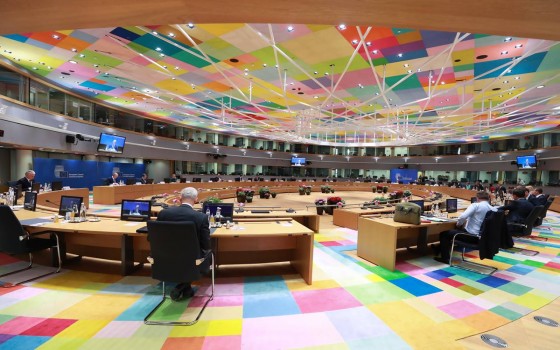
The European Council of Foreign Affairs met in Brussels to discuss trade, and a final statement was issued focusing primarily on trade relations between the European Union and the United States. The statement read, "Over luncheon, EU trade ministers exchanged views with US Secretary of Commerce Howard Lutenick and US Trade Representative Jamison Greer. The discussion was forward-looking, focusing on transatlantic trade relations following the conclusion of the EU-US Joint Declaration on Trade on August 21, 2025, and shared global challenges related to, for example, global excess production capacity, the resilience of supply chains, and economic security." The European statement quoted Lars Løkke Rasmussen, the Danish Foreign Minister and representative of the Danish Presidency of the EU, who chaired the meeting, as saying, "Today's discussions reaffirmed the shared commitment of the EU and the US to the full implementation of the Joint Declaration of August and to building on the progress we have made to ensure stable, fair, and predictable trade." We are determined to move forward together, without compromising the balance of the agreement, as we continue to address shared challenges and strengthen our economic ties.
The ministers and Commissioner Šefčovič affirmed that the joint statement has restored a significant degree of predictability and stability to transatlantic trade. At the same time, they emphasized the importance of addressing global challenges together. Both sides reaffirmed their commitment to continued close cooperation in the coming months.
On another topic, EU-China trade relations, the statement said: “Ministers exchanged views on the current state and future prospects of EU-China trade relations, in light of growing imbalances. The Council reviewed the widening trade deficit, long-standing market access restrictions, and China’s continued use of trade as a tool of pressure, including through export controls on critical raw materials and restrictions affecting semiconductors.
The Commission provided an update on its recent cooperation with its Chinese counterparts, including on rare earth export controls, which Chinese authorities suspended globally for one year following the US-China agreement.
Ministers agreed that the temporary suspension did not address the underlying weaknesses and emphasized the need to accelerate diversification of supply sources, deepen cooperation with like-minded partners, and continue implementing the EU Risk Reduction Strategy.” On the subject of ongoing bilateral trade negotiations, the statement continued: “Ministers reviewed the progress made across the EU’s ongoing bilateral trade negotiations network. They stressed the importance of trade diversification in the current environment of geoeconomic instability and fragmentation.” The discussion focused particularly on India, where negotiations have entered a critical phase. The Commission highlighted recent work on a potential trade agreement aimed at ensuring a commercially viable outcome in the coming months.
Ministers discussed the key elements of a potential package, including tariff liberalization on industrial goods, the removal of non-tariff barriers, and the need for the EU to guarantee at least the same level of market access that India would grant to other third countries.
During the discussion, ministers also expressed their support for accelerating the finalization of agreements already negotiated and for continued engagement in ongoing negotiations.
The European statement concluded with a section on "Other Business," noting that under this section, the European Commission briefed ministers on its annual report on the implementation and enforcement of EU trade policy, and Commissioner Šefčovič presented his annual progress report on simplification, implementation, and enforcement.
Estonia, Finland, Germany, Latvia, Lithuania, Poland, and Sweden briefed ministers on their requests to the Commission regarding a proposal to impose additional tariffs on products imported from Russia and Belarus. Lithuania also briefed the ministers on the situation on the border with Belarus following the recent hybrid attack and its commercial aspects, including the border closure and its effects on freight traffic.


No Comments Found