
Led by Egypt and Slovenia, the UN adopts two resolutions to strengthen the peacebuilding architecture

- Europe and Arabs
- Thursday , 27 November 2025 7:22 AM GMT
New York: Europe and the Arab World
The Security Council and the General Assembly adopted two essentially identical resolutions on the 2025 Peacebuilding Architecture Review. The two UN resolutions outline unprecedented institutional steps, including an annual work program for the Peacebuilding Commission and the launch of a "Peacebuilding Week" next June.
The adoption of "twin resolutions" by the General Assembly and the Council on peacebuilding is an innovative practice dating back to December 20, 2005, when the two bodies adopted identical substantive and operational texts to establish the Peacebuilding Commission and the Peacebuilding Support Office, and requested the Secretary-General to establish a Peacebuilding Fund. According to the UN Daily News, this two-track approach allows the General Assembly and the Security Council to develop and commit to a common framework to support peacebuilding efforts across the UN's pillars of development, human rights, and peace and security.
Egypt reaffirms its unwavering commitment to peacebuilding.
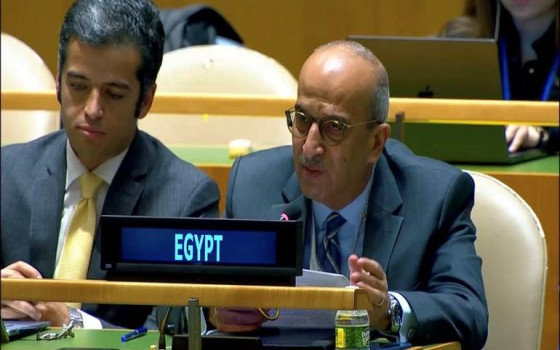
Ambassador Osama Abdel Khalek, Permanent Representative of Egypt to the United Nations, addressed the General Assembly following the adoption of the two resolutions on Wednesday.
Speaking on behalf of Egypt and Slovenia, Ambassador Abdel Khalek emphasized that the consensus in both the General Assembly and the Security Council reflects the strength of multilateralism and the shared commitment to promoting peacebuilding worldwide. He noted that the review process was broad, comprehensive, and based on national ownership, prevention, meaningful partnerships, and projected funding.
Looking ahead, he affirmed that the adoption of the two resolutions "is not the end of the journey, but the beginning of a new chapter focused on implementation and achievement." He stressed the need for tangible and measurable results that make a real difference in conflict-affected communities and called for enhanced cooperation with international financial institutions, innovative financing mechanisms, and evidence-based approaches.
He emphasized Egypt’s unwavering commitment to peacebuilding was highlighted, with the country’s leadership in the Peacebuilding Commission and the African Union being emphasized. Ambassador Osama Abdel Khalek announced that this briefing would be his last as Egypt’s Permanent Representative to the United Nations.
Investing in peace makes a difference.
Following the adoption of the two resolutions, Assistant Secretary-General for Peacebuilding Support Elizabeth Spehar and the Chair of the Peacebuilding Fund Advisory Group, Ambassador Macharia Kamau, spoke to reporters in New York about the Fund’s recent activities.
Elizabeth Spehar announced that the Fund had surpassed the $1 billion mark in approvals (for funding) since 2020, supporting the Fund’s current global strategy for UN programs that fund national peacebuilding and prevention efforts around the world. She stressed that this represents significant progress towards achieving the Secretary-General’s call for a quantum leap in peacebuilding financing.
Spehar described this funding milestone as an important achievement that underscores that peacebuilding work continues, even though headlines are filled with war and military spending.
She emphasized that investing in peace makes a difference. The International Monetary Fund has estimated that every dollar invested in prevention can achieve Savings range from $25 to $100. However, these savings are not realized if the investment is not primarily in prevention.
What is the Peacebuilding Fund?
The Peacebuilding Fund was established by joint Security Council and General Assembly resolutions in 2005, as part of the UN peacebuilding architecture, in collaboration with the Peacebuilding Commission and the Peacebuilding Support Office of the Department of Political and Peacebuilding Affairs.
The Fund is the UN’s flagship instrument for investing in prevention and peacebuilding programs, in partnership with the wider UN system, national and subnational authorities, civil society organizations, regional organizations, and multilateral banks.
The Fund supports joint UN responses to address critical peacebuilding opportunities, linking peace and development, human rights, and humanitarian action. Its core principles are timeliness, catalysts, risk-taking, facilitating inclusivity and national ownership, integrated approaches, and coherent UN strategies.
The Peacebuilding Fund is primarily financed through voluntary contributions from Member States. In addition, the General Assembly has approved an allocation of US$50 million from earmarked funds. Annually, starting in 2025.
What do the resolutions stipulate?
This year’s peacebuilding review was the fourth since the establishment of the UN peacebuilding architecture in 2005. The General Assembly and Security Council resolutions stipulated, among other things:
The Peacebuilding Commission was tasked with developing a detailed and predictable annual programme of work that more closely links its activities with those of the General Assembly, the Security Council, and the Economic and Social Council.
The Peacebuilding Commission was reaffirmed as a platform to assist Member States and to request support for national strategies for prevention and peacebuilding, capacity building, the exchange of good practices, and resource mobilization.
The Peacebuilding Commission was requested to enhance its impact through regular follow-up, monitoring, and evaluation of its activities; to increase the visibility of its work; and to support global efforts to close peacebuilding funding gaps—particularly to facilitate the participation of women and youth in peacebuilding efforts—including through increased coordination with international financial institutions and strategic dialogue with the Peacebuilding Fund.
Member States were encouraged to strengthen the capacities of the Peacebuilding Support Office—within the limits of available resources or through voluntary funding—and to advocate for better coordination and integration of considerations. Peacebuilding within UN reforms and field missions.
Encouraging the Secretary-General to include more systematic data and analysis in his relevant reports to the Security Council, drawing on the expertise and system-wide capabilities of the Peacebuilding Support Office to track the impact of peacebuilding at the country and regional levels, within the limits of available resources.
A decision was made, within available resources, to establish an annual "Peacebuilding Week" in June to promote dialogue, share best practices, and raise public awareness of the United Nations' efforts in building and sustaining peace.
A call was made for another comprehensive review of peacebuilding in the United Nations by 2030.


No Comments Found