
Arabic at the Heart of the United Nations – Celebrating a Language that Enriches the World… Multilingualism: A Fundamental Tool for Multilateral Action

- Europe and Arabs
- Wednesday , 3 December 2025 7:51 AM GMT
New York: Europe and the Arabs
"I come from the land where the Arabic language was born and where its tribes and poets spoke it... The multiplicity of languages in the world is a source of richness and diversity, and our languages bring us closer and allow us to understand one another," said the Secretary-General of the King Salman Global Academy for the Arabic Language at the opening of an event at the United Nations headquarters commemorating Arabic Language Day. According to the UN Daily News, the Academy's Secretary-General, Dr. Abdullah Al-Washmi, noted the influence of Arabic on many of the world's languages: "Many people from various languages can hear the Arabic voice and find in their heritage a diverse collection of Arabic words that have been adapted and incorporated into the languages of the world."
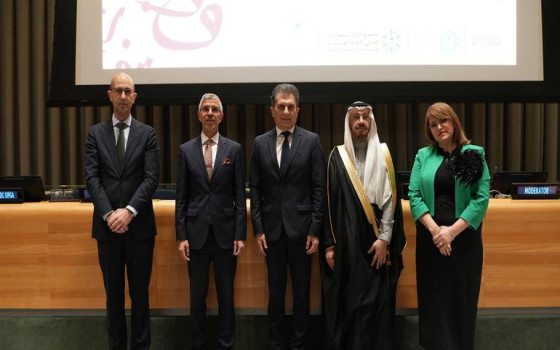
The Academy organized the event in conjunction with the Permanent Mission of the Kingdom of Saudi Arabia to the United Nations. Participants included the Under-Secretary-General for General Assembly and Conference Management, the Deputy Chief of Staff to the President of the General Assembly, and the Deputy Permanent Observer of the League of Arab States to the United Nations. A number of diplomats and those interested in the Arabic language also attended.
Promoting the Presence and Use of the Arabic Language
Al-Washmi noted that this event is being held at the United Nations headquarters for the fourth consecutive year. He spoke about the Kingdom of Saudi Arabia's commitment to promoting the presence of the Arabic language in international forums and expanding its use in various fields.
The United Nations celebrates Arabic Language Day on December 18th each year, the day in 1973 when Arabic was adopted as an official language of the organization, joining five other official languages: English, Chinese, Spanish, Russian, and French.
Al-Washmi also discussed several activities of the King Salman Global Academy for the Arabic Language, including the "Arabic Language Index," which measures its presence in institutions and countries; the "Balasem Index," which measures the maturity of large-scale linguistic modeling technologies in Arabic; a report on Arabic language teaching in 300 institutions worldwide; the Encyclopedia of the Arabic Language; the "Hamza Test," which measures Arabic proficiency levels; and scholarships and Arabic language learning platforms.
Artificial intelligence does not measure up to the professionalism of linguistic specialists.
Movsis Apliyan, Under-Secretary-General for General Assembly and Conference Management, who also serves as the UN Coordinator for Multilingualism, said, “The Day of the Arabic Language provides an opportunity to reflect on one of the world’s most influential and richest languages: the language of the letter Ḍād. For centuries, Arabic has shaped poetry, science, philosophy, literature, and cultural exchange. It has brought civilizations together and served as a repository of knowledge and a platform for dialogue across regions and generations.”
He added that Arabic holds a special place at the United Nations as one of the organization’s six official languages. He emphasized that multilingualism is essential for multilateral action.
He addressed emerging technologies and artificial intelligence, saying they open new horizons for supporting multilingual communication. He stated that the UN Secretariat is working to leverage these tools to streamline processes and enhance the services it provides. He cautioned, however, that AI-powered tools are not a magic bullet for the challenges of preserving multilingualism at the United Nations. He stated, "These tools may help streamline multilingual communication tasks and complement linguistic work across the Secretariat, but they cannot yet replicate the quality of human language professionals."
He added that this shortcoming underscores the importance of human intervention, particularly the contextual awareness and cultural understanding that language specialists bring.
A significant role in enriching human thought
Ambassador Abdulaziz Al-Wasil, Permanent Representative of the Kingdom of Saudi Arabia to the United Nations, said that the designation of an Arabic Language Day was "in recognition of the venerable status of this great language and in appreciation of its human and civilizational role spanning centuries, and its significant role in enriching human thought and building bridges of communication between peoples and cultures."
For the Saudi Ambassador, the Arabic language is not merely a means of communication, but a comprehensive civilizational vessel, a mirror of a nation's identity, and a preserver of its scientific, cultural, and spiritual heritage. The speech delivered by Ambassador Nasseria Faliti, Deputy Permanent Observer of the League of Arab States to the United Nations, was poetic, celebrating the beauty of the Arabic language and the elegance of its words.
The representative of the League of Arab States began her speech by saying: "The Arabic language shines brightly in our gathering today, its light a radiant flame, redolent with the fragrance of jasmine and roses. It hangs in the sky of this international forum like a star adorned with pearls and lapis lazuli, never fading or diminishing, but shining ever brighter as it flourishes, enriching every era of narrative. This evening is like the ascension of the soul when touched by Arabic, its language and stature, causing it to rise, stand upright, and reclaim within its pulse the meaning of dignity... We gather today under a distinctly Arab, international, and Saudi umbrella that unites not only letters, but also hearts and minds..."
Referring to this year's theme, "Innovative Paths for the Arabic Language," she stated that Arabic is capable, as it always has been, of opening the doors to the future and redefining its relationship with science. She added that "the first people to speak the language of digitization, engineering, algebra and computing were originally Muslims and Arabs."


No Comments Found