

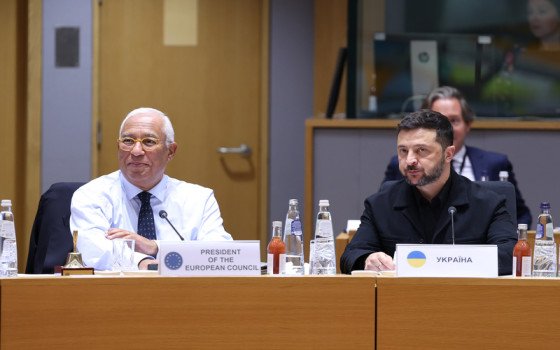
The European Union has only 10 days to save Ukraine. Belgium fears Moscow's retaliation if it uses €140 billion in frozen Russian assets. Member states criticize the lack of a concrete alternative proposal.

- Europe and Arabs
- Sunday , 7 December 2025 11:5 AM GMT
Brussels: Europe and the Arabs
European leaders will convene in Brussels on December 18 for the final European Council summit of 2025. The stakes are high: they must find a way to move forward with thorny proposals to ensure Ukraine does not run out of money by the middle of next year, jeopardizing its security and very existence.
A report in Playbook, the European edition of Politico, stated, "Kyiv's allies are hoping to avoid a repeat of last October when Belgium blocked plans to use €140 billion in frozen Russian assets to guarantee a compensation loan, citing legal concerns. Since then, diplomats have lashed out at the European Commission for failing to address those concerns beforehand. In a letter obtained by Politico, Commission President Ursula von der Leyen warned capitals that the alternative to such a move would be costly national or EU borrowing, and urged them to agree on a way forward. 'It is now essential to quickly reach a clear commitment on how to ensure that the necessary funding for Ukraine is agreed upon at the next European Council meeting,' von der Leyen wrote. 'Moving forward on this will allow us to continue to put pressure on Russia, deny it any hope of victory, and lay the groundwork for a suspension of hostilities and the foundation for long-awaited peace negotiations.' The Danish Council presidency and other partners will have to try to mediate." To reach an agreement before next summit.
"If you want a decision at the European Council meeting, we [the EU] need to do our part now," a senior Belgian official told Playbook. Belgium hosts the vast majority of Russia's frozen assets and is concerned about both litigation and retaliation from Moscow; it wants the EU to share the risks equally. However, the official said that while "everyone wants a solution" and "to avoid a repeat" of the October impasse, "we won't agree as long as we don't know in detail what we're talking about."
It's not just Belgium: other countries are increasingly critical of the failure of stakeholders to present a concrete proposal, instead focusing on trying to convince them that the Russian asset plan is the best of bad options. "There is no realistic option here other than using the frozen assets," said a diplomat from a Central European country. "The Commission needs to stop wasting time and provide more details about the proposals to member states, so they know what they are supporting."
Speaking to Playbook, Ukraine's ambassador to the EU, Vsevolod Chintsov, said that "reaching a quick agreement on the compensation loan is essential." It will provide predictable funding from early 2026 at no cost to taxpayers. EU involvement is crucial, as only the EU can provide the scale, predictability, and coordination needed to maintain Ukraine’s stability—and Ukraine’s stability enhances the resilience and security of the entire EU.
Meanwhile, Kyiv’s supporters will have to find a way to present a united front and secure a majority for policy, especially since any reliance on national borrowing will likely require member states’ approval. Hungarian Minister for European Affairs János Bucca told my colleague Grigory Szorgi that Budapest is “not prepared to agree to any decision that places additional legal or financial responsibility on the Hungarian government to guarantee payments to Ukraine.” In an interview with Playbook in Brussels, Finnish President Alexander Stubb said the EU may ultimately have to settle for a “mixture” of the three options under consideration: using Russian assets, national borrowing, and borrowing from the EU. “But that decision rests with the European Council,” he added. “And, of course, with Belgium itself.” Meanwhile, at the White House, Donald Trump reiterated his willingness to impose sanctions on Russia, as long as he retains the final decision-making authority, according to Reuters.





No Comments Found