


Israeli airstrikes on Gaza... Ceasefire stalled in its first phase... Winter storms affect 65,000 families, and tents cannot be the only shelter option

- Europe and Arabs
- Wednesday , 7 January 2026 11:12 AM GMT
Gaza – New York: Europe and the Arab World
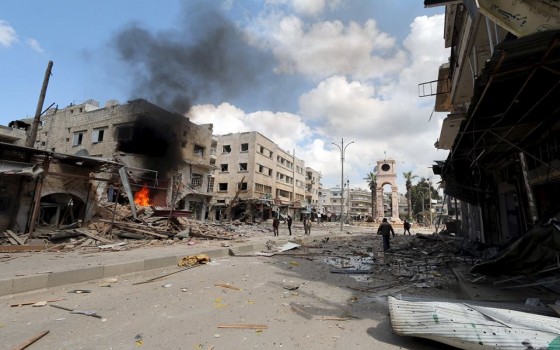
Israeli aircraft carried out airstrikes targeting areas east of Gaza City, Khan Younis, and Deir al-Balah, coinciding with gunfire from military vehicles and the demolition of residential buildings.
These developments come amidst continued violations of the ceasefire agreement, which remains stalled at its initial phase, with efforts to move to the second phase showing no tangible progress.
While Israeli reports indicated the possibility of opening the Rafah crossing in the southern Gaza Strip, Israeli Prime Minister Benjamin Netanyahu stated on Tuesday that understandings exist with the US administration stipulating that the crossing will not be opened until the body of the last Israeli held captive in the Strip is returned. This was reported by the European news network Euronews in Brussels.
Meanwhile, Egypt and Qatar announced on Tuesday that they were discussing efforts to advance the implementation of the second phase of the plan proposed by US President Donald Trump, particularly regarding Israeli withdrawals from the Gaza Strip.
On another front, statements from Israeli officials continued following the car-ramming attack that occurred last night in Jerusalem, in which a Haredi teenager was killed and others were injured. Israeli President Isaac Herzog said, "We have experienced a very sad and painful evening," adding that "the violence has crossed a red line in the most serious and severe way," and describing the incident as "a wake-up call for all of us." He called on "all those concerned to act responsibly, calm the situation, and do everything possible to prevent the next tragedy before it is too late." He added that he trusts the police "to conduct a swift and thorough investigation, with the aim of bringing those responsible to justice as soon as possible and drawing the necessary conclusions." He also expressed his condolences to the boy's family and wished a speedy recovery to the injured.
For his part, National Security Minister Itamar Ben-Gvir said his "heart bleeds," expressing his solidarity with the family "during this difficult time." He noted that the police informed him that "all lines of inquiry are being examined, and the incident is being treated with the utmost seriousness." On the other hand, the United Nations Office for the Coordination of Humanitarian Affairs (OCHA) reported that winter storms in Gaza in December affected 65,000 families. Displacement tents were uprooted or damaged, homes collapsed under the force of the storms, and personal property was damaged in several locations.
OCHA added that entire displacement sites were flooded due to inadequate drainage systems and low-lying land. It noted that aid workers provided support to approximately 80,000 families last month, distributing more than 40,000 tents and over 135,000 plastic sheeting. Nearly 115,000 other items of supplies, including mattresses and blankets, were also distributed.
Shelter partners stressed that tents cannot be the primary or only shelter option in Gaza, as they only provide temporary protection. They emphasized the urgent need to move towards more sustainable solutions, including the repair of damaged homes.
They also warned of the lack of available land for people seeking to relocate to areas less prone to flooding. Delivery of Secure Communications Equipment
The Office for the Coordination of Humanitarian Affairs (OCHA) noted further progress in scaling up the humanitarian response despite ongoing obstacles.
With recent rainstorms reversing some of the gains made during the ceasefire, OCHA estimated that more than one million people in the Gaza Strip still urgently need shelter assistance.
It added that the recent winter storms also damaged temporary learning spaces and roads used by aid workers to bring much-needed supplies into Gaza.
In another development, OCHA reported that last week it completed the delivery of secure communications equipment that had been stored in Jerusalem awaiting approval to enter Gaza since August 2024.
It said that while this is crucial for enhancing the safety of humanitarian operations, other equipment, including essential power supply solutions, continues to be blocked.







No Comments Found