
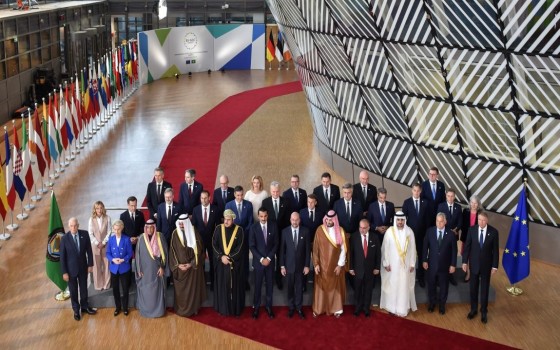
Today, a summit of leaders from the European Union, the Gulf States, Egypt, Iraq, Syria, Lebanon, and Jordan will discuss the type of additional European assistance available as the conflict in the region enters its second week, along with developments in the energy markets.

- Europe and Arabs
- Monday , 9 March 2026 6:19 AM GMT
Brussels: Europe and the Arabs
A video conference summit is being held today, Monday, bringing together European Union leaders with their counterparts from the Gulf states and the Middle East to discuss developments in the ongoing conflict between the United States and Israel on one side and Iran on the other, according to a statement issued by EU institutions in Brussels.
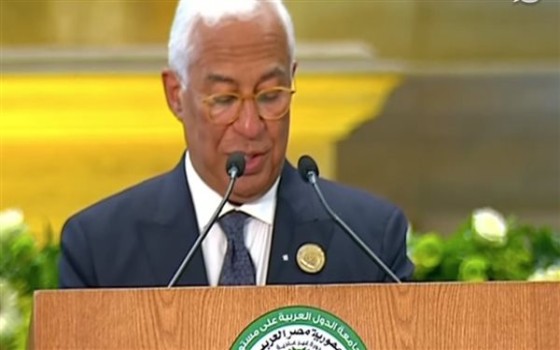
European Commission President Ursula von der Leyen and European Council President António Costa will join the video conference today with leaders from the Gulf states and their counterparts from Egypt, Iraq, Jordan, Lebanon, and Syria. According to Costa, the discussion will focus on the type of additional assistance the EU can provide as the "very worrying" conflict enters its second week.
According to Playbook, the European edition of Politico, the Gulf states, which are facing drone and missile attacks, are eager for air defense systems that do not cost millions of dollars per missile and thus do not risk running out of ammunition. This has led Ukraine to offer assistance, expressing its willingness to share weapons designed to intercept drones with the Gulf states. However, this is unlikely to be the main topic of discussion at today's meeting. Instead, senior EU officials are likely to share details about the two ongoing maritime defense missions, Aspidis and Atalanta, which are set to be reinforced by two French ships, as reported by Playbook last week. Aspidis was originally launched to protect commercial shipping from attacks by the Iranian-backed Houthi rebels, but it has taken on a new scope and urgency as the war in the region has intensified.
Regarding energy bills, EU countries will discuss ways to mitigate the war's impact on global energy markets, given the halt in liquefied natural gas production at a major Qatari refinery and the sharp rise in oil prices. They will also discuss how to complete the repatriation of thousands of European citizens currently stranded in the region.
Concerns about soaring energy prices will dominate today's meeting of Eurogroup finance ministers, according to our colleagues in the professional financial services department. However, in Washington, President Donald Trump downplayed fears about the economic fallout, posting on TruthSocial last night: "Short-term oil prices, which will quickly drop once the Iranian nuclear threat is gone, are a very small price to pay for security and peace for the United States and the world. Only fools would think otherwise!"
Also today: French President Emmanuel Macron is traveling to Cyprus "to show France's solidarity" following last week's drone and missile attacks on the island. He is scheduled to meet with the Cypriot president and the Greek prime minister to discuss strengthening "security around Cyprus and in the Eastern Mediterranean, with the aim of contributing to de-escalation in the region," the Élysée Palace told AFP.
...No End in Sight: Under this headline, Playbook wrote, "Hopes rose over the weekend for an end to the fighting after Iranian President Masoud Pezeshkian apologized to neighbors targeted by Iranian missiles, but the Iranian Islamic Revolutionary Guard Corps later retaliated. Trump appears unwilling to end the US military operation, warning that he will accept nothing less than 'unconditional surrender' from Iran.
It is also unlikely that Iran's new Supreme Leader will ease tensions. Iranian state media announced on Sunday the selection of Mojtaba Khamenei as the successor to his father, Ayatollah Ali Khamenei. Although he has never held a government position, Khamenei quietly wielded considerable influence during his father's lifetime, according to reports by American journalists. Israel has threatened to target him, and Trump, who insisted that the US have a say in the selection of the new Supreme Leader, has called him 'weak.'" Meanwhile, under the headline "Still Keen to Stay Out of It," Playbook wrote, "German Finance Minister Lars Klingbeil told RND media that the conflict The conflict is "not our war." Despite describing the Iranian government as a "terrorist regime," Klingbeil said he "highly doubts" that US-Israeli airstrikes will lead to a lasting solution.
A few days ago, a statement was issued by the European Union institutions in Brussels, which read: “The foreign ministers of the Gulf Cooperation Council (GCC) and the European Union held an extraordinary meeting on March 5, 2026, to discuss the escalation in the Middle East and Iran’s unjustified attacks on GCC countries.
The ministers emphasized the importance of the strategic partnership between the EU and the GCC, established under the 1988 Cooperation Agreement and renewed at the EU-GCC Brussels Summit in October 2024.
The ministers strongly condemned Iran’s unjustified attacks on GCC countries, which threaten regional and global security, and called on Iran to immediately cease its attacks.
The EU reiterated its solidarity with the GCC countries.
The ministers reaffirmed their commitment to regional stability and called for the protection of civilians, full respect for international law and international humanitarian law, and adherence to the principles of the UN Charter.
The ministers recalled that they have repeatedly urged Iran to curb its nuclear and ballistic missile programs and to refrain from destabilizing activities in the region and Europe.” And stop the horrific violence against its people.
The ministers discussed the serious damage caused by the recent indiscriminate Iranian attacks on the Gulf Cooperation Council (GCC) states, which targeted civilian infrastructure, including oil installations, service facilities, and residential areas, resulting in material damage and threatening the security, safety, and lives of civilians.
The ministers commended the intensive diplomatic efforts undertaken by the European Union, its member states, and the GCC states prior to the attacks, as well as the latter's commitment not to allow its territory to be used to launch attacks against Iran.
The ministers reaffirmed their firm commitment to dialogue and diplomacy as the means to resolve the crisis, praising the constructive role played by the Sultanate of Oman in this regard, and emphasizing the need to restore regional stability and security.
The ministers recalled the inherent right of the GCC states, in accordance with Article 51 of the Charter of the United Nations, to defend themselves, individually and collectively, against Iranian armed attacks. They affirmed that the GCC states have the right to take all necessary measures to defend their security and stability, protect their territories, and safeguard their citizens and residents in order to restore international peace and security. The ministers noted the responsibility of the UN Security Council in restoring and maintaining international peace and security.
They agreed to pursue joint diplomatic efforts to achieve a lasting solution that prevents Iran from acquiring nuclear weapons, halts the production and deployment of ballistic missiles, drones, and any technologies that threaten the security of the region and beyond, and prevents any destabilizing activities in the region and Europe, ultimately enabling the Iranian people to determine their own future.
The ministers reaffirmed the importance of protecting regional airspace, maritime routes, and freedom of navigation, including in the Strait of Hormuz and Bab el-Mandeb, as well as the safety and security of supply chains and the stability of global energy markets.
They stressed that the security and stability of the Gulf region are fundamental pillars of global economic stability and are closely linked to European and global security.
In this context, the ministers acknowledged the importance of the EU's maritime defense operations Aspidis and Atalanta in protecting vital waterways and mitigating disruptions to supply chains, and encouraged coordination to support these operations. The ministers also stressed the need to protect regional airspace and maritime routes, as well as energy security and nuclear safety.
The European Union expressed its gratitude to the Gulf Cooperation Council (GCC) countries for their hospitality and assistance to EU citizens on their territories. The EU and its member states will continue to do their utmost to ensure the safe departure of their citizens, in close cooperation with the GCC countries.



No Comments Found