
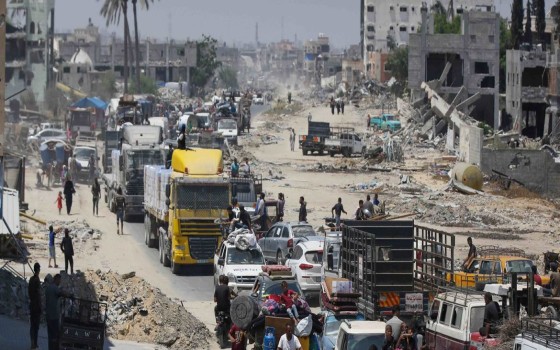
The Security Council discussed the situation in the Palestinian territories. A UN rapporteur stated that Israel's systematic torture—protected by impunity and political cover—has become an instrument of genocide.

- Europe and Arabs
- Wednesday , 25 March 2026 8:5 AM GMT
Geneva – New York: Europe and the Arabs
Francesca Albanese, the UN Special Rapporteur on the situation of human rights in the Palestinian territories occupied since 1967, stated that “the systematic torture perpetrated by Israel against Palestinians – protected for decades by impunity and political cover – has become an instrument of the ongoing genocide in the occupied Palestinian territory.”
In a report submitted to the UN Human Rights Council in Geneva, the Special Rapporteur said: “Since the beginning of the genocide, the Israeli prison system has degenerated into a laboratory of calculated cruelty… What was once done in secret is now practiced openly: a systematic system of humiliation, pain, and degradation, with the approval of the highest political levels.” This was reported in the UN Daily News Bulletin.
Albanese added that policies imposed by senior officials, “including National Security Minister Itamar Ben-Gvir,” have institutionalized torture, collective punishment, and inhumane detention conditions. The human rights expert added that those responsible for these "horrific human rights violations—which cannot be tolerated even in times of war—must face investigation and justice, including before the International Criminal Court."
Francesca Albanese's report warns that more than 18,500 Palestinians across the occupied Palestinian territory—including at least 1,500 children—have been detained since October 2023, and that thousands remain in detention without charge or trial.
It added that many have been forcibly disappeared, and nearly 100 have died in custody. The report stated that detainees were subjected to "unimaginable abuses, including rape with bottles, metal bars, and knives; starvation; broken bones and teeth; being spat on; and being attacked and urinated on by dogs."
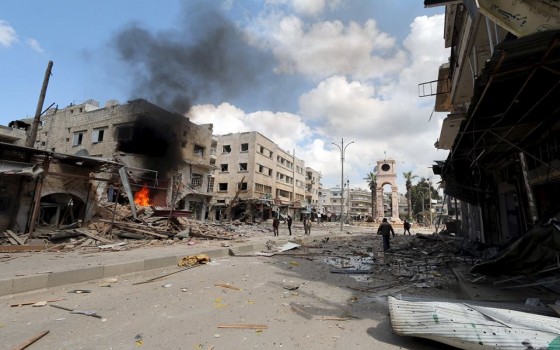
The report, submitted to the Human Rights Council, stated that torture extends beyond prison walls. He stated that “Israel has created a torture environment throughout the occupied Palestinian territory” through relentless bombing, forced displacement, starvation, the destruction of homes, hospitals, and infrastructure, pervasive surveillance, and the “terrorism” perpetrated by soldiers and “terrorist settler militias.”
Albanese said that Palestinians “in Gaza, the West Bank, and East Jerusalem are subjected to continuous suffering. There is no safe haven or place to live.”
At a meeting on the Palestinian question, the UN Security Council heard briefings from the UN Resident Coordinator in the occupied Palestinian territory on settlement activities, and from the High Representative of the Peace Council in Gaza on developments in the Council’s work and the disarmament framework in Gaza.
UN Coordinator Ramiz Alekperov, who also serves as Deputy Special Coordinator for the Middle East Peace Process, briefed the Security Council on the implementation of Resolution 2334 concerning settlement activities in the occupied Palestinian territory, including East Jerusalem.
The Security Council resolution adopted in 2016 affirms that “Israel’s establishment of settlements in the Palestinian territory occupied since 1967, including East Jerusalem, has no legal validity and constitutes a flagrant violation under international law and a major obstacle to achieving a two-state solution and a just, lasting, and comprehensive peace.”
In his opening remarks on the Secretary-General’s report on the implementation of the resolution, Alekperov noted that the resolution reiterates the demand that Israel immediately and completely cease all settlement activities in the occupied Palestinian territory, including East Jerusalem.
He stated that settlement activity, despite this, has continued at high levels. During the reporting period, from 3 December to 13 March, Israeli planning authorities advanced or approved more than 6,000 housing units in the occupied West Bank.
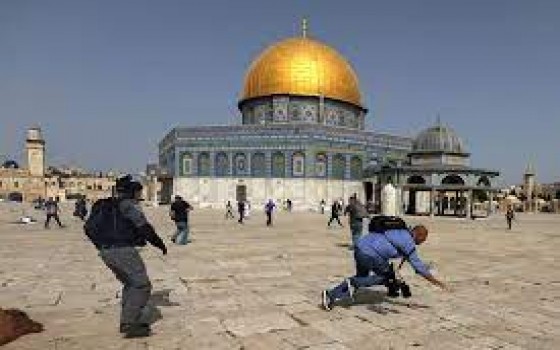
Alekperov also reported an accelerated pace of demolitions and confiscations of Palestinian-owned structures, attributing this to the near impossibility for Palestinians to obtain Israeli-issued building permits. He added that the expulsion of Palestinians from their homes in occupied East Jerusalem continued, as did the violence against civilians, with a large number of deadly incidents.
The UN coordinator said the ceasefire in Gaza was extremely fragile, noting the continuation of Israeli air operations, shelling, and gunfire throughout the Gaza Strip, including in the vicinity of the so-called "Yellow Line," while Hamas and other Palestinian armed groups engaged in exchanges of fire with Israeli forces.
The UN coordinator also reported that the high levels of violence in the occupied West Bank, including East Jerusalem, continued at an alarming rate.
During the months covered by the report, 32 Palestinians – including 7 children – were killed in large-scale operations by Israeli security forces, exchanges of fire, settler attacks, and other incidents.
According to Israeli sources, two Israeli civilians, including a woman, were killed by Palestinian gunmen.
The UN official said that daily settler attacks, often in the presence of Israeli forces, have escalated, resulting in casualties, property damage, and displacement in Palestinian communities throughout the occupied West Bank. The UN official conveyed the Secretary-General's condemnation of Israel's continued and relentless settlement expansion in the West Bank, stating that this expansion fuels tensions, obstructs Palestinian access to their land, and threatens the possibility of a fully independent and geographically contiguous Palestinian state. He said that Israel must comply with its obligations under international law.
He also expressed concern about unilateral Israeli steps to deepen Israeli administrative and territorial control over the West Bank. He said that these measures will likely lead to increased Israeli control over the land and contribute to the expansion of settlements.
In his report, the Secretary-General reaffirmed his commitment to supporting Palestinians and Israelis in ending the illegal occupation and resolving the conflict in accordance with international law, UN resolutions, and bilateral agreements, with the aim of achieving the vision of a two-state solution, with both states living side by side in peace and security, based on the pre-1967 lines: Israel and a sovereign, independent, democratic, and geographically contiguous State of Palestine, comprising Gaza and the West Bank.
Peace Council and Disarmament Framework for Gaza
The Security Council also heard a briefing from Nikolay Mladenov, the High Representative for the Peace Council in Gaza, on the implementation of resolution 2803, which endorsed the "comprehensive US plan to end the conflict in Gaza."
Mladenov stated that his office, together with the guarantors of the ceasefire agreement—the United States, Egypt, Turkey, and Qatar—had developed a comprehensive framework for the disarmament and reintegration of armed groups.
He said that the framework had been formally presented to the parties concerned and that serious discussions were now underway. He clarified precisely what he meant by "disarmament" in the context of Gaza, stating, "The comprehensive plan agreed upon by the parties established the principle of one authority, one law, one weapon. This principle applies to all armed groups in the Gaza Strip without exception."
He said this requires the complete disarmament of the Gaza Strip and placing all weapons under the control of the Palestinian Interim Authority.
He explained that the framework is based on five principles:
First, reciprocity: Disarmament will proceed in parallel with the phased Israeli withdrawal. Mladenov emphasized the importance of this for the credibility of the entire process.
Second, prioritization: The most dangerous weapons, including rockets, heavy ammunition, explosives, and assault rifles held by armed groups, will be dealt with first, along with the neutralization of tunnels. Personal weapons will be addressed last through a registration and collection process.
Third, verification: Compliance will be monitored and verified. Reconstruction will not begin until the disarmament phases are documented, Mladenov stated. Fourth – Engaging with people, including providing pathways for individuals currently associated with armed groups to reintegrate into civilian life with dignity through structured amnesty measures and reintegration programs.
Fifth – The Office of the High Representative will have the authority to extend timeframes when the parties undertake good offices.
The High Representative for the Peace Council in Gaza thanked Egypt for agreeing to be the lead training partner for developing the core of the Gaza police force.
He commended Morocco, Indonesia, Kazakhstan, Kosovo, and Albania for their commitment to contribute troops to the international stabilization force in Gaza, under US leadership. He called on all states to contribute to this force.
It should be noted that Special Rapporteurs and independent experts are appointed by the Human Rights Council in Geneva, an international body responsible for promoting and protecting human rights worldwide. Special Rapporteurs and experts are mandated to examine and report on human rights situations to the Council. They carry out their duties in their personal capacity and are completely independent of any government or organization, including the Office of the High Commissioner for Human Rights and other UN agencies. Any views or positions they express are their own and do not necessarily reflect the positions of the United Nations or the Office of the High Commissioner for Human Rights.




No Comments Found