

A strange discrepancy in developments... between the downing of drones over the Strait of Hormuz and the announcement of a final draft agreement between Washington and Tehran... and everyone is watching closely for the repercussions on the situation in Lebanon.

- Europe and Arabs
- Saturday , 13 June 2026 6:47 AM GMT
Washington – Tehran: Europe and the Arabs
The past few hours have witnessed strange contradictions in statements and positions regarding the Middle East conflict and the current fragile truce between Iran and the United States. According to European media reports, anticipation remains high after the Pakistani Prime Minister announced on Friday that a final draft of the memorandum of understanding between Washington and Tehran had been reached. This move reinforced the atmosphere of optimism expressed by US President Donald Trump over the past two days. Attention is now focused on whether these understandings will lead to a regional de-escalation.
Simultaneously, the US Central Command announced today that the Strait of Hormuz remains open to international trade and revealed that it had shot down drones launched by Iran toward commercial vessels in the strait. In contrast, the official Iranian news agency quoted the commander of the Khatam al-Anbiya Construction Headquarters as saying that the world "will soon hear the echo of our victory." According to a report by the European news network Euronews in Brussels:
In Israel, American sources revealed to Axios that Trump's announcement of an agreement with Iran surprised Prime Minister Benjamin Netanyahu, who then contacted allies in Washington to learn its details. The sources added that Netanyahu realized during a call with Trump that he could not prevent him from proceeding with the agreement, while some officials in Washington believe he might try to obstruct it even after its conclusion.
Meanwhile, in Lebanon, which continues to suffer from ongoing Israeli strikes, attention is focused on whether the anticipated understandings will affect the course of confrontations between Israel and Hezbollah. Yedioth Ahronoth quoted an Israeli source as saying that information available to Israel indicates that the agreement between Washington and Tehran already includes a ceasefire in Lebanon, despite continued Israeli warnings of retaliation against any attacks that Hezbollah or Iran might carry out in the coming period.
Hezbollah announces clashes with Israeli forces in southern Lebanon.
Hezbollah reported that Israeli forces came under fire Thursday evening as they advanced toward Majdal Zoun, about five kilometers from the border. The group said it forced the soldiers to retreat with repeated rocket fire.
On Friday, Hezbollah announced renewed clashes at the same location. It stated that Israeli soldiers were targeted with "light and medium weapons, in addition to rockets." Hezbollah also claimed responsibility for other attacks on Israeli forces in southern Lebanon.
The Israeli military had earlier called for the evacuation of three villages in southern Lebanon. The official Lebanese news agency, ANI, later reported several attacks, including on areas for which Israel had not issued any warnings. Later, the agency reported loud explosions and artillery shelling near Nabatieh. The Israeli military intercepted a humanitarian aid convoy belonging to the Papal Nuncio to Lebanon, which was en route to Christian villages in the south where residents had remained despite the conflict, and forced it to change course.
Hezbollah reported that Israeli forces came under fire Thursday evening as they advanced toward Majdal Zoun, about five kilometers from the border. The party stated that it forced the soldiers to retreat with repeated rocket fire.
On Friday, Hezbollah announced renewed clashes at the same location. It reported that Israeli soldiers were targeted with "light and medium weapons, in addition to rockets." Hezbollah also claimed responsibility for other attacks on Israeli forces in southern Lebanon.
The Israeli military had earlier called for the evacuation of three villages in southern Lebanon. The official Lebanese news agency, ANI, later reported several attacks, including on areas for which Israel had not issued any warnings. Later, the agency reported loud explosions and artillery shelling near Nabatieh. The Israeli military intercepted a humanitarian aid convoy belonging to the Papal Nuncio to Lebanon, which was en route to Christian villages in the south where residents had remained despite the conflict, and forced it to change course.
The United States shot down several Iranian attack drones near the Strait of Hormuz on Friday, a source familiar with the matter told Reuters, as Washington and Tehran announced progress in peace talks.
According to the source, who requested anonymity, the drones were single-rotor attack aircraft and posed a threat to commercial shipping in the strategically important waterway.
This interception represents a new military escalation between the United States and Iran, despite statements from both countries indicating progress in peace negotiations.
Earlier on Friday, President Donald Trump warned Iran against launching more drones at ships transiting the Strait of Hormuz, urging Tehran to "act quickly."
The United States and Iran are currently engaged in negotiations to reach a potential agreement to reduce tensions. According to a draft agreement seen by multiple sources and reviewed by Reuters, Washington would release billions of dollars in frozen Iranian assets and lift sanctions on Iranian oil exports in exchange for the reopening of the Strait of Hormuz.
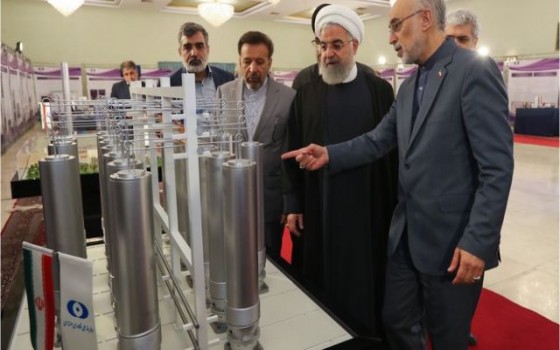
The Iranian nuclear program would then be discussed over a 60-day period. A senior Trump administration official said the agreement should ultimately lead to the dismantling of Iran's nuclear program, which would involve the destruction and removal of its stockpile of highly enriched uranium.
Iranian Foreign Minister Abbas Araqchi stated on state television that Tehran wanted to retain its uranium in a diluted form.
Iranian Foreign Minister Abbas Araqchi stated on state television that Tehran wanted to retain its uranium in a diluted form. © Reuters
The agreement also includes an inspection regime to monitor compliance with the agreement in the long term. However,
According to available information, Iran has not agreed to dismantle its nuclear program. Deputy Foreign Minister Abbas Araqchi stated on state television that Tehran wants to retain its uranium in a diluted form. He added, "For Tehran, the only acceptable solution for its stockpile of highly enriched uranium is to dilute it."
According to sources, the proposals also include talks on potential compensation for Tehran and the abandonment of longstanding U.S. demands regarding restrictions on Iran's missile program. However, a U.S. official denied this account. An official, speaking on condition of anonymity, said, "No money will be disbursed until they fulfill their promises. The Strait of Hormuz will remain open. And Iran will not provide any funding to terrorist groups." He added that it is a "performance-based agreement."
The negotiations have thus far been marked by conflicting statements from both sides, making it unclear what terms might ultimately lead to an agreement.


No Comments Found