
Arab Nations at UN Meetings — Egypt: Water security is an existential issue that allows for no compromise; Lebanon: The nation's future cannot be decided on its behalf; Iraq: We possess the will to build a new economy; Bahrain: We reject restrictions on navigation in the Strait of Hormuz.

- Europe and Arabs
- Saturday , 26 September 2026 5:37 AM GMT
New York – Europe and the Arabs
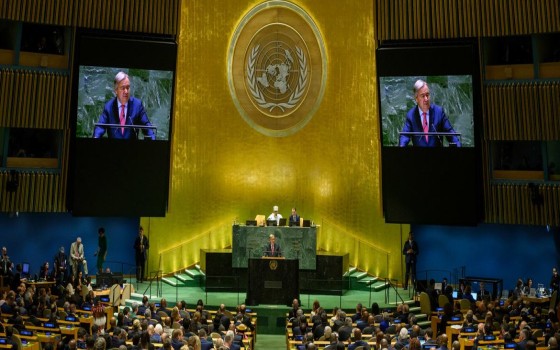
Egyptian Prime Minister Mostafa Kamal Madbouly stated that his country's water security is an existential issue that allows for no compromise, affirming Egypt's belief that transboundary water resources should be a realm for cooperation and integration rather than conflict.
These remarks were made during his address to the UN General Assembly’s high-level general debate, where he emphasized that Egypt "believes water security and development are not conflicting goals, but rather complementary ones—provided there is political will, good intentions, and respect for international law."
He stressed that Egypt does not oppose any people's right to development, adding: "Egypt reserves its legitimate right, guaranteed by the UN Charter and international law, to protect its water security and safeguard the existential interests of its people."
The Palestinian Cause
The Egyptian Prime Minister warned that "confidence in the viability of collective action and the multilateral system has eroded," emphasizing that restoring this trust requires three interconnected pillars: fairness in representation and decision-making, fairness in the application of the law, and fairness in the distribution of opportunities for development and transformation.
He noted that "if fairness in the application of rules is the true test of the international system's credibility, then the Palestinian cause remains the most prominent testament to the existing imbalance."
He stated that the suffering, oppression, and violations the Palestinian people have endured—and continue to face—"must not be allowed to become a normalized reality or a protracted crisis managed merely from one round of conflict to the next." He emphasized that consolidating the ceasefire in the Gaza Strip, ensuring full adherence to it, halting daily Israeli violations, completing the withdrawal, securing the safe and sustainable delivery of humanitarian aid, enabling the National Committee for Gaza Management to commence its work, and subsequently transitioning immediately to early recovery and reconstruction, are "not merely humanitarian steps; they are also the essential gateway to a serious political path that addresses the root causes of the conflict."
He added: "Peace cannot be built upon uprooting a people from their land. Any notion that regional stability can be achieved while ignoring the suffering of the Palestinian people—and persisting in a policy of managing the occupation rather than ending it—is sheer delusion and fantasy."
Regional Security
The Egyptian Prime Minister also addressed regional security, affirming that his country’s vision is grounded in state sovereignty, territorial integrity, and respect for national institutions. He rejected the dismantling of states or the creation of parallel entities, advocating instead for political solutions and inclusive national settlements over the logic of force and the imposition of *faits accomplis*.
Madbouly stated: "Security is indivisible; a state’s security cannot be built upon the insecurity of its neighbors, threats to navigation, trade, and energy routes, or the violation of state sovereignty and the bombardment of nations in contravention of international law."
He warned that any regional actor believing its political and economic interests can be realized by undermining national state institutions, supporting militias, or fostering separatist agendas and civil strife becomes part of the problem—making it the responsibility of the entire international community to confront such an actor and its practices. He added: "None of the region's crises can be treated in isolation; rather, they must be viewed within the context of an interconnected security and regional environment."
He also addressed the crisis in Sudan, emphasizing that the Sudanese people find a strong supporter in Egypt—a supporter of their right to unity, of institutions capable of safeguarding their national assets, and of justice that upholds their dignity.
For his part, Bahraini Foreign Minister Abdullatif bin Rashid Al Zayani stated that the Gulf Cooperation Council (GCC) states and the Hashemite Kingdom of Jordan have been subjected to "waves of unjustified Iranian attacks involving ballistic missiles and drones."
Al Zayani explained that these attacks "targeted civilian facilities, residential areas, ports, airports, and energy infrastructure, in flagrant violation of international law and the UN Charter."
He made these remarks during the UN General Assembly’s high-level general debate on Friday evening, noting that Iranian attacks have totaled approximately 7,000 incidents—including the launching of ballistic missiles, cruise missiles, and drones, as well as the targeting and seizure of commercial vessels in the region.
He added that around 1,000 cargo ships and tankers, manned by nearly 20,000 sailors, had been detained, while 72 commercial vessels were targeted, resulting in the deaths of 22 sailors. Al-Zayani stated that these figures represent more than mere statistics; behind them lie ships, ports, markets, and families awaiting the return of their loved ones. He pointed to the targeting of commercial vessels in the Strait of Hormuz, the laying of mines in an international shipping lane, and the imposition of restrictions on transit—actions he described as contrary to international law.
The Bahraini Foreign Minister warned that the repercussions of these developments extend beyond the Arabian Gulf region, impacting global energy and food prices, shipping and insurance costs, and supply chains worldwide.
Al-Zayani reiterated Bahrain’s solidarity with the Gulf states that have been subjected to attacks, commending the competence of the Bahrain Defence Force and the air defense systems of fellow Gulf nations, as well as their readiness to counter such attacks.
He affirmed that these nations uphold their right to take legitimate measures to defend their sovereignty and territorial integrity, in accordance with Article 51 of the UN Charter and the GCC Joint Defense Agreement.
At the same time, he emphasized his country’s commitment to exercising the utmost restraint, underscoring its dedication to achieving security and peace for the peoples of the region.
Bahrain Rejects Restrictions on Navigation in the Strait of Hormuz
Regarding the Strait of Hormuz, Al-Zayani stressed that Bahrain’s position is grounded in international law, affirming that the Strait constitutes an international shipping lane and that the right of passage through it is guaranteed for vessels under the UN Convention on the Law of the Sea. He stated that the Kingdom categorically rejects any permit or fee system imposed on vessels transiting the strait, and likewise rejects the use of international waterways as a means of pressure, economic blackmail, or the seizure of ships.
He warned that accepting such practices in one international waterway could open the door to similar demands regarding other waterways vital to global trade, emphasizing that resorting to alternative routes should not replace adherence to international law.
Bahrain Affirms Commitment to Coexistence and Development
Elsewhere in his address, the Bahraini Foreign Minister highlighted his country’s experience with tolerance and religious coexistence, noting that mosques, churches, and temples have coexisted in Bahrain for generations.
Al-Zayani addressed Bahrain’s development trajectory, noting the continued implementation of Bahrain’s Economic Vision 2030 and commitment to the Sustainable Development Goals. He also highlighted efforts to enhance the role of Bahraini women and the adoption of the "Women, Peace, and Security" and "Youth, Peace, and Security" agendas as key priorities for the Kingdom during its tenure on the Security Council.
Al-Zayani also discussed rapid developments in artificial intelligence, recalling the call made two years ago by Bahrain’s Crown Prince and Prime Minister for an international treaty to govern AI development in a manner that supports peace and prevents the escalation of conflicts.
In concluding his remarks, he affirmed that his country’s vision views regional security and prosperity as interconnected paths, and that—in his words—just peace and sustainable stability form the foundation for a dignified life for the region’s peoples, across their diverse religions and cultures. Al-Zayani called for strengthening the United Nations' capacity to implement its resolutions, stating that the challenge lies not so much in issuing further resolutions as in ensuring their implementation and safeguarding the rights they uphold.
Meanwhile, Lebanese Prime Minister Najib Mikati emphasized the paramount importance of confining the possession of arms and the authority to decide on war and peace exclusively to the State and its constitutional institutions. He described this as a priority reflected in decisions adopted by the Council of Ministers after Lebanon found itself facing a war that was imposed upon it, rather than one it had chosen.
In his address, Mikati stated that the war erupted "despite our repeated warnings regarding the dangers of being dragged into it. As the conflict expanded across the region and various initiatives to end it emerged, we adhered to a non-negotiable principle: no one speaks or negotiates on behalf of Lebanon other than the Lebanese State through its constitutional institutions."
He affirmed his rejection of Lebanon becoming an arena for others' conflicts or a bargaining chip in their hands, declaring, "Lebanon’s future cannot be decided by others on its behalf; its security and stability must not become the price paid for settlements reached in its absence."
He underscored that Lebanon’s stance on the war has been clear from the outset: demanding an end to hostilities, solidifying a ceasefire, securing Israel’s withdrawal from all Lebanese territory, releasing all detainees, and ensuring the return of residents to their villages and the subsequent reconstruction of those areas.
He added that, based on this premise, the Lebanese State had entered into negotiations with Israel—under the auspices of the United States and its President—to reach arrangements ensuring an end to the war and the restoration of full Lebanese sovereignty.
He concluded by stating that the success of any agreement is measured not by declared intentions, but by the fulfillment of obligations. Nawaf Salam commended the role of the United Nations Interim Force in Lebanon (UNIFIL), as well as the courage and sacrifices of its leadership, personnel, and staff in maintaining stability, supporting the Lebanese Armed Forces in their missions, and implementing Security Council Resolution 1701.
He referred to Security Council Resolution 2790, which mandates the conclusion of UNIFIL operations by the end of the current year and the commencement of a gradual withdrawal. The resolution requests the UN Secretary-General to explore available options for the continued implementation of Resolution 1701.
The Lebanese Prime Minister emphasized the need to avoid the vacuum that could result from a UNIFIL withdrawal—were it to occur without an agreement on a new international force to replace it and ensure the continuity of monitoring, reporting, and liaison functions.
Salam addressed the humanitarian crisis and extensive destruction caused by the war—affecting housing, public facilities, infrastructure, and productive sectors—and noted that large numbers of Lebanese people have been deprived of their homes and livelihoods.
He thanked UN agencies and international partners for their humanitarian contributions and called for continued funding to meet the basic needs of those affected—particularly the displaced—alongside the requirements for early recovery, reconstruction, and development.
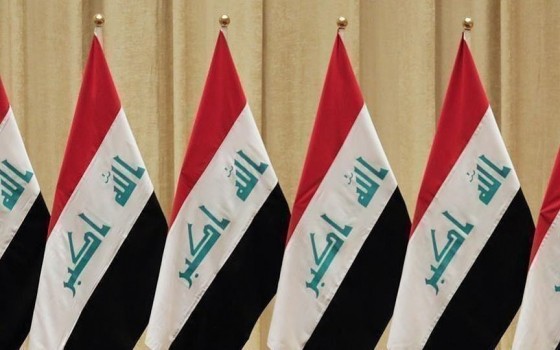
He stated that Lebanon is fulfilling its responsibilities regarding reform and the extension of state authority across its entire territory, but also called upon the international community to shoulder its own responsibilities in ensuring respect for Lebanon’s sovereignty and the implementation of international legitimacy resolutions. For his part, Iraqi Prime Minister Ali Faleh Al-Zaidi stated that his country seeks to leverage its influence as an active economic power in the region and as a bridge for dialogue and cooperation among its peoples. He said: "We are committed to ensuring the state holds the decision-making authority regarding peace and war, and that arms and instruments of power remain in the hands of its constitutional institutions, so that the law serves as the ultimate arbiter and the national interest acts as our compass."
He explained that their executive measures in this area are moving in the right direction, as they lay the foundation for building a state of institutions, protecting sovereignty, consolidating stability, and creating an environment conducive to development and investment.
He noted that with the conclusion of the International Coalition's mission in Iraq, "we are transitioning our relationship with strategic partners into a new phase—shifting from military cooperation to economic and developmental cooperation that serves our mutual interests."
He called on all parties to secure the borders, address security gaps, and remain constantly vigilant to prevent the emergence of an environment that fosters extremism. Addressing institutional reform, he said: "Our government is waging a battle against corruption and to protect public funds; we are pursuing a path of fundamental, sustainable solutions to enhance performance efficiency and improve services."
He added that they are working to harness successful expertise and innovative practices from the worlds of economics, finance, and business to drive Iraq's economic and financial reform and to create a secure environment for both domestic and foreign investment.






No Comments Found