
Brussels: Today, ministerial meetings between the European Union and the countries of Southeast Asia and the Indian and Pacific Ocean region

- Europe and Arabs
- Friday , 2 February 2024 15:48 PM GMT
Brussels: Europe and the Arabs
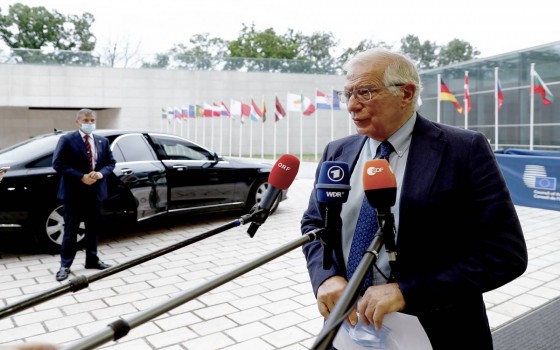
European Union Foreign Policy Coordinator Josep Borrell said in a post on X (formerly Twitter): “Today we are holding a ministerial forum between the European Union and the Pacific Rim and a ministerial meeting between the European Union and the Association of Southeast Asian Nations. These regions have a desire to work together to enhance our shared security and resilience, especially in times of competition between global powers.
In a statement distributed in Brussels, Borrell said that at the beginning of 2024, Europeans are naturally deeply concerned about the ongoing Russian aggressive war against Ukraine and the conflict that has erupted again in the Middle East. However, we do not forget the broader picture: the center of gravity of the global economy has shifted to the Indo-Pacific region, which contains approximately 50% of global GDP and 60% of the world's population. Peace and stability in this region are crucial for Europe and the world.
In recent years, the European Union has been steadily improving its cooperation with the region, in particular by becoming in 2020 a strategic partner of the Association of Southeast Asian Nations (ASEAN), launching its Indo-Pacific strategy in 2021, and concluding a successful alliance For the European Union. - The ASEAN Summit in 2022 and the adoption of the Samoa Agreement with Pacific countries in 2023. We will accelerate the path in 2024.
Economic ties between the European Union and the Indo-Pacific region have reached an impressive level, unimaginable forty years ago. The region's sea routes have become the arteries of the world: every day 2,000 ships transport cargo across the Indian Ocean and the South China Sea to Europe and back. However, the security environment is deteriorating. Major tensions are rising, from the South China Sea, to the Taiwan Strait, the Korean Peninsula, and the Red Sea. There is less trust between major global and regional players; Less respect for international law and multilateral agreements; Force and coercion are on the rise. We are at risk of returning to a world where “might makes right.”
The European Union intends to confront this trend. Multilateral solutions and regional approaches exist and we will always defend international law, including UNCLOS and the non-proliferation regime. To defend the rules-based global order, we want to cooperate more closely with our partners committed to multilateralism in the Indo-Pacific region.
The European Union maintains regular security and defense dialogues with China, Japan, India, Australia, South Korea and other countries. However, our cooperation increasingly extends beyond dialogue to include concrete and operational activities.
Under our strategic partnership with the Association of Southeast Asian Nations (ASEAN), security cooperation has also become an increasingly key element. We participate with members of the Association of Southeast Asian Nations (ASEAN) in regional naval exercises, and the navies of our Asian partners are cooperating with us in Operation Atalanta, near the Horn of Africa. These are good examples of what we can do together.
Going forward, we propose to use the advanced capabilities of our member states to become an “intelligent security enabler,” helping to build the capabilities of our partners in the region in maritime security, cybersecurity, counter-terrorism, and foreign information manipulation and interference.
We need each other to help stabilize this world. The challenges we face offer us no other recourse than close cooperation to help avoid conflicts and ensure respect for international law. In order to protect freedom of navigation, EU member states are already working to increase their reach between the EU and the Indo-Pacific region. The region can count on us as a reliable partner.
On the economic side, Russia's aggression against Ukraine has shown us the high costs of the European Union's over-reliance on Russian gas. We are therefore focused on improving the EU's economic security by reducing this type of over-dependence. But this does not mean closing our borders. On the contrary, it should lead to the development of our economic relations with many countries in the Indo-Pacific region, in order to remove risks to our economy and diversify our supply chains.
In this context, the European Union recently signed a free trade agreement with New Zealand, and negotiations are underway with India, Indonesia and Thailand. We are also engaging with Japan, South Korea, Singapore and India to ensure stable and diversified supply chains in digital technologies and have proposed to our partners in the Indo-Pacific region to work together on the sustainable extraction and processing of critical and essential raw materials. For green and digital transitions.
The EU also wants to cooperate more actively with Indo-Pacific countries towards a green and sustainable future. The Green and Blue Alliance with the Pacific Islands helps strengthen their resilience to climate change. Together with our G7 partners, we have also agreed just energy transition partnerships with South Africa, Indonesia and Vietnam, and the European Investment Bank is already investing €500 million to accelerate Vietnam’s green transition in a way that benefits people and the planet.
In short, we are fully aware of the critical importance of EU engagement in the Indo-Pacific region.
We are showcasing this through Pacific Day in the European Parliament in early February, to highlight our thriving cooperation with our Pacific Island partners. The next day, the Third Indo-Pacific Ministerial Forum will bring together Foreign Ministers of the region and the European Union. After that, we will hold our biennial EU-ASEAN Ministerial Meeting.
In a world of geopolitical turmoil and great power rivalry, these three high-level meetings demonstrate the strong and shared interest between the EU and Indo-Pacific countries in cooperating more closely to enhance their security, prosperity and resilience.




No Comments Found