
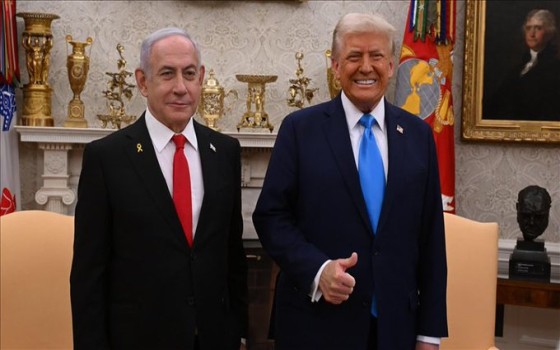
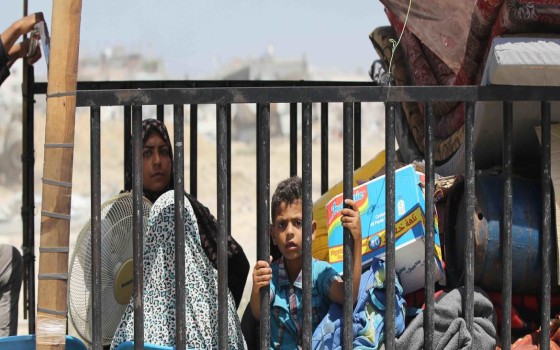
A new meeting brings Netanyahu and Trump together in Washington amid international condemnation of Israeli actions in the West Bank... Gaza suffers from water shortages, the dangers of explosives, and restrictions on humanitarian aid.

- Europe and Arabs
- Wednesday , 11 February 2026 7:7 AM GMT
Gaza - Washington: Europe and the Arabs - Agencies
Amid international condemnation of Israeli actions in the West Bank and the continued suffering of Palestinians in Gaza from water shortages, the dangers of explosives, and restrictions on humanitarian aid, a new meeting is scheduled between the US President and the Israeli Prime Minister. White House spokeswoman Caroline Levitt said that President Donald Trump will hold a bilateral meeting with Benjamin Netanyahu at the White House on Wednesday, according to the Brussels-based European news network Euronews. Netanyahu explained before leaving Israel that the discussion will focus on the Gaza Strip, the regional situation, and especially Iran, emphasizing that he will present Trump with principles for negotiating with Tehran that are "important to those seeking peace and security in the Middle East."
Sources close to Netanyahu indicated that he is expected to present Trump with information about Iran's rebuilding of its ballistic missile program. Meanwhile, some US officials believe that the Israeli Prime Minister is leaning towards the option of launching an attack on Iran and is seeking to push for this step during his visit, according to the Cairo-based Youm7 website.
This comes after the Canadian Foreign Ministry strongly condemned Israel's decision to expand its control to annex the West Bank. The Canadian Foreign Ministry said in a statement: "These actions violate international law, undermine the prospects for peace, and weaken the possibility of a Palestinian state. We call on Israel to reverse this decision and immediately halt settlement expansion."
In this context, a White House source told an Axios reporter that US President Donald Trump has consistently opposed such actions by Israel.
The foreign ministers of Saudi Arabia, Jordan, the UAE, Qatar, Indonesia, Pakistan, Egypt, and Turkey also condemned the Israeli actions in the West Bank, considering them to be undermining ongoing efforts to establish peace in the region. According to them, these actions accelerate the illegal annexation process and the displacement of the Palestinian population.
For its part, France also condemned the recent decisions taken by the Israeli Security Cabinet, which aim to expand Tel Aviv's control over the West Bank, particularly Areas A and B.
The French Foreign Ministry stressed that these decisions contravene international law and constitute a serious challenge to the Oslo Accords and the Hebron Agreement. The Israeli Security Cabinet, in its meeting on Sunday, approved a series of decisions pushed by Finance Minister Bezalel Smotrich and Defense Minister Israel Katz to deepen the de facto annexation of areas in the West Bank.
The UN Secretary-General expressed grave concern over the reported decision by the Israeli Security Cabinet to authorize a series of administrative and executive measures in Areas A and B of the occupied West Bank. He warned that the current trajectory on the ground, including this decision, undermines the prospects for a two-state solution.
In a statement issued by his spokesperson, Secretary-General António Guterres reiterated that all Israeli settlements in the occupied West Bank, including East Jerusalem, and the associated settlement infrastructure, have no legal validity and constitute a flagrant violation of international law, including relevant UN resolutions.
The statement added that such actions, including Israel’s continued presence in the occupied Palestinian territory, are not only destabilizing but also illegal, as the International Court of Justice has ruled. The Secretary-General called on Israel to reverse these measures and urged all parties to uphold the only path to lasting peace: a negotiated two-state solution in accordance with Security Council resolutions and international law.
Water Shortages in Gaza
Regarding the situation in Gaza, the United Nations Office for the Coordination of Humanitarian Affairs (OCHA) reported that the UN and its partners continue to provide hundreds of thousands of meals daily, in addition to digital cash assistance and monthly food rations, despite ongoing obstacles.
OCHA quoted colleagues responsible for the water, sanitation, and hygiene (WASH) sector as saying that Gaza City continues to face a severe shortage of drinking water and water for domestic use.
This is despite the reopening of the Mekorot water pipeline valve, which connects Israel to Gaza to supply fresh water. Only 6,000 cubic meters of water are reaching the city's residents daily, with significant water losses in hard-to-reach areas.
OCHA reported that to alleviate this shortage, the UN and its partners have increased water production and trucked transport from groundwater wells and privately owned desalination plants. Explosive Ordnance Risk Assessment
In another development, UN Spokesperson Stéphane Dujarric said that mine action partners conducted more than 200 potential explosive ordnance risk assessments in the week leading up to last Wednesday to support debris removal in Gaza.
He noted that this is in addition to the support they provide to secure the movement and operations of humanitarian aid in an extremely challenging environment. He explained that last week, mine action partners also educated more than 10,000 children and adults about the dangers of explosive ordnance.
They pointed out that this remains a significant risk, with 33 incidents involving explosive ordnance reported since the ceasefire came into effect last October, resulting in 9 deaths and 65 injuries.
The UN spokesperson quoted humanitarian partners as saying that restrictions, including those on the entry of items classified as “dual-use” or non-humanitarian, continue to impede the humanitarian response. These items include spare parts and some shelter materials.
Dujarric also said that the deregistration of some important international NGOs undermines humanitarian operations, while restrictions on the United Nations Relief and Works Agency for Palestine Refugees (UNRWA) and other UN agencies persist.






No Comments Found