
Iceland to Hold Early Referendum on EU Membership Following Disputes with Washington over Greenland, the War in Ukraine, and Rising Living Costs

- Europe and Arabs
- Thursday , 26 February 2026 4:27 AM GMT
Brussels – Warsaw: Europe and the Arabs
Iceland has announced its intention to expedite a referendum on joining the European Union due to tensions in the Arctic, according to European media reports in Brussels. The reports added that Iceland will hold a referendum on its potential EU membership "in the coming months." At the beginning of last year, the Icelandic government indicated its intention to hold the referendum by 2027, but during a visit to Poland, Prime Minister Kristrún Frostadóttir stated that the referendum would be held sooner. Reuters quoted her as citing tensions surrounding Greenland, which lies between Iceland and the United States. Iceland applied to join the European Union in 2009 but withdrew its candidacy in 2013. According to opinion polls, rising living costs and the war in Ukraine have increased interest in joining the EU. The Belgian newspaper Newsblad, based in Brussels, added that "repeated threats made by US President Donald Trump against Greenland have made the issue of EU membership more pressing." Urgently. Iceland has a population of around 400,000.
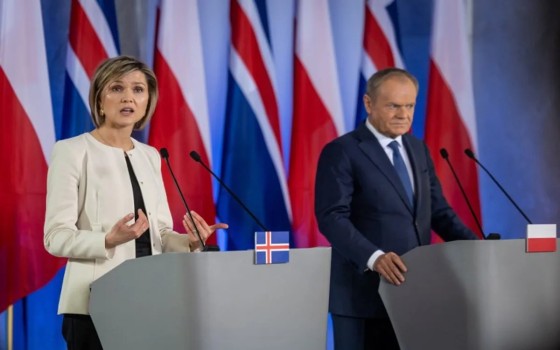
In the referendum, the Icelandic people will be asked whether the country should resume accession negotiations with the European Union. Prime Minister Frostádóttir said during a press conference with her Polish counterpart, Donald Tusk, that resuming these talks aims to "create an opportunity" for Iceland and seek better integration of the island into Europe.
The Republic of Iceland is a European island country in the North Atlantic Ocean, on the Mid-Atlantic Ridge. It has a population of 389,990 and a total area of 103,000 km². Its capital and largest city is Reykjavík, and it and the southwestern regions are home to more than two-thirds of the country's population. Iceland is a volcanically and geologically active country. The mainland consists of a plateau characterized by sand fields, mountains, and glaciers, while many glaciers flow into the sea through the lowlands. The Gulf Stream moderates Iceland's climate, making it temperate and habitable despite its location on the edge of the Arctic Circle. The European Union has expanded several times throughout its history by admitting new member states. To join the EU, a country must meet the political and economic criteria known as the Copenhagen criteria (named after the Copenhagen Summit held in June 1993). These criteria require a stable, democratic government that respects the rule of law, freedoms, and institutions consistent with the country's legal framework. According to the Maastricht Treaty, accession requires the approval of the European Parliament and each member state. This expansion process is sometimes referred to as European integration. The term is also used to describe the increasing cooperation among EU member states as their governments gradually align their laws with those of the Union.
The European Economic Community (EEC), the precursor to the EU, was established by six countries in 1958 following the Treaty of Rome. Since then, the number of EU member states has grown to 28, with Croatia being the most recent to join in July 2013. The most recent geographical expansion of the EU was the accession of Mayotte in 2014. Notable instances of the EU's geographical boundaries, and the pre-EU single market, shrinking occurred when Algeria withdrew following its independence in 1962, and Greenland left in 1985. Since 2019, accession negotiations have been underway for Serbia (since 2014), Montenegro (since 2012), and Turkey (since 2005). Serbia and Montenegro are considered among the top candidates for EU membership, according to European Commission President Jean-Claude Juncker and Commissioner for European Neighbourhood Policy and Enlargement Negotiations Johannes Hahn, who anticipate their accession by 2025, during the new European Commission term. Talks have also taken place with Turkey regarding joining the Union, but the pace of those talks has slowed, especially after the attempted coup in Turkey in 2016, which led to the European Union objecting to the Turkish government's response to the coup attempt.




No Comments Found