


UN approves Egyptian-drafted resolution demanding Israel withdraw from Syrian Golan Heights... Journalist killed in Gaza... Israeli army establishes new secret units to rebuild its "technological brain"

- Europe and Arabs
- Wednesday , 3 December 2025 8:19 AM GMT
Gaza – New York: Europe and the Arabs
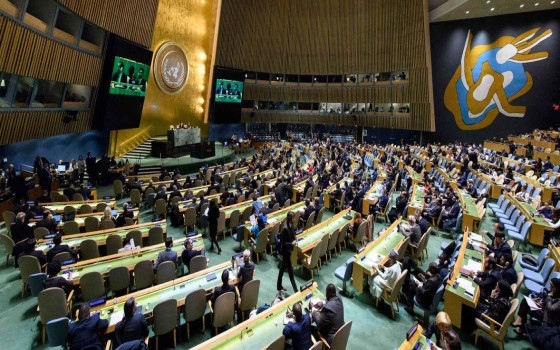
The United Nations General Assembly adopted a resolution demanding that Israel withdraw from the Syrian Golan Heights to the pre-June 4, 1967 borders, when Israel seized part of this territory from Syria during the Six-Day War. The resolution describes this occupation as "illegal," partly because it violates previous UN Security Council resolutions.
European media outlets in Brussels covered the matter, with the Belgian daily newspaper Nieuwsblad reporting that the resolution, drafted by Egypt, was adopted by a vote of 123 to 7, with 41 abstentions. Israel, the United States, and the United Kingdom, among others, voted against it.
Israel's ambassador to the United Nations, Danny Danon, described the resolution as a "farce." He wrote, "Instead of addressing the activities of militias in Syria, the resolution demands that Israel withdraw from the Golan Heights, a vital line of defense protecting our citizens." He added, "Israel will not return to the 1967 borders and will not relinquish the Golan Heights, not now, not ever." Under the headline "Israel kills another journalist in Gaza," the same media sources reported that the Palestinian news agency WAFA reported on Tuesday that Israel had killed another journalist in the Gaza Strip. Another journalist was injured in a drone strike in Khan Younis, in the southern part of the Gaza Strip, which has been devastated by Israel.
According to WAFA, the suspected attacker was photojournalist Mahmoud Wadi. He was using a drone to film footage for various media outlets. Mohammed Abdel Fattah Aslih was wounded in the attack. His brother, Hassan Aslih, was killed earlier in May in an Israeli drone strike near Nasser Hospital.
Israel targets journalists and media workers. According to the Committee to Protect Journalists, Israel has killed more than 200 journalists in the Gaza Strip since the start of the war two years ago.
In related news, the Israeli military confirmed on Tuesday that its Communications, Computing, and Cyber Defense Directorate (C4I), responsible for command, control, communications, computers, and intelligence, will establish two new departments: one dedicated to all radio waves and frequencies, and the other to artificial intelligence. This is based on lessons learned by Israeli forces during the war with Hamas. The military explained that these two departments will be added to the directorate to better address future challenges.
The Radio Frequency and Waves Division and its Operational Role
The Army indicated that the Radio Frequency and Waves Division will be an operational-technological division leading efforts to achieve superiority in the field of radio frequencies and strategic communications, the area upon which the Army's communications, radar, and satellite systems rely.
It stated that this division was initially established to meet defensive needs, but field experience during the war highlighted the need to develop it to perform offensive missions as well, ensuring the Army's freedom of action in various conditions.
The Army added that this division will also handle work in the space and satellite field, an area of increasing global importance.
The Army explained that the new Artificial Intelligence Division will lead the development of AI-based platforms and systems, aiming to achieve a significant leap in the operational effectiveness of the Army and its units.
It stated that this development will be achieved through the adoption of advanced technologies and joint operations between several branches and agencies, along with a focus on developing personnel, work methodologies, and the digital culture required by modern warfare. The military also confirmed that it had determined during the war the need to increase reliance on reservists with experience in the cybersecurity sector from their civilian work, and therefore the new department will include a unit composed entirely of reservists.
Euronews added, under the headline "Developments in the Directorate During the Israel-Hamas War": The army stated that the Directorate's activity expanded and intensified during the war, and that the need arose to provide rapid technological solutions that meet the demands of the field and to ensure the continuity of communications in combat conditions. It noted that, for the first time, solutions were developed that allow operational units to access information in real time across all existing operational systems. The Directorate is also working on developing a system that uses artificial intelligence to transcribe communications inside tanks, aircraft, and submarines within seconds, instantly converting voices into text, which improves the management of combat operations. The army stated that the Directorate is also developing cloud-based systems for faster and more effective identification of fallen soldiers, and other systems for organizing manpower and managing reserve soldiers to reduce personnel shortages and improve troop readiness. The army explained that the C4I and Cyber Defense Directorate originally comprised the Cyber Defense Division, the Operations and Signal Corps Division, and the Force Affairs and Building Division, and that it currently operates under the command of Major General Aviad Dagan. The article was titled "National Directorate of Artificial Intelligence." The European News Network reported that, concurrently, the Israeli Prime Minister's Office announced the establishment of a National Directorate of Artificial Intelligence, headed by Reserve Brigadier General Erez Ascal. The office stated that the directorate was created at the initiative of Prime Minister Benjamin Netanyahu and aims to transform Israel into a global powerhouse in artificial intelligence.
It explained that the directorate will be responsible for formulating and implementing the national strategy related to artificial intelligence, leading innovation, regulation, infrastructure, and scientific research, while enhancing Israel's standing on the international stage.
The military did not clarify how coordination will take place between the existing military artificial intelligence directorate and the new national directorate under the Prime Minister's Office.







No Comments Found