

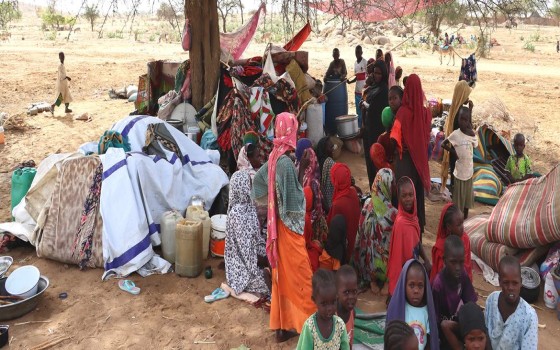
Violations in Sudan escalate, and the technologically advanced war is supported by foreign actors. The UN: An ugly, bloody, and senseless war... and concerns over the militarization of societies.

- Europe and Arabs
- Friday , 27 February 2026 5:10 AM GMT
Khartoum – New York: Europe and the Arabs
UN High Commissioner for Human Rights Volker Türk said that the nearly three-year-long war in Sudan has turned the country into a "land of despair," and that both the Sudanese Armed Forces and the Rapid Support Forces continue to use explosive weapons in densely populated areas, attacking schools, hospitals, markets, and places of worship in flagrant violation of international humanitarian law. According to the UN daily news bulletin, a copy of which we received this morning, Türk presented a report during an interactive dialogue held by the Human Rights Council on the situation in Sudan, which he described as "another chapter in a record of brutality." He stated that the report documents persistent patterns of violence against civilians, including killing, rape, and torture.
He added that violations of international law by all parties to the conflict have escalated as the fighting has intensified, in the absence of accountability. Civilian Casualties on the Rise
According to data documented by the UN Human Rights Office, civilian deaths in 2025 were more than two and a half times higher than the previous year, while thousands of people remain missing or unidentified.
The High Commissioner for Human Rights spoke of the increasing use of sophisticated, long-range drones, which has extended the scope of harm to civilians into previously safe areas far from the front lines.
He said that the parties—primarily the Rapid Support Forces—have repeatedly used drones to target vital infrastructure, including power stations, dams, and fuel depots, with devastating consequences for civilians.
Violation of Women’s and Girls’ Bodies
“The bodies of Sudanese women and girls are being used as a weapon to terrorize communities,” said Volker Türk. He added that his office identified more than 500 victims of sexual violence in 2025, including rape, gang rape, sexual torture, and enslavement, which in some cases resulted in death.
The office also documented a sharp increase in summary executions of those accused of collaborating with the other side. The UN official also spoke of widespread arbitrary detention by both sides and their allied militias.
In areas controlled by the Sudanese Armed Forces, he said civilians were arrested and convicted without due process, and many trials resulted in death sentences or life imprisonment. There is also no formal justice system in areas controlled by the Rapid Support Forces.
Despite warnings, the massacre was not prevented. The High Commissioner for Human Rights said that the Rapid Support Forces' takeover of the Zamzam camp in April and their offensive on El Fasher in October resulted in a massacre that killed thousands of people, amounting to war crimes and possible crimes against humanity.
He said he had repeatedly warned of the dangers facing El Fasher, but "the massacre was not prevented." As the conflict shifts to the Kordofan region, the UN official expressed grave concern about the potential for such crimes to be repeated. He noted the alarming escalation in drone attacks and blockades by the Rapid Support Forces and the Sudanese Armed Forces in and around Kordofan, including attacks on humanitarian aid convoys. He stated that nearly 600 civilians have been killed or injured since January 1.
Turk also spoke of the dire situation of people with disabilities, whose numbers increase with each attack, the targeting of health and relief workers and aid convoys, and the denial of education to some 13 million children due to the bombing, use for military purposes, or closure of schools.
He expressed concern about the increasing militarization of communities, including the recruitment of children and young people to fight, the shrinking of civic space, the targeting of journalists and human rights defenders, and the spread of hate speech.
An ugly war
Turk said the war in Sudan is ugly, bloody, and senseless. He added, "I can only wonder how those who are leading or profiting from this madness, whether inside or outside Sudan, can sleep at night." He called on all parties to prioritize the interests of the people and the country, and stressed the urgent need to immediately cease all attacks against civilians and civilian infrastructure. He urged states to pressure the parties to uphold their obligations under international law regarding the protection of civilians and ensuring humanitarian access.
He also called on states to fully comply with the arms embargo in Darfur and prevent the flow of weapons into Sudan, stating that "this is a technologically sophisticated war supported by foreign actors." He added that he had personally witnessed in Sudan the devastation caused by the sophisticated and complex weapons that continue to flow into the country.
He emphasized the importance of holding all those responsible for violations accountable. He said that all states must do everything possible to ensure justice for the victims, including through universal jurisdiction and by supporting the referral of the situation in Sudan to the International Criminal Court.
He stressed the urgent need for stronger diplomatic and political pressure to push the parties to agree on a humanitarian truce leading to a permanent ceasefire, followed by peace negotiations and a transition to full civilian rule.
In closing, he commended the strength and spirit of the Sudanese people, especially women and youth, saying that during his visit he had witnessed how this spirit remained strong. He affirmed that the Sudanese people would ultimately prevail. But he wondered how much time and suffering it would take before this war would end.






No Comments Found