

Homeless Asylum Seekers in Dutch Cities: Temporary Solutions Like Repeatedly Putting Out the Fire Without Permanent Solutions

- Europe and Arabs
- Thursday , 21 May 2026 8:4 AM GMT
The Hague: Noureddine Amrani
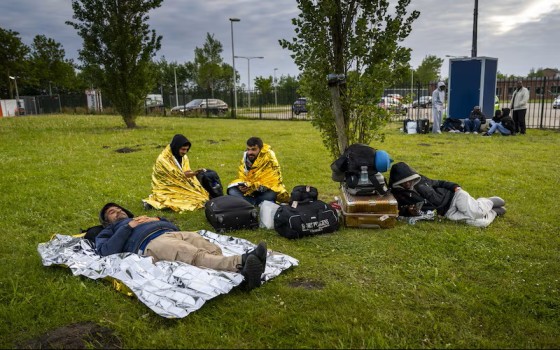
The situation became tense again on Wednesday evening in front of the registration center in Ter Apel: would there be a place for everyone to sleep? The neighboring municipality of Stadskanaal quickly stepped in to offer assistance. "It's like putting out the same fire repeatedly," one man remarked.
It remains unclear exactly where the approximately 30 asylum seekers who cannot stay at the registration center will sleep. A spokesperson for Stadskanaal told the Dutch news agency ANP that the municipality has chosen a "safe building" that is not located "in the middle of a residential area." The spokesperson added that the asylum seekers will be accommodated there if the municipality of Westerwolde (to which Ter Apel belongs) requests it.
But for most of the evening, the question lingered for the dozens of asylum seekers remaining in front of the registration center: would a municipality rush to their aid in time? Among them was a young Nigerian man wearing a denim jacket with the words "Everything will be alright this time" written on the back.
Nowhere
He is one of dozens of men waiting in front of the registration center in Ter Apel after 8 p.m. What are they waiting for? They have no idea. On Wednesday morning, the Central Agency for the Reception of Asylum Seekers (COA) announced that there was no room for everyone inside. The number of residents had swelled to over 2,300 – 300 more than the permitted limit – the highest number in a long time.
"With these numbers, we can no longer guarantee the safety and living conditions of the residents and staff," the agency stated. Priority is being given to "vulnerable groups," such as unaccompanied minors and people with health conditions.
And so it is the men who are waiting. Like Stoian Nicolae, 36, from Moldova. "My parents are inside, but there's no room for me," he says. What now? "I have no idea. It's a disaster."
The grassy area in front of the agency's registration center has once again become a playground for suitcases. The only bright spot is the thermal wrapping distributed by Red Cross volunteers. "Silver inside, gold outside."
Repeat. They were here too in the summer of 2022, when people were forced to sleep on the grass for days because of the same situation. And in 2024, when the situation threatened to worsen again. Even calling it a repeat of past events is itself a repetition.
The reasons for the overcrowding remain the same. Reception centers for asylum seekers (ASCs) are overcrowded. Too few municipalities are taking on their share of the burden.
Furthermore, the officials' statements haven't changed. "We agreed that we wouldn't experience this again, but The Hague isn't keeping its promises," said a frustrated Westerwold Mayor, Jaap Wilma, earlier on Wednesday.
He pointed out that the asylum seeker reception crisis is entering its fifth year. "After all these ministers and governments, the problem remains unresolved." The current minister in charge, Bart van den Brink (CDA), is also "frustrated." He has no solution. According to him, the Asylum Seeker Distribution Act can only provide a long-term solution.
Another constant: In the end, Westerwold benefits more from a good neighbor than a distant friend. By 9 p.m., the name "Stadskanaal" echoed through the grassy square, as the municipality—just as it had two years prior—announced it would provide shelter if people threatened to sleep rough.
"It's heartbreaking," said Stadskanaal's mayor, Klaas Slots. "It's unimaginable that we've reached this point again. It's like putting out the same fire repeatedly." He believes the central government must take responsibility. "Municipalities can help, but they can't solve this problem alone." The government and the Association of Dutch Municipalities (VNG) held an emergency meeting Tuesday evening to discuss the unrest surrounding the reception of asylum seekers and the violence that has marred protests against reception centers.
The VNG called for this emergency meeting last week. In both IJsselstein and Loosdrecht, protests had spiraled out of control. In Loosdrecht, during protests against the construction of a temporary reception center, fires were set, police officers attempting to extinguish them were pelted with objects, and firefighters were prevented from carrying out their duties.





No Comments Found