

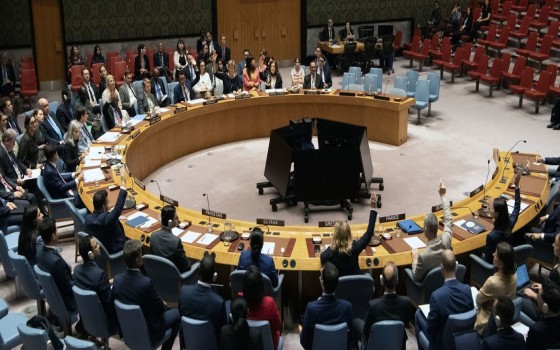
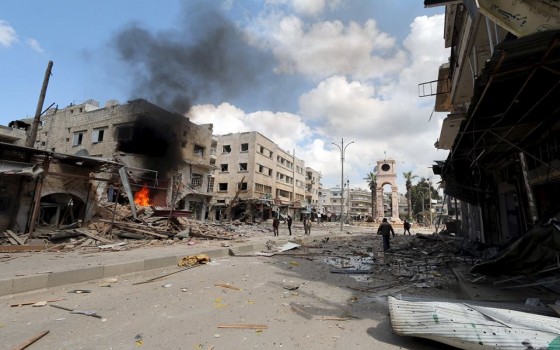
United Nations: Southern Lebanon is burning; the situation in the country is deeply worrying, and diplomatic efforts must be given space.

- Europe and Arabs
- Tuesday , 2 June 2026 6:55 AM GMT
Beirut – New York: Europe and the Arab World
A UN official warned that the situation in Lebanon is deeply concerning, noting the deeper incursion of Israeli ground forces into Lebanese territory and Hezbollah's intensified attacks reaching deeper into Israel.
In her briefing to the Security Council on the situation in Lebanon, Martha Bobey, UN Assistant Secretary-General for Peace Operations and Political Affairs, said that the escalation of hostilities since March 2 has resulted in a "devastating human toll."
She reported that, according to the Lebanese Ministry of Public Health, at least 3,412 people have been killed and more than 10,000 injured in Lebanon. She added that four Israeli civilians have also been killed. She further noted the destruction and displacement of communities on both sides of the Blue Line caused by the hostilities.
Bobie warned that "these developments represent a dangerous and alarming escalation, directly undermining the cessation of hostilities agreement announced by the United States on April 16 and eroding fragile diplomatic efforts to de-escalate the situation." She added that these developments also cast a heavy shadow on ongoing efforts to facilitate direct talks between Lebanon and Israel, "and threaten to derail the already fragile path toward a permanent ceasefire."
She stressed that diplomatic efforts must be given sufficient space to succeed, adding that "further escalation cannot be tolerated. The people of Israel and Lebanon have already suffered immensely, and immediate steps must be taken to alleviate that suffering."
The only legitimate armed force in Lebanon
The UN official emphasized that the Israeli presence north of the Blue Line constitutes a flagrant violation of Lebanon's sovereignty and territorial integrity, as well as a violation of Security Council Resolution 1701.
She added that Hezbollah and other non-state armed groups in Lebanon must disarm and cooperate with government efforts to extend state authority and assert its monopoly on the use of force. “The Lebanese Armed Forces are the only legitimate armed force in Lebanon,” said Ms. Poppy. “We reiterate the urgent need for increased international support for the Lebanese Armed Forces and other state security institutions to enable them to fully exercise their authority and responsibilities to ensure security and stability throughout Lebanese territory.”
She also warned that humanitarian needs in Lebanon are rising sharply, as the ongoing destruction of homes, basic services, and civilian infrastructure exacerbates an already dire situation.
Ms. Poppy called on all actors to exercise maximum restraint and refrain from any actions that could undermine efforts to reach a lasting solution.
She urged regional states with ties to Hezbollah to press the group to cooperate with the Lebanese state’s efforts to establish its exclusive control over weapons.
The UN official called on Israel to withdraw its forces from Lebanese territory and fully respect Lebanon’s sovereignty and territorial integrity.
She also stressed the need to protect civilians and refrain from targeting civilian infrastructure, including cultural heritage sites. She said: “UN personnel must not be targeted, and UN premises must remain inviolable.”
France
France’s ambassador and permanent representative to the UN, Jérôme Bonnafont, said his country requested the emergency meeting in response to the “serious escalation currently underway” and the “significant expansion of Israeli military operations in Lebanon,” despite the US-brokered ceasefire.
He said that “Hezbollah, backed by Iran, bears responsibility for igniting the conflict, having dragged Lebanon and the Lebanese people” into war. He also condemned the continued attacks on Israel.
However, Bonnafont said, “There is no justification for the continuation and scale of Israeli military operations,” and the resulting civilian casualties, displacement, and what he described as the deepening of the occupation of Lebanese territory.
Bonafont described Israel’s actions as a “grave strategic error,” saying they violate the commitments made under the April ceasefire and UN Security Council resolutions. Referring to Israel's recent raising of its flag over Beaufort Castle, the French ambassador warned that Israel was "returning to an era that many thought was over."
Bonafont emphasized that the shelling of villages and the resulting civilian casualties would ultimately strengthen Hezbollah and weaken the Lebanese government, which he said his country supports in its efforts to consolidate state authority.
He stated, "Lasting security lies not in war or occupation, but in peace with neighbors and in regional stability."
He announced his strong support for the ongoing direct talks between Lebanon and Israel, scheduled to resume on June 2 and 3 under US mediation. He described the talks as a "crucial opportunity" and expressed his hope that they would lead to a lasting political settlement, including the disarmament of Hezbollah, the withdrawal of Israeli forces from Lebanese territory, and guarantees for Lebanon's sovereignty and territorial integrity.
Russian Federation
Vasily Nebenzia, the Permanent Representative of the Russian Federation to the United Nations, stated that the ceasefire "reached on April 17 between West Jerusalem and Beirut, facilitated by Washington, was unfortunately a smokescreen for a creeping aggression against Lebanon. While the world awaited the second round of negotiations scheduled for June 2 in the American capital, Israel continued to systematically expand its occupation." He added that evidence confirms that Lebanon is witnessing a near-identical scenario to what happened in Gaza, with the imposition of widespread occupation and the forced displacement of the population.
Nebenzia strongly condemned "Israeli acts of aggression" and reaffirmed his country's unwavering commitment to Lebanon's sovereignty, independence, and territorial integrity.
He demanded the immediate withdrawal of Israeli forces from Lebanese territory, stating, "Without this, it will be impossible to achieve a ceasefire."
He added that history shows that military gains and the expansion of occupation do not solve the security problems facing northern Israel, "but on the contrary, they undermine the position of the Lebanese government, which undoubtedly aims for a negotiated settlement." He said the deteriorating situation in Lebanon is a direct result of the "unjustified aggression" by the United States and Israel against Iran.
United States Ambassador to the United Nations, Mike Waltz, said that "it is clear that Hezbollah sees Lebanon only as a launching pad for its Iranian-inspired attacks against Israel." He added that Hezbollah "does not care about Lebanon, neither as a country nor about the future of its people."
Waltz said of Hezbollah: "It is a terrorist group that has attacked Americans, killed UNIFIL peacekeepers, held civilians hostage for decades, and assassinated the brave people it claims to protect."
He noted that the issue at hand is that Lebanon has once again been dragged into war by a "terrorist organization, at a heavy price paid by innocent Lebanese civilians." He added: "The legitimate Lebanese government is demonstrating courage and true leadership, as it finally seeks to liberate its country from the grip of a terrorist organization that owes allegiance to Tehran and is indifferent to the suffering of its people." He affirmed that his country supports the Lebanese government's efforts to restore Lebanon to its former glory.
He recalled that the leadership of US President Donald Trump facilitated the first-ever direct talks between the governments of Israel and Lebanon.
Waltz stated that the path forward is clear: Hezbollah must cease its attacks on Israel, the Lebanese Armed Forces and the legitimate government must establish their control over Lebanese territory, and Iran must stop using Lebanon as a forward operating base. He added: "Then, the Lebanese people—who have suffered for far too long—will have one last chance to rebuild a homeland that belongs to them alone."
Lebanon's Permanent Representative to the United Nations, Ambassador Ahmed Arafa, said that Israel—"despite the Lebanese government's efforts to contain the crisis—has escalated its military operations dangerously, resulting in thousands of deaths to date." He accused Israel of continuing its "systematic destruction of villages, towns, and residential neighborhoods, targeting medical personnel, hospitals, journalists, schools, infrastructure, security forces, UNIFIL forces, places of worship, archaeological sites designated as World Heritage sites, and much more that embodies Lebanon's memory and cultural identity."
The Lebanese ambassador stated that his country condemns, in the strongest and most unequivocal terms, these Israeli practices and violations, which he said contravene the provisions of the Charter, international human rights law, and international humanitarian law, "and in many cases amount to crimes."
He added that Israel's creation of security zones and the drawing of geographical lines constitute a direct occupation and a flagrant violation of Lebanon's sovereignty, unity, and territorial integrity. He called on the Security Council to condemn these attacks and to fulfill its obligations under the Charter to put an end to them. He continued, saying, "The Israeli government's intentions are no longer a secret. They are evident in the statements of its officials and their calls for expanding the avenues of aggression and occupying larger parts of Lebanon. This is undoubtedly a result of the collective inability to produce solutions and the absence of accountability, which fuels a culture of impunity."
Ambassador Arafa praised the initiative of US President Donald Trump and the US administration for their "constructive efforts aimed at giving the diplomatic track a chance, including the efforts President Trump is personally undertaking today to de-escalate the situation."
He affirmed Lebanon's commitment to providing the conditions and requirements for the success of these efforts.
Israel
Israel's Permanent Representative to the United Nations, Danny Danon, said, "Israel did not wake up one morning and decide to invade Lebanon simply because it wanted to. We are not seeking escalation, we do not covet Lebanese territory, and Israel does not want to engage in conflict with the Lebanese people. The problem is Hezbollah." He added that Hezbollah is carrying out Iran's wishes on the ground, "keeping the flames of conflict burning, holding Lebanon hostage, and subjecting northern Israel to attacks."
He stated that last weekend, "the threat expanded beyond the border towns." He spoke about Hezbollah's drone use, emphasizing that his country would continue "to neutralize the danger before it reaches its people."
The Israeli ambassador said, "As long as Hezbollah threatens our citizens, Israel will act wherever necessary to defend them, whether south or north of the Litani River. If there is no calm in northern Israel, Hezbollah will not enjoy calm."
He noted that Israel and Lebanon are engaged in direct, historic talks mediated by the United States, "believing that a better future is possible. These talks continue despite the current challenges, and our commitment to them remains steadfast." Danny Danon said, "The road to peace is not complicated. We know it well, and we know what it requires: the complete disarmament of Hezbollah."
The United Nations has previously expressed grave concern over the escalation of military operations in southern Lebanon and beyond. It stated that Israeli warnings of imminent strikes on Beirut's southern suburbs are deeply troubling and have exacerbated fear and uncertainty among the Lebanese population.
UN Spokesperson Stéphane Dujarric strongly condemned all civilian casualties. He reiterated the imperative of protecting civilians and civilian infrastructure. He urged all parties to respect the ceasefire and avoid any further escalation.
"There is no alternative to a diplomatic solution to break this cycle of violence and achieve lasting stability on both sides of the Blue Line," Dujarric said during the daily press briefing in New York. "The US-sponsored Lebanese-Israeli negotiations, which resume tomorrow, must be given a genuine chance to succeed."
Dujarric explained that the UN Special Coordinator for Lebanon, Jeanine Hennis-Plasschaert, continues to engage with all parties to de-escalate tensions, reinforce the agreed ceasefire commitments, and promote practical confidence-building measures.





No Comments Found