
Save the people of Gaza... While the world watches the World Cup, overcrowding, pollution, and water shortages fuel the spread of disease.

- Europe and Arabs
- Saturday , 20 June 2026 7:56 AM GMT
Gaza - New York: Europe and the Arabs
While the world watches the World Cup matches in the United States, Mexico, and Canada, the suffering of Gaza's residents continues.
In a tent erected near a sewage treatment plant in the Sheikh Radwan neighborhood north of Gaza City, Ikrami Jumaa says his family is no longer looking for a safe place, but rather any space where they can stay.
Ikrami Jumaa and his family have been displaced about six times before settling in an area besieged by sewage, stench, insects, and rodents. But he says moving is no longer a realistic option in a strip of land where the space available to civilians has shrunk, with most of the population concentrated west of what is known as the "Yellow Line," an area that now encompasses the entire population of Gaza within a narrow, overcrowded strip. According to the UN Daily News, Ikrami Juma, a father of six, said: “We couldn’t find anywhere else in the Gaza Strip. We have no choice but to endure this place despite all the suffering. It’s not just the insects and reptiles; this environment transmits diseases. I suffer from heart disease, diabetes, and high blood pressure, and I can’t bear it, but we have no alternative.”
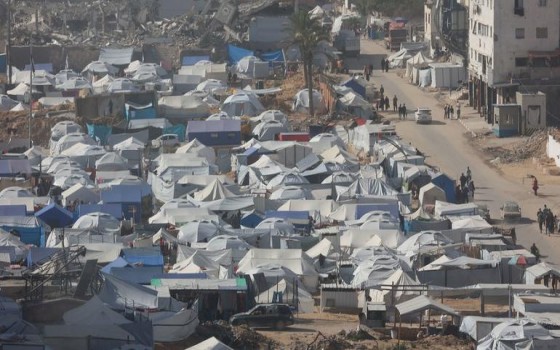
The prevalence of skin diseases is a common complaint. Juma’s testimony reflects a crisis that extends beyond the deterioration of public health to the lack of geographical space that would allow displaced people to escape sources of pollution and infection. With tents crowded west of the Green Line, residents find themselves trapped between destroyed, restricted, or unsafe areas and overcrowded camps lacking basic water, sanitation, and hygiene.
The UN says that most of Gaza’s population remains displaced in increasingly cramped and overcrowded spaces, while essential services are stretched beyond their capacity. The UN Office for the Coordination of Humanitarian Affairs (OCHA) reported that more than 70 percent of the population relies on water delivered by tankers, warning that funding shortages threaten the continuation of these supplies as the peak of summer approaches.
At the Red Crescent field hospital in the center of Gaza City, dozens of patients wait outside the dermatology clinic. Many are children with blisters, redness, and skin irritations, indicating the spread of diseases linked to overcrowding, heat, and shortages of water and hygiene supplies.
The mother of a child named Maher Khalifa says that living in tents has worsened her son's condition. She added, "We are now living in tents, and this child cannot tolerate the high temperatures or sun exposure. Because of this, the blisters on his body have increased. Due to the large number of displaced people in the camps, diseases are spreading, and there are many types of skin diseases and rashes, like the one my son has, and others." The UN News Daily, commenting on a photo of a child's foot showing signs of skin disease, stated: "The health situation in the Gaza Strip is deteriorating as displacement continues and living conditions worsen. The climate, severe overcrowding, and poor shelter conditions, coupled with inadequate water and sanitation services, are creating a high-risk environment for the spread of disease.
The lack of alternatives exacerbates the plight. UN data indicates that a pest control campaign has treated more than 2,000 sites since mid-May, yet skin diseases and external parasitic infections continue to rise. UN agencies attribute this to limited access to safe water, sanitation, and medical treatment, as well as ongoing restrictions on access to landfills, leading to the accumulation of waste within populated areas.
These conditions are exacerbating the crisis for displaced people trapped in a confined space. The lack of alternative locations forces families to remain near makeshift dumps, sewage swamps, or in overcrowded tents." “We woke up this morning to find my child’s body red from an allergic reaction,” said Abu Muhammad Habib, holding his child, who had a rash, as he waited outside a dermatology clinic. “I went to primary care, and they told me I needed to see a dermatologist. We spent three hours here: an hour and a half to get the appointment, and another hour and a half waiting to see the doctor.”
The United Nations says communicable diseases continue to strain an already overstretched health system. Reported cases include acute respiratory infections, acute watery diarrhea, skin diseases, and infections linked to external parasites. The overcrowded tent environment increases the spread of infection, especially among children, the elderly, and those with chronic illnesses.
Known but On the Rise
Dr. Raed Abu Suriya, a consultant dermatologist, said that the conditions patients are experiencing are not necessarily new diseases, but they are becoming more severe and presenting with greater complications. He added: “As a consultant dermatologist with nearly twenty years of experience, I haven’t encountered any new diseases. The diseases are familiar to me, but I have noticed an increase in their severity and the emergence of complications we haven’t seen before. This is largely due to weakened immunity and malnutrition resulting from the famine people have endured.”
These complications are inextricably linked to the reality of repeated displacement. Families who have lost their homes or are no longer able to return to their areas east of the Green Line are crowded into densely populated western areas, where the distance between tents is so small that quarantine is nearly impossible, and waste and sewage management becomes even more challenging.
UN Efforts to Remove Waste
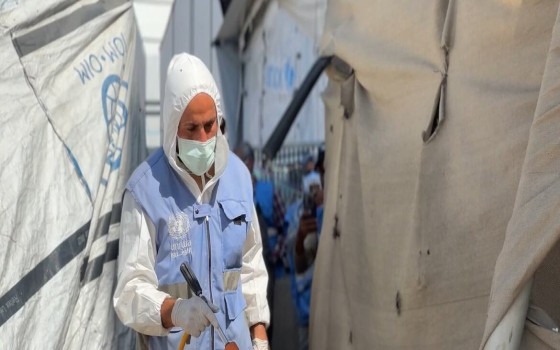
In Gaza City, machinery belonging to the United Nations Development Programme (UNDP) and local partners is working to remove waste from the Firas Market area—one of the largest waste accumulations in the city—to a site far from residential areas.
The UN says that since early March, water, sanitation, and hygiene (WASH) partners have removed approximately 100,000 cubic meters of waste from the Firas market and transported it to the Abu Jarad site.
However, waste management remains a major challenge, as the sector relies on temporary dumps near displacement areas due to the difficulty of accessing main landfills and bringing in the necessary equipment and materials to remove rubble and debris. UN agencies say that the accumulation of garbage near residential areas attracts rodents and insects, increasing the risk of food, water, and sleeping areas becoming contaminated.
According to the UN, WASH partners distributed more than 11,500 hygiene kits, 273,000 bars of soap, and 1,500 gallons of water, among other supplies, during the latest response, reaching tens of thousands of people. However, the scale of the aid does not keep pace with the growing needs in overcrowded camps, nor does it address the broader cause of the crisis: the continued presence of large numbers of people in a limited area that does not allow for further displacement or relief from overcrowding. As temperatures rise, humanitarian workers warn that the lack of alternative shelter will force more families to remain in unsanitary conditions, even as the tents themselves become breeding grounds for disease. They say that the combination of overcrowding, water shortages, accumulating waste, and the spread of insects and rodents could turn skin diseases, diarrhea, and respiratory infections into a wider crisis within the communities.
For Ikrami Juma, the tent pitched near the sewage system encapsulates Gaza’s current predicament: disease visible on children’s bodies, waste that never reaches the landfills, and residents with nowhere else to go.
Juma says his family stays there not because they can endure it, but because they have no other choice. In Gaza, the distance between danger and survival is no longer measured solely by bombings or control lines, but by the few meters separating one tent from another.




No Comments Found