
Morocco is the closest Arab country to it... The Strait of Gibraltar: An Islamic story that has endured for 750 years, and now a British-Spanish agreement determines its future.

- Europe and Arabs
- Thursday , 16 July 2026 9:15 AM GMT
Brussels: Europe and the Arabs
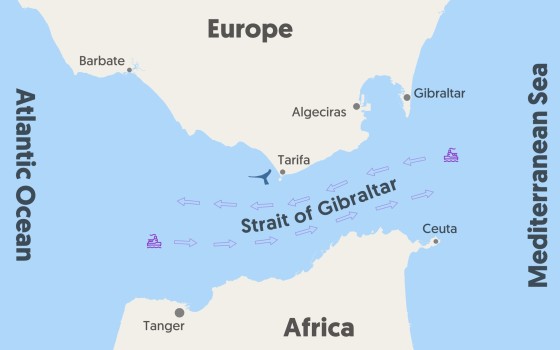
As of Wednesday, July 15th, history has written a new chapter in the story of the Strait of Gibraltar, following the agreement signed between Spain and Britain regarding the future of the territory, which has now entered into force. Morocco is considered the closest Arab and Islamic country to the strait and the territory. Gibraltar is a British Overseas Territory located at the southern tip of the Iberian Peninsula on a rocky promontory jutting into the Mediterranean Sea. Locally, it is called "Gibraltar," a European corruption of the Arabic name "Jabal Tariq." The territory was named after the Muslim military commander Tariq ibn Ziyad. It was a British colony until 1981 when Britain revoked its status and decided to establish self-governing territories in its remaining former colonies. After the change in the form of government in Gibraltar, Spain demanded the return of the territory to its sovereignty, pointing out that the agreement between the two countries stipulates the return of the territory to Spain in the event of a British relinquishment. Britain declared that it had not relinquished the territory and that self-governance did not negate its status as a British Crown dependency. Nevertheless, Britain agreed to open the port of Gibraltar to Spanish ships. Over the years, Spain renewed its claim to Gibraltar and negotiated this possibility with the British government. However, the inhabitants of the territory, most of whom were of British origin, strongly rejected this and demonstrated against it.
During the reign of the Umayyad Caliph Al-Walid ibn Abd al-Malik, Muslims crossed from Morocco under the leadership of the Umayyad commander Tariq ibn Ziyad on April 30, 711 AD. For four centuries, no urban development took place in Gibraltar. However, starting in 1150 AD, during the reign of Sultan Abd al-Mu'min, one of the Almohad sultans, a city was established and fortified. Traces of the city and its walls are still visible in the Moorish palace located within the city. Later, Gibraltar was annexed to the Kingdom of Granada until 1309 AD. When Spanish forces invaded the city, an invasion that lasted until 1333 CE, it was liberated by the Banu Marin tribe, who in turn returned it to the Kingdom of Granada in 1374 CE. The Kingdom of Granada retained control of the city until its final fall to the Spanish in 1492 CE, thus ending 750 years of Muslim rule.
The Spanish Era
After the Spanish recapture of Gibraltar, a group of Spanish Jewish converts (those who had converted from Judaism to Catholicism) were settled there. One of them, Pedro de Herrera, led 4,350 Jews and established a small state in Gibraltar, which lasted only three years before these Jews were returned to Granada and Gibraltar was finally annexed to the Spanish Crown, established in 1501. One of the famous battles that took place on the Gibraltar peninsula was the naval battle that took place between the Dutch and Spanish fleets in 1607, which resulted in the complete loss of the Spanish fleet anchored in Gibraltar in just four hours, as the Dutch fleet surprised the Spanish ships while they were anchored. Queen Isabella considered Gibraltar "the key to Spain," believing that Spain's security depended on the strength of Gibraltar.
During the war waged by England, the Netherlands, and Austria to prevent a Franco-Spanish alliance that could upset the balance of power in Europe, the three nations joined forces and attacked southern and western Spain. An attack on August 4, 1704, following a six-hour bombardment beginning at 5:00 AM, led by Admiral George Rooke at the head of a force of 1,800 British and Dutch sailors, resulted in the fall of Gibraltar. A surrender agreement was signed, allowing the inhabitants of the peninsula to evacuate peacefully.
Despite Franco-Spanish attempts, Spain was unable to recapture the peninsula. In 1714, the Treaty of Utrecht was signed, by which Spain ceded Gibraltar to England permanently and declared British sovereignty over the peninsula. Throughout history, Spain attempted to reclaim Gibraltar. In 1779, with the assistance of French artillery, they besieged the territory for three years. However, the British fleet broke the siege, inflicting losses on the Franco-Spanish forces, and a peace treaty was signed between the warring parties.
Gibraltar has historically been one of Britain's most important bases, and its significance increased with the opening of the Suez Canal. This prompted British forces to establish a naval base there to protect their interests in the Mediterranean Sea and along the route to their colonies in India and Australia.
In 1950, during General Franco's rule, Spain revived the issue of Gibraltar's sovereignty, further complicating the free movement of people across the border. The first referendum on the peninsula's sovereignty was held in 1967, offering the choice between remaining under British rule and transferring to Spanish sovereignty. The population overwhelmingly voted to remain under British rule.
Tensions reached their peak in 1969 when Spain closed the border after Gibraltar's residents voted overwhelmingly in a referendum to remain under British sovereignty. The border remained closed until 1985. Following years of complex negotiations after Brexit, the Gibraltar Agreement came into effect, marking one of the most significant political settlements in Europe in recent years. The agreement, signed by the UK, the EU, Spain, and Gibraltar, not only removes border barriers between the territory and Spain but also carries political, economic, and strategic dimensions that could reshape relations in the region for years to come.
According to the Spanish newspaper 20 Minutos, the agreement's most notable feature is the removal of the border fence known as "La Verga," which separated Gibraltar from the Spanish city of La Línea, and the end of traditional border checks. Under the new arrangements, immigration and border control procedures will be transferred to Gibraltar's port and airport, in accordance with the Schengen Area rules, allowing for greater freedom of movement of people and goods between the two sides. The newspaper noted that, economically, the agreement represents a significant boost for the border region. Approximately 15,000 workers cross daily between Spain and Gibraltar for work, and they have faced long queues and complex procedures since Brexit. The removal of these obstacles is expected to increase trade and investment activity and improve conditions for workers and businesses on both sides of the border. The agreement also opens the door to broader economic integration between Gibraltar and the surrounding European markets.
A Delicate Political Balance
Politically, the agreement can be considered a victory for both European and British diplomacy. After years of tension regarding the territory's future, the parties succeeded in reaching a formula that serves everyone's interests without resolving the historical issue of sovereignty. Spain did not relinquish its sovereign claims, Britain maintained Gibraltar's status as a British territory, and the residents gained tangible economic and social benefits.
Future Challenges and Concerns
But despite the celebratory atmosphere surrounding the removal of the border, questions remain about the future. Some voices in Gibraltar fear that the new arrangements will increase Spanish or European influence within the territory, while others believe the agreement's success will hinge on the parties' ability to manage sensitive issues related to security, immigration, and taxation.
Ultimately, the Gibraltar agreement is not merely about facilitating movement; it represents a model for addressing one of the most complex issues left by Brexit. This is why Spanish Prime Minister Pedro Sánchez described the removal of the fence as "the fall of the last wall in continental Europe," signaling the end of a long period of division and the beginning of a new era of cooperation between the two sides of the border.








No Comments Found