
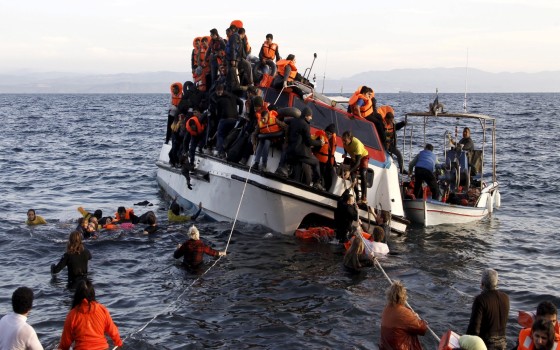
The European Union intends to increase funding for Morocco to control borders and manage migration after the Ceuta crisis. Migrants confirmed that Moroccan authorities encouraged them to cross the border, while Rabat denied any wrongdoing.

- Europe and Arabs
- Friday , 21 August 2026 5:58 AM GMT
Brussels: Europe and the Arabs
The European Union intends to increase funding allocated to Morocco for border control and migration management, as Brussels moves towards concluding a comprehensive strategic partnership with Rabat by the end of the year, according to European officials who spoke to Euronews, the European news network in Brussels. The report added that the move comes after the Ceuta crisis at the end of July, when some 72,000 people crossed the border irregularly into the Spanish enclave, resulting in nearly 100 deaths and bringing the issue of migration back to the forefront of EU-Morocco relations.
European officials said the crisis did not accelerate the signing of the partnership agreement, which was already expected before the end of the year, but it did prompt Brussels to increase the resources allocated to security, migration, and border management.
Brussels and Rabat have been working for years on preparing a broader partnership agreement, similar to the one the European Commission concluded with Egypt in 2024, which included a €7.4 billion financing and investment package to support the Egyptian economy, manage migration, and promote regional stability. Negotiations with Morocco stalled until January 2026, when a meeting between the two sides in Brussels helped to revive them. Two officials told Euronews that "the dispute over Western Sahara was one of the reasons for the delay, and the issue remains unresolved."
Immigration at the Heart of the Negotiations
Spanish MEP Juan Fernando López Aguilar, a former Spanish justice minister, told Euronews that immigration presents a particular challenge in EU-Morocco relations, noting that the EU's only land border outside Europe is between Morocco and Spain.
López said, "The more the situation spirals out of control, the more impossible it becomes not to assume that some of Morocco's tactics or strategic decisions are behind what is happening."
Migrants have told The New York Times that Moroccan authorities encouraged them to cross the border, while Morocco denies any wrongdoing. The influx of migrants has strengthened Morocco's negotiating position, as Brussels prepares to reinforce the migration section of the EU-Morocco Partnership Agreement. Existing European Funding
A European Commission spokesperson told Euronews that Morocco already benefits from financial support for migration management, noting the EU's commitment to provide €222 million between 2021 and 2024.
The spokesperson added that the Commission expects to provide an additional €190 million by the end of the current budget cycle in 2027. European support for migration management in neighboring countries is typically divided into two tracks: assisting border authorities through training, surveillance equipment, and patrols, and strengthening migrant reception capacities, including the establishment of refugee camps.
Von der Leyen Calls for Border Reinforcement
In a letter to Spanish Prime Minister Pedro Sánchez in early August, European Commission President Ursula von der Leyen stated that the EU is working with Moroccan authorities on a "more structured and forward-looking partnership."
Von der Leyen called for stricter border controls and the erection of physical barriers to prevent a recurrence of similar incidents. She said the EU could strengthen border management and early warning systems, and increase technical and financial support to Morocco.
She described Morocco as an "important strategic partner," particularly in the area of migration. During an informal videoconference of European interior ministers held in response to the Ceuta crisis, the partnership agreement with Morocco was not explicitly mentioned. However, the ministers agreed on the need to strengthen partnerships to combat irregular migration.
A Commission spokesperson stated that the EU wants to address the challenges with Morocco, strengthen the relationship between the two sides, and expand the existing partnership into new areas of priority and common interest.
The spokesperson added that the EU is determined to deepen the bilateral partnership and negotiate a comprehensive strategic partnership, building on the existing relationship.
A European model based on funding for migration management: In recent years, the European Union has relied on partnerships with non-EU countries to manage migration through medium- and long-term projects with countries of origin and transit from which migrants attempt to enter the EU irregularly.
The EU has concluded more structured agreements with Egypt, Jordan, Mauritania, Tunisia, and other countries. These agreements include investments in sectors such as digital transformation, green policies, migration, and artificial intelligence, in exchange for the partner countries' cooperation in reducing migration departures from their territories. These projects are typically implemented by EU member states and private companies, some of whose activities are funded by European governments, along with UN agencies.
This approach has faced criticism from civil society organizations and NGOs, which cite abuses and exploitation of migrants by local authorities.
Sarah Prestiani, Advocacy Director at EuroMed Rights, told Euronews that the Ceuta crisis should prompt the EU to examine the reasons why so many young people are willing to risk their lives to cross European borders.
She called for a focus on the socio-economic and political factors driving migration, rather than a strict security approach and an overemphasis on border management.
The EU and Morocco already have several partnerships, particularly in green policy, as well as strong trade ties.
The Spanish government declined to comment on whether it was aware of the ongoing negotiations regarding the partnership agreement.





No Comments Found