

Brussels Meeting to Resolve Dispute Over Control of EU Budget for Next Seven Years; Debate Over Potential UK Return to the Bloc; Calls to Uphold Schengen Agreement

- Europe and Arabs
- Thursday , 1 October 2026 5:26 AM GMT
Brussels – Europe and the Arabs
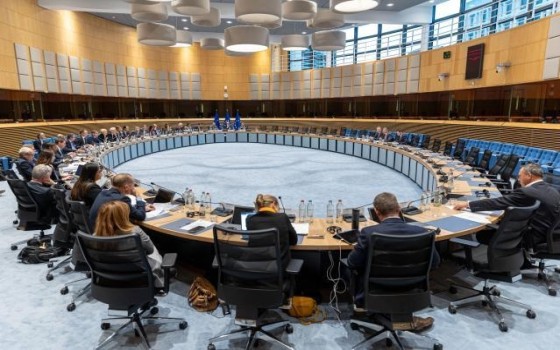
Who controls EU spending? Today marks a new chapter in the ongoing tug-of-war between Brussels and national capitals over control of the EU budget for the next seven years, as a discussion takes place within the European Commission that could deeply unsettle national governments. According to the "Brussels Playbook" newsletter—published by the European edition of the American outlet *Politico*—the meeting will unfold as follows:
In this closed-door session, Commission officials Declan Costello and Maria Teresa Fabregas Fernandez will present government experts with "examples of reforms, investments, and outputs." They will also discuss the "territorial and spatial aspects" of a budget segment worth approximately €2 trillion (accounting for half the total budget), according to an agenda obtained by journalist Gregorio Sorgi.
Warning signs: While this wording may seem innocuous, it touches precisely upon the issues that worry national capitals.
Another source of potential concern is that the meeting was convened and coordinated by Ursula von der Leyen’s powerful Secretariat-General. Costello—who heads the Secretariat-General’s Structural Reform Support Service (DG REFORM)—is set to open the discussion. This is highly significant, given that this team played a key role in steering the post-COVID economic recovery fund. This experiment—based on the "money-for-reforms" principle—serves as the prototype for the new spending mechanism adopted by von der Leyen, a move that is causing significant concern among governments.
Some governments fear that the new system will marginalize regions and grant the Commission excessive control. A Polish government official—speaking on condition of anonymity due to the sensitivity of the discussions—stated: "We have made it clear before, and will reiterate today, that the regional dimension must not be compromised or weakened."
The Commission’s controversial plan involves merging spending allocations for agriculture, regional affairs, and migration into national financial funds known as "National and Regional Partnership Plans" (NRPPs).
Even more sensitive is the proposal to tie financial disbursements to the implementation of economic reforms by governments—a model similar to the mechanism used for the recovery fund. Ten countries, ranging from Poland to Luxembourg, have already voiced objections, fearing that Brussels might demand politically explosive changes, such as overhauls to pension systems or the judiciary.
Thus, today’s meeting offers a revealing glimpse not only of the tug-of-war between the Commission and national governments over control of the purse strings but also of how von der Leyen seeks to concentrate that power within the Commission itself. Although the Secretary-General is leading the entire process, Commission departments that traditionally held spending authority now find themselves relegated to secondary roles. According to an official, the Directorate-General for Agriculture (DG AGRI) can send only four representatives, with additional staff directed to a separate hearing room. Another official noted that the Directorates-General for Regional Policy (REGIO), Home Affairs (HOME), Employment (EMPL), and Maritime Affairs (MARE) will also participate. All these bodies are involved in "National Reform and Investment Programmes" (NRPPs) but are among the entities that could face potential mergers as part of a comprehensive, large-scale restructuring of the Commission.
The meeting signals that the overall direction is becoming clear: decision-making authority over the budget is shifting toward Ursula von der Leyen’s inner circle, implying that her successor could inherit significantly greater control over how Europe spends its funds.
Call for spending flexibility: Italian Prime Minister Giorgia Meloni has stated she will ask Ursula von der Leyen to relax the Commission’s fiscal rules, enabling governments to help businesses and households cope with price hikes driven by energy costs. Meloni intends to raise this issue during upcoming meetings of the Economic and Financial Affairs Council (Ecofin) and the European Council.
Burnham’s bid to reset relations: The *Financial Times* reported that Andy Burnham will seek to relaunch the UK’s relationship with the EU at a summit in November, following the resolution of a dispute regarding EU "Made in Europe" requirements. Burnham’s proposal regarding a potential British return to the EU has been welcomed by Emmanuel Macron and Pedro Sánchez, while Brussels remains cautious and has refrained from a clear reaction; an official spokesperson stated, "We are open to discussing options that might be put forward in this regard."
Return to Brussels: The Romanian Parliament yesterday rejected Siegfried Mureșan’s bid to form a government, sending the EU budget negotiator back to his previous role.
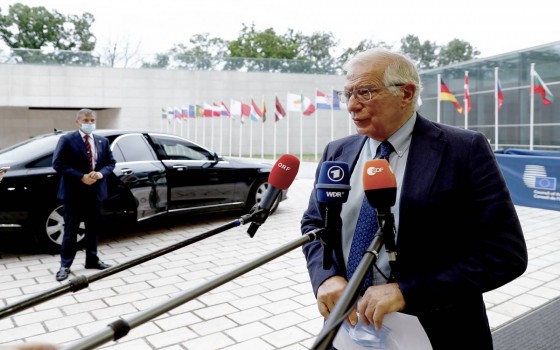
Schengen Standoff: Former European Commissioners—Josep Borrell, Nicolas Schmit, and László Andor—are backing a complaint filed by "The Good Lobby" accusing Brussels of failing to protect the Schengen Area after Italy once again extended border controls; they warn that this inaction threatens to undermine citizens' rights and the European legal order.




No Comments Found