

Brussels Summit Today Aims to Reach Agreement on a €2 Trillion EU Budget and Support for Ukraine

- Europe and Arabs
- Thursday , 26 November 2026 6:30 AM GMT
Brussels: Europe and the Arabs
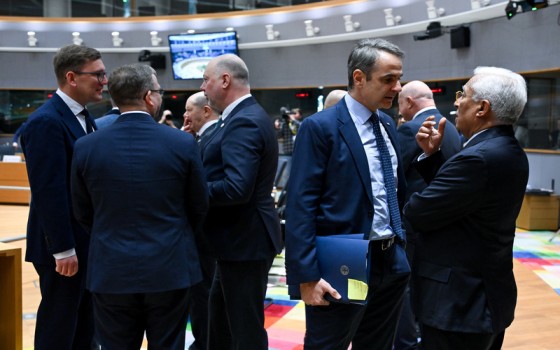
European Council President António Costa is focusing on several key issues at today’s EU summit in Brussels: reviving negotiations on the bloc’s seven-year budget, mobilizing financial support for Ukraine, and reminding leaders of the reasons why they wanted him in the position in the first place. The battle lines have already been drawn, according to a report by *Playbook*—the European edition of the American outlet *Politico*—published ahead of today’s summit. Leaders are set to discuss a budget of nearly €2 trillion, funding for farmers, and support for Ukraine’s war-torn economy. It promises to be a day of "political theater," as two European diplomats separately remarked to Sebastian Starcevic and Gregorio.
The choreography: According to two EU diplomats, Costa will meet with leaders both bilaterally and in small groups. The talks are expected to drag on for so long that one diplomat told Gregorio they plan to play a game of Scrabble to pass the time. None of the diplomats or officials who spoke to *Playbook* anticipate any form of consensus.
At least one leader is also downplaying the chances of reaching an agreement. Hungarian Prime Minister Viktor Orbán—referred to in the report—wrote a "fairly long letter" to Costa earlier this week, stating that the discussions scheduled for Thursday and Friday are "completely pointless."
Among the key battles to watch is whether Hungary, Slovakia, the Czech Republic, and Bulgaria will agree to contribute toward the borrowing costs associated with a €45 billion EU loan for Ukraine—part of a broader €100 billion package earmarked for Kyiv in the upcoming budget. A European diplomat told Sebastian that... Bratislava is the primary holdout, while others are open to some form of compromise.
The mood does not look good; one diplomat remarked that the leaders are bracing for a "fight." Another diplomat described the situation as a "bloodbath," noting that leaders will be answering to their domestic constituencies, and that steering the talks toward a conclusion will be a major test of Costa’s leadership. They added that placing both Ukraine and the budget on the same agenda is risky, given the potential for an internal breakdown.
There is at least one area where agreement is possible: who should replace Christine Lagarde as President of the European Central Bank. My colleague Giorgio Leali reports that, according to an official at the Élysée, France and Germany are in alignment regarding the candidates.
Costa needs a win following a series of difficult episodes during his presidency. At the previous summit, he drew the ire of various capitals by allowing a discussion on energy policy to devolve into a heated, protracted argument. He was also sidelined when EU leaders—deciding who should speak on Europe’s behalf in potential peace talks with Russia—opted for an expanded format that included EU institutions and the "European Quint" (a group of five major European powers). Furthermore, his summit with the United Kingdom nearly fell apart due to objections from member states over tuition fees.
Despite these frustrations, Costa has not lost the room. It is widely expected that he will secure another term as President of the European Council before his current mandate ends in May. One European diplomat reassured Sebastian, saying, "We don't hate him"—though they insisted that a repeat of past events cannot be allowed to happen. It happened at the last European Council—things went "off-script." Good luck with that this time.
A spokesperson for Costa stated that the leaders are officially scheduled to meet for two days, though whether they return tomorrow "will be determined based on the outcome of the consultations." One EU government official noted that they are bringing only a small backpack to Brussels, betting on a one-day summit.
Who won’t be there: Spanish Prime Minister Pedro Sánchez is skipping the gathering ahead of Sunday’s elections, having delegated his voting rights to Emmanuel Macron.
Big and Broken
The Parliament is sharpening its knives: After the European Parliament voted overwhelmingly yesterday to move EU budget files directly into negotiations, President Roberta Metsola forwarded the Parliament’s position—its "negotiating mandate"—to Costa, Commission President Ursula von der Leyen, and Irish Taoiseach Micheál Martin (as Dublin currently holds the rotating presidency of the Council). In a phone call with Costa, Metsola remarked: "Getting 27 players to agree is no easy task. Now, imagine what it will take to reach 361."
In a statement—seen by *Playbook* and set to be released later today—the Parliament’s budget rapporteurs, Siegfried Mureşan and Carla Tavares, warned against "a smaller budget for a weaker European Union." They are urging the Council to adopt a position—something the Parliament has been waiting for since April. The statement reads: "Our consent cannot be taken for granted." "...rather, it must be earned."
The re-election battle: Socialist and liberal groups in the European Parliament have frozen talks regarding Metsola’s re-election, following the European People’s Party’s decision to once again collaborate with the far-right on green legislation.




No Comments Found