

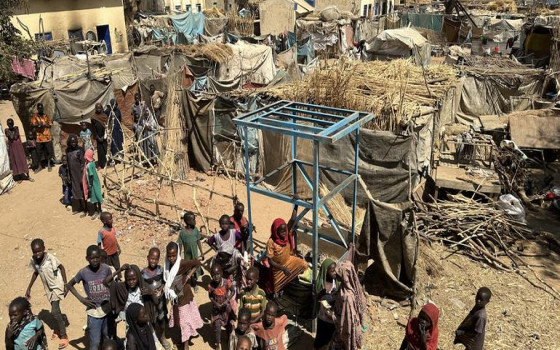
Half of all girls are forced into early marriage, and more than two million children are at risk of malnutrition in South Sudan. Meanwhile, children are killed in Kordofan, and an aid convoy is attacked in Darfur.

- Europe and Arabs
- Sunday , 7 December 2025 10:9 AM GMT
New York: Europe and the Arabs
UNICEF Executive Director Catherine Russell concluded a visit to South Sudan, urging the government and the international community to intensify efforts to protect children's lives amid escalating conflict, climate shocks, and mass displacement in the world's newest nation. According to the UN Daily News, Russell's visit highlighted the growing needs of South Sudanese children. More than 2.1 million children under the age of five are at risk of malnutrition, and 9.3 million children – three-quarters of the population – require life-saving humanitarian assistance. In addition, nearly 1.3 million refugees and returnees fleeing the war in Sudan have arrived in South Sudan, further straining already limited water, food, and medical services.
Russell visited Bentiu to speak with communities displaced by violence and flooding, stating that the combined impact of conflict and climate shocks is creating "a perfect storm of suffering for children in South Sudan, in an already precarious situation." Girls Forced into Early Marriage
According to UNICEF, nearly half of all girls in South Sudan are forced into early marriage, and 65% of girls and women aged 15 to 64 have experienced violence. Russell visited a center that provides a safe space for women and girls.
“I spoke with girls and women who had experienced horrific violence,” Russell said of the visit. “Two of them told me they had contemplated suicide before coming to the UNICEF-supported center. They told me that having a safe space to receive counseling and peer support was a lifeline.”
Funding Cuts
Funding cuts have forced the closure of more than a third of the safe spaces for women and children supported by UNICEF this year. Russell also spoke with mothers whose children are suffering from acute malnutrition. Two out of every five children across the country are at risk of acute malnutrition, particularly in areas affected by flooding, conflict, and violence. Insecurity has caused a 25% increase in humanitarian access restrictions this year, leaving communities without desperately needed supplies.
“I was at the country’s only children’s hospital in Juba and saw babies and toddlers suffering from malnutrition and entirely preventable diseases. It’s heartbreaking,” Russell said. “We know how to save these children, and I saw the heroic efforts of health workers at the hospital and in the community. With sustained focus and investment from the government and the international community, we can save even more lives.”
Millions Out of School
2.8 million school-aged children remain out of school, one of the highest rates globally. More than half of all schools lack safe classrooms, trained teachers, and water and sanitation facilities. Girls are disproportionately affected, often forced to drop out due to child marriage, insecurity, and the lack of safe learning environments. In Sudan, following reports of the killing of at least ten children in South Kordofan state, the United Nations Children's Fund (UNICEF) warned that the killing and maiming of children in attacks on schools and hospitals "constitutes a grave violation of children's rights."
The organization cited reports that a drone strike killed more than ten children—aged between five and seven—at a kindergarten in the Al-Qadeer locality of Kadugli.
At the daily press briefing in New York, UN Spokesperson Stéphane Dujarric said these attacks come amid a "sharp deterioration in the security situation in the two Kordofan states since early November, leading to widespread displacement and exacerbating humanitarian needs."
UNICEF said medical services are collapsing, basic supplies are running low, and education is disrupted, depriving children of learning opportunities and exposing them to severe psychosocial stress.
Dujarric said the organization continues to work with its partners to provide life-saving support in Sudan, "but the scale of the needs far exceeds the available resources." UNICEF called on the international community to intensify efforts to protect children and provide urgent assistance.
Humanitarian workers are not a target.
Meanwhile, the UN spokesperson strongly condemned an attack on a World Food Programme (WFP) truck near Hamra Sheikh town on Thursday evening.
He said the truck was part of a larger 39-truck convoy en route to deliver vital food assistance to support starving families who have fled to Tawila in North Darfur in search of food and safety. The WFP is supporting some 700,000 people with food aid.
Mr. Dujarric said the convoy had traveled more than halfway through its 1,000-kilometer journey when the attack occurred. He emphasized that this was the sixth serious attack on WFP trucks, assets, and facilities in Sudan in the past year alone, noting that eight humanitarian workers and partners have been killed and others injured. He added: "Of course this is unacceptable. Unimpeded access must be guaranteed to the most vulnerable families in Darfur and all famine-stricken areas. Humanitarian workers and their property must never be a target. The fact that we have to repeat this is a tragedy in itself."








No Comments Found